

Hyundai was late to the hot hatch game when it revealed its Veloster N to an American audience. It needed to convince enthusiasts that this was a serious attack on the Civic Type R or Golf GTI, and that, crucially, its cars would still look convincing once the novelty wore off.
Some years later, the first N cars have accumulated significant mileage and the driving experience is still rock solid. And perhaps the best part is that depreciation has created an attractive price gap between them and some of those other benchmark hot hatches.
Used N Cars Are Starting To Look Like Serious Performance Bargains
2019-2022 Hyundai Veloster N Performance Blue Front View Track DrivingHyundai
Part of that staying power shows up in the used market – where N cars are holding value well enough to look like genuine bargains against rivals.
In 2026, the average price of a used Veloster N hovers around $19,000, with 2020 examples below that threshold and low-mileage 2021 or 2022 cars generally in the low $20k range. That represents quite a change from new car money, as the 2019 Veloster N went on sale for $26,900 before destination. It came with an optional performance pack and could produce up to 275 horsepower, and by 2021, Hyundai had also added the optional eight-speed wet dual-clutch transmission.
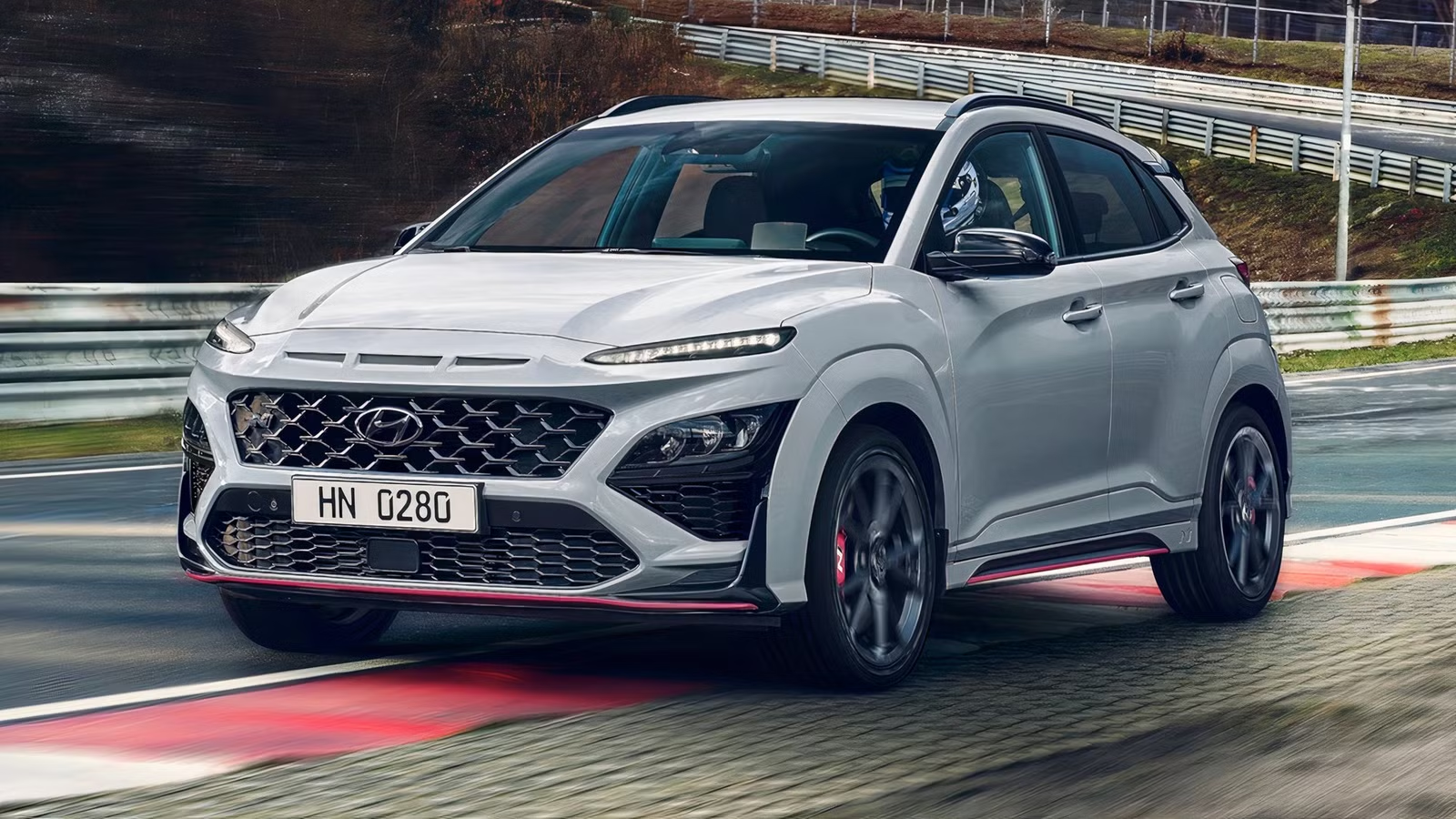
Meanwhile, another from the N brigade, a 2022 Elantra N should flirt with $26,000 against an original MSRP of $32,150. A quick scan of listings shows that high-mileage examples are available below $20,000, too. The supply of the Kona N is thinner, and 2022 examples seem to range from the high teens to the low $20s, with our own CarBuzz Marketplace suggesting $22,106 as an average.
The US never got to sample the i30 N, but value-wise, it’s going through a similar pattern in Europe. For example, a 2018 i30 N Performance should cost around £18,400 (about $25,000) from a dealer, against its original launch price of £27,995 (or $38,000). Like the American N models, the i30 N hasn’t suffered from disastrous depreciation. But that depreciation has put an early N within reach of buyers who might once have been shopping several rungs lower down the hot hatch ladder.
The i30 N Built The Formula And The Veloster N Gave Early Durability Evidence
2020 Hyundai i30 N front quarterHyundai
Hyundai’s performance sub-brand started out with the original i30 N and with a lot on the line, the company was quite serious about testing. It subjected the original car to more than 100,000 miles of simulated durability testing, with stints at serious testing grounds like the Nürburgring. Hyundai even entered two new development cars in the Nürburgring 24-hour race.
The i30 N featured a turbo 2.0-liter inline-four and front-wheel drive, and had an electronically controlled limited-slip differential on the Performance model. It also had adaptive suspension, adjustable drive modes, rev matching, launch control, and variable exhaust. By 2021, Hyundai was able to sell more than 54,000 of those cars worldwide, establishing the foundation of its fledgling performance sub-brand.
MotorTrend even put a 2019 Veloster N through a two-year test to assess its durability and provide some good evidence about how an N model’s early hardware ages. This car performed remarkably well, with the engine requiring no unscheduled maintenance and the interior surviving impressively. Strikingly, the Hyundai also appeared to get faster over those two years, with its 0-60 mph time improving from 5.4 to 5.3 seconds over that time period.
There were some issues, including a clogged climate control evaporator drain and a one-off engine control problem fixed by an ECU reflash. Yet none of these issues amounted to a major mechanical failure and the car effectively passed its test with flying colors.
The Elantra N And Kona N Brought The Same Formula To A Sedan And A Crossover
Blue 2022 Hyundai Elantra N on track from sideHyundai
When the Elantra N arrived in 2022, Hyundai retained the same N philosophy as the i30 N. Its 2.0-liter turbo engine generated 276 hp and 289 lb-ft, and the car came with either a six-speed manual or Hyundai’s eight-speed wet DCT. The Elantra N also had the company’s revolutionary N Grin Shift feature (which temporarily increased boost pressure for 20 seconds), an electronically controlled LSD, adaptive dampers, and substantial chassis reinforcement.
Next, the Kona N appeared with much of the same, but within a crossover body instead. This was front-wheel drive rather than the all-wheel-drive approach favored by some competitors, but it also produced 276 hp and had the same wet DCT and electronically controlled differential.
But before you start searching listings, there’s one important caveat that any used N buyer needs to understand.
Two Major Recalls Mean Used Buyers Still Need To Check Carefully
Front 3/4 view of 2022 Hyundai Veloster NHyundai
While these N models may age encouragingly, that doesn’t mean they’re always trouble-free. For example, one important recall covered certain Hyundai models that had the eight-speed DCT. That NHTSA campaign – #22V-746 – covered 2021 to 2022 Veloster Ns, some 2022 Elantra Ns, and Kona Ns as well. It involved the transmission’s high-pressure electric oil pump and a situation that might cause the transmission to disengage the clutches, leading to a loss of drive power. The remedy was to inspect the transmission and replace it, if necessary, as well as update the transmission control software.
A different recall – #24V-528 – concerned 2019 to 2022 Veloster Ns, 2022 to 2023 Elantra Ns, and 2022 to 2023 Kona Ns. This involved wear in the high-pressure fuel pump’s fuel control valve that could allow excess fuel to get into the pump, leading to rough running or a loss of motive power. The subsequent repair called for an update of the engine control software, as well as inspection or replacement of the fuel pump if necessary.
Recalls like these emphasize how important it is to check the records and run a VIN check when looking at a used N. The NHTSA’s recall system can then confirm whether a previous owner completed all the applicable work. Shoppers also need to be on the lookout for questionable tunes, modified engines, neglected maintenance, accident damage, or repeated track use, as all can take a toll on any used performance car.
Still, nothing in the available N engine history to date reveals a pattern of dramatic failures. So, these engines do not routinely destroy themselves as mileage climbs, which helps to reinforce their appeal on the used car market.
Civic Type R And Golf R Resale Values Show Where Hyundai Wins
2021 Honda Civic Type R FK8 Blue Front viewHonda
Hyundai’s N models may represent serious players in the performance compact market, but the company’s rivals are still strong in several important ways. After all, the Honda Civic Type R has long been the front-wheel-drive benchmark, and it has also passed a similar kind of long-term test with flying colors. In that test, the drivers praised its chassis, steering, and everyday usability when assessing that FK8 Type R.
Meanwhile, Volkswagen’s Golf R seems to have another type of advantage, as it combines serious performance with all-wheel drive traction, while sporting a more discreet and refined personality.
But Hyundai still doesn’t have to beat either car outright when it comes to its used car proposition, as it certainly seems to have price on its side. And here, Hyundai’s lower original pricing, combined with somewhat softer residual values, creates a major used-market price advantage.
The average cost of a 2019 Veloster N may be around $19,000, compared with a 2019 Civic Type R, where the average is approximately $34,900, and a 2019 Golf R where shoppers are looking at about $29,200. Even allowing for variations in specification, condition, or mileage, the Hyundai is in a very different place in the used performance market.
Slightly newer cars also display the same pattern. An average 2022 Elantra N may be around $26,200, but a 2021 Civic Type R is roughly $39,600. And that suggests an approximate $13,000 difference between two relatively recent FWD performance cars, without accounting for individual vehicle conditions. So, for those who already own a Type R, its resale strength may be a significant asset. But for buyers entering the used market, Hyundai’s price positioning is their advantage.
It’s still too early to say that an Elantra N or a Kona N will turn out to be a painless 150,000-mile car because there simply isn’t enough long-term model-specific evidence. But where evidence does exist about the vehicle’s potential longevity, it seems to be relatively encouraging.
Meanwhile, the Civic Type R should remain the more prestigious front-wheel-drive benchmark, and the Golf R should still offer greater refinement and good all-weather traction, but neither has fallen in value in quite the same way as those early Hyundai N cars. And that could certainly be enticing news for used car shoppers, and suggests that the N badge is worth a second look.
Sources: Hyundai, NHTSA
