

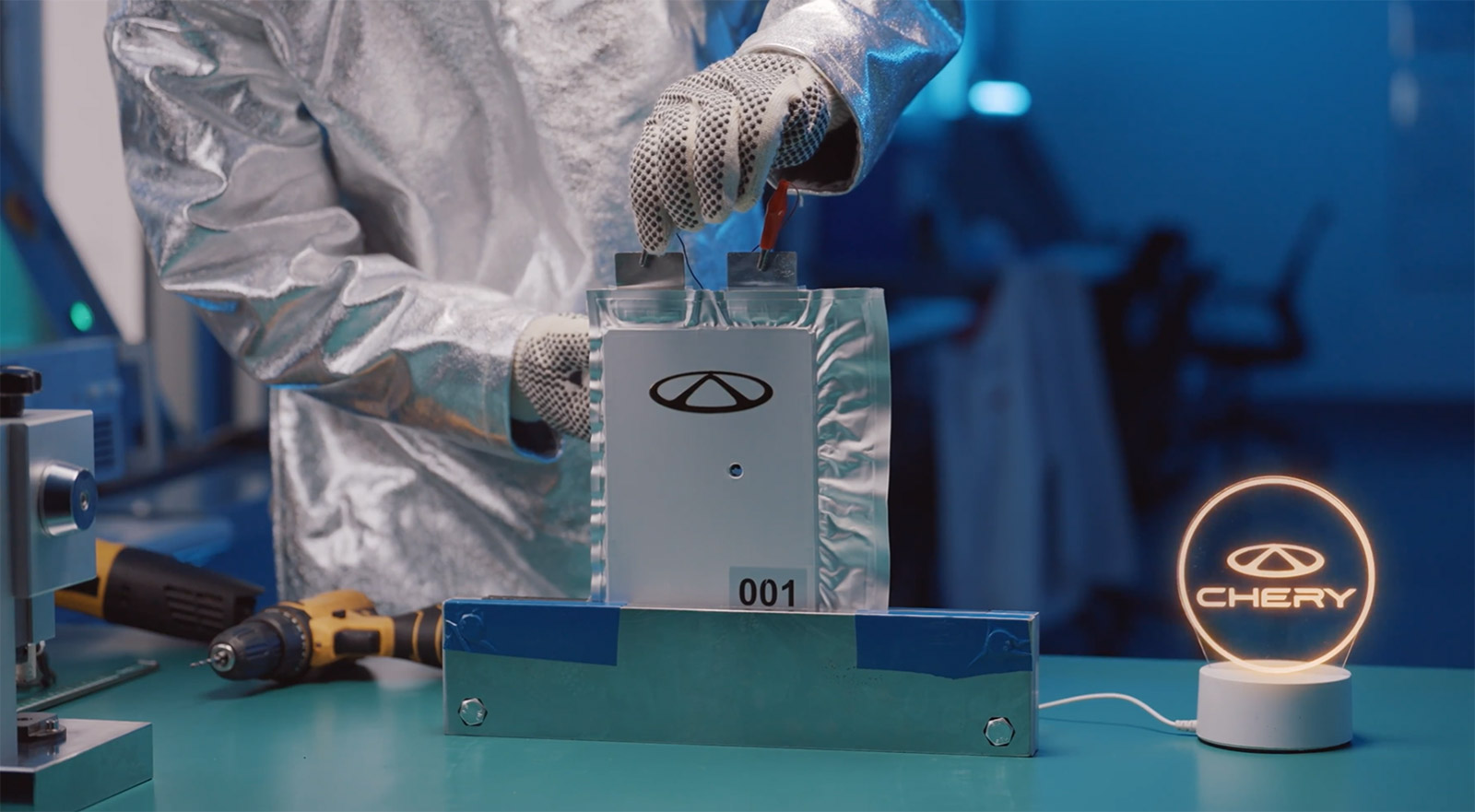
A screenshot from a Chery video shows a solid-state battery cell continuing to operate after a puncture test. Credit: Chery
- Chery plans to install solid-liquid hybrid batteries in vehicles in the fourth quarter of 2026 and begin vehicle validation of all-solid-state batteries in 2027.
- The latest timeline puts Chery among Chinese automakers racing for the 2027 commercialization window for solid-state batteries.
Chery Auto (HKEX: 9973) has unveiled its latest solid-state battery timeline, with plans to begin vehicle validation of all-solid-state batteries in 2027.
The Chinese automaker’s chairman Yin Tongyue announced the plan on Thursday at the 2026 World Power Battery Conference in Yibin, Sichuan province.
Chery’s Rhino Battery lineup includes 3 series for hybrids, battery electric vehicles (BEVs), and solid-state applications. Its solid-state cells have achieved an energy density of 400 Wh/kg, Yin said, according to a report by National Business Daily.
As a transitional solution, the solid-liquid hybrid version of the Rhino Battery is scheduled to be installed in vehicles in the fourth quarter of 2026. The all-solid-state battery will enter vehicle validation in 2027, he said.
The timeline is broadly consistent with Chery’s roadmap unveiled in March, indicating that solid-liquid hybrid technology will be the first to enter vehicle applications.
Chery said at the time that its Rhino S series included a 60-Ah solid-state cell with an energy density of 400 Wh/kg.
The cell uses a sulfide-based solid electrolyte and a high-nickel ternary cathode, making it one of Chery’s main technology routes toward the commercialization of all-solid-state batteries.
The company also showcased a polymer-based solid-state cell with an energy density of 600 Wh/kg in March, saying it could support a vehicle range of more than 1,500 kilometers.
However, the mass production of solid-state batteries still faces challenges including cost, reliability, and manufacturing yield.
CATL (HKEX: 3750) chairman Robin Zeng said in June that if the solid-state battery technology route were measured from level 1 to level 9, current progress would be only at level 4, while level 9 would indicate readiness for mass production.
CATL and BYD (HKEX: 1211) are both targeting 2027 for the small-volume deployment of all-solid-state batteries in vehicles.
Geely Auto (HKEX: 0175) said in January that it planned to complete its first in-house developed all-solid-state battery pack in 2026 and conduct vehicle validation.
Dongfeng Motor, meanwhile, plans to deliver 50,000 vehicles equipped with its in-house developed solid-state batteries in 2027.
Chery will advance multiple battery solutions in parallel, but no technology will be used in vehicles before meeting safety requirements, Yin said.
The Rhino Battery features a “360-degree safety protection system” and must undergo tests involving high temperatures, extreme cold, crashes, underbody scraping, and water immersion, he said.
Yin also said green electricity accounts for more than 52% of the power used at Chery’s manufacturing bases in China, while carbon-footprint accounting covers 100% of its models currently on sale.
He expects China’s automobile exports to exceed 10 million vehicles in 2026, with new energy vehicles (NEVs) accounting for more than half.
The global expansion of Chinese automakers should not focus on short-term sales, but instead promote localized operations and industrial cooperation, Yin said.
The 2026 World Power Battery Conference is being held in Yibin, Sichuan province, from September 3 to September 4.
Lithium-ion batteries will be subject to a 2% consumption tax from September 1, 2026, with the rate rising to 4% from September 2027.
