

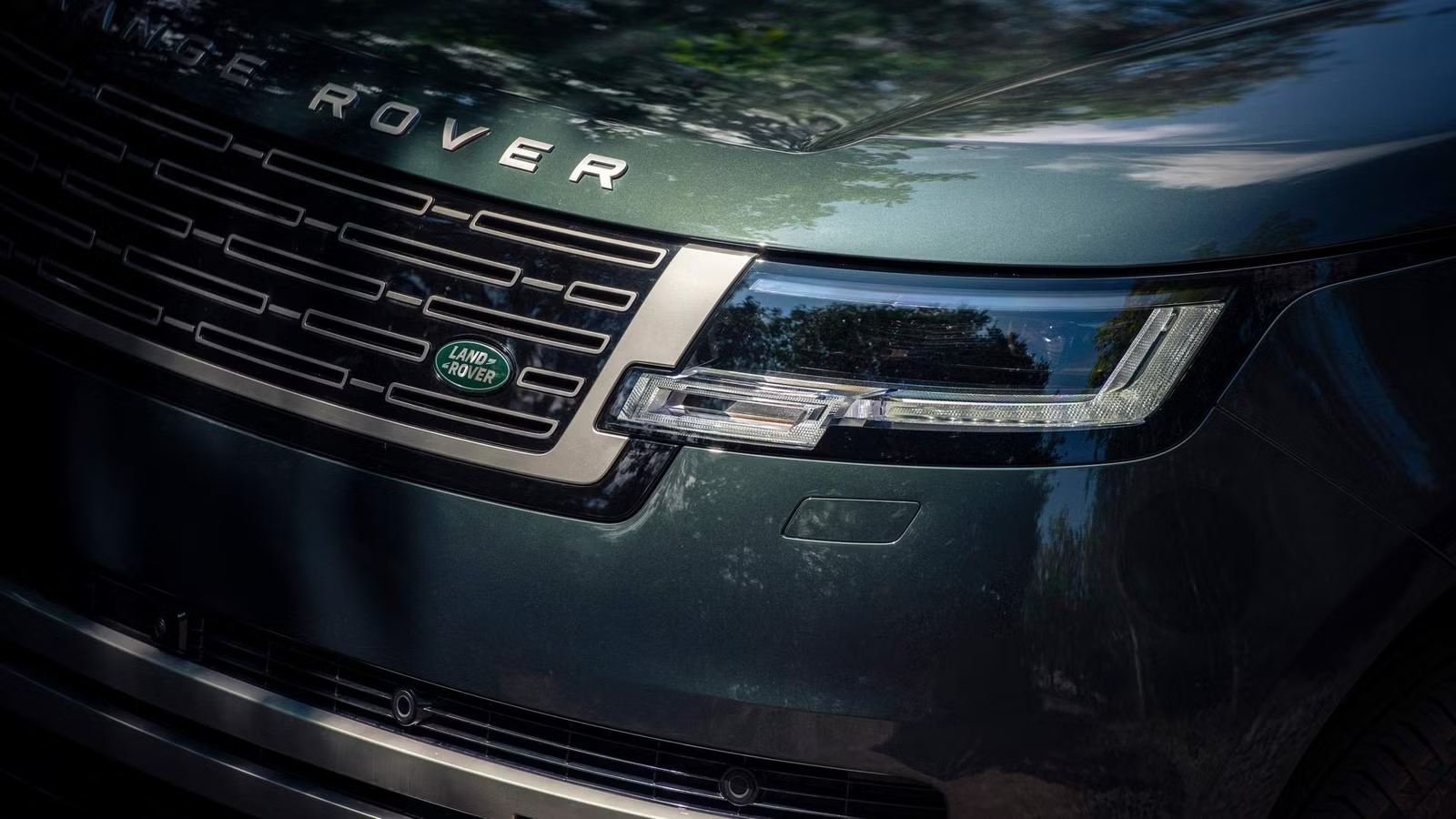
Range Rover has just launched an SUV that makes plenty of sense, but still might go over like a safari without any animals. The Range Rover Electric could be the ultimate expression of the model’s go-anywhere-but-do-it-serenely philosophy. It makes less noise, has more torque, and is even more capable of traversing rough or slippery terrain.
But good luck telling the difference between the Range Rover EV and the gas or PHEV models without taking a look under the hood.
Range Rover Customers Do Not Want Change
Close
“We want it the same.” That’s what Range Rover customers told the brand, and it’s what Range Rover management repeated over and over again when showing off its first electric vehicle. And that’s just what the company delivered. The same three-line bodywork as the standard model is here. There are a few tweaks, like a filled-in aero grille, underbody shielding changes, and special wheels. But it’s only just enough to improve the range slightly.
Do Customers Like More Power?
Range Rover ElectricRange Rover
Underneath, the Range Rover Electric has a pair of 260 kW electric motors. They’re the company’s own design, which includes hairpin windings and internal oil-cooling jets, plus they’re sealed off, save for high-mounted vent tubes for water wading. Range Rover says claims they make 20% more torque than other motors their size.
The result is 542 horsepower, 19 more than the standard 4.4-liter V8 and 64fewer than the SV. It also has 627 pound-feet of torque, 74 lb-ft more than the SV and more than any other Range Rover so far. Zero to 60 mph takes 4.3 seconds, while on the move, a 50-75 mph passing maneuver takes just 2.7 seconds.
333 Miles Of Range, But How Quick Does It Charge?
Close
Range Rover packed the cells under this SUV in two rows. That gives it room for 118.5 kWh of capacity, enough for a 333-mile EPA estimated range. The EV can charge at up to 350 kW on an 800-volt-compatible charging station, or the pack can split charge at 400 volts on a lesser station and still pull in 250 kW.
On a 350 kW fast-charger, the electric Range Rover can go from 10-80% in about 22 minutes, or add 125 miles in 10 minutes. On a slower but more common 400V 250kW charger, that’s more like 100 miles in 10 minutes, which still isn’t bad.
For slower charging, there are AC charge ports on both sides. Having chargers on both sides is useful if your plug is on the other side of the garage, but also on European streets where you can park against traffic and there are electrical plugs for charging on the side of the road.
Electric Power Doesn’t Guarantee Serenity
Range Rover ElectricRange Rover
The big SUV isn’t quieter just because there isn’t a big V8 under the hood. An EV can bring its own slew of new noises from new places. The stiffer high-voltage electrical cables, for example, were bringing road noise into the cabin. The rear motor is also far noisier than a differential.
Fixing it required added insulation and big tweaks to the active noise cancellation system. The result is an SUV that’s 7 dB quieter at full throttle and 5 dB quieter under moderate acceleration. After a quick spin on the company’s UK test track, we can confirm you can’t hear much of anything from inside.
New Powertrain Enhances Go-Anywhere Capability
Close
Prolific torque and better control from the electric motors help Range Rover engineers deliver more confidence and capability in slippery or rough terrain. Traction control responds 100 times faster than a combustion engine, and responds with more precision. The drive modes have been configured to take advantage of it to make sure it can do what Range Rover owners expect.
As part of the reveal, CarBuzz got a few minutes of off-roading on the track where Range Rover tests its SUVs. The electric, to no surprise, performed admirably on their circuit.
The big battery underneath lowers the SUV’s center of gravity by 3.5 inches. That doesn’t sound like a lot, but it’s enough that Range Rover can meet its handling goals without the heavy and complex active roll control system. It gets the twin-valve dampers from the Range Rover Sport SV instead, which increase the range between soft and firm settings for optimal ride and handling.
Range Rover could have gotten away with even thinner anti-roll bars than the gas models, but the company instead made a better pick from its existing choices. Why? Parts availability. It turns out that cost of ownership matters even to Range Rover buyers, or at least that’s the claim.
Off-Road And Behind The Wheel
Range Rover ElectricRange Rover
JLR’s off-road track wasn’t a particularly challenging course, but the Range Rover isn’t a Jeep Wrangler Rubicon. The electric SUV handled extreme side slopes and a 30-degree hill climb without trouble. The traction control system responded so quickly it was imperceptible, with none of the angry gunfire-like noises and jerkiness you get when a gas SUV’s ABS pump fires wildly to get through slippery areas.
We couldn’t test the SUV’s water-fording capability, because the UK hadn’t seen more than a hint of rain all summer, leaving all the deep puddles dry. Still, we don’t doubt the claims, and sensors in the battery can detect and remediate issues that include water somehow getting inside.
The EV doesn’t have low range gearing like the rest of the line, but the company says it doesn’t need it. It can still deliver more wheel torque at low wheel speeds without it, so the extra complexity wasn’t necessary.
Built To Tow, Not Just Go
Range Rover ElectricRange Rover
Off-roading is a huge part of the Range Rover brand image, but do owners actually use that capability? It depends on who you ask. According to owners, 40% of them do serious off-roading. Range Rover’s own figures put that at closer to 10%, but the customer, as they say, is always right.
Speaking of owners, Range Rover says that 40% of owners tow, and they often tow loads like horse boxes and boats. So the EV will tow around 5,500 pounds to help accommodate all that. It’s less than the 7,700 of a gas model, but still not bad. The company also analyzed over 360 million owner trips while developing this EV. The 330-mile range, it said, will cover 97% of the daily travel of those owners based on that data, and it has taken steps to make sure it can actually deliver 330 miles, or at least be honest with you about what it can do.
Heat Recovery Can Add 25 Miles Of Range
Range Rover ElectricRange Rover
One of those range-extending features is a new heat management system it calls ThermAssist. The system can recover waste heat from the battery as it charges and discharges, even from regenerative braking.
The system can recover up to 3.5 kW of heat for every 1 kW of electricity that goes through the battery. This doesn’t add range directly, but it can cut cabin heating demands almost in half, and reduce battery heating and cooling loads. Range Rover claims it adds as much as 25 miles of driving on the road, not on the official test.
No Frunk, And Here’s Why:
Range Rover ElectricRange Rover
Cargo space in the rear matches the combustion-powered models, but this Range Rover will not come with extra space in a frunk. Officials told CarBuzz that “with the exception of literally one person” who was on the fence about it, every potential customer that was asked rejected the idea. A contrast to the potential Range Rover GT buyer, then.
The Range Rover Electric will be available on both short and long-wheelbase models. The SUV will be built on the same line as gas, diesel, and PHEV variants, and Range Rover can shift production to meet whatever split customers want.
Customers in the US will get an NACS plug and will have access to the Tesla Supercharger fast-charge network. Order books are open now, and buyers can pick SE, Autobiography, and SV grades as well as a special First Edition model. Pricing starts from $138,000, the same price as the standard V8.
CarBuzz Insight – Why This Matters
Range Rover ElectricRange Rover
The Range Rover Electric is powerful, comfortable, capable, and luxurious. It’s everything the company’s customers ask for and then some. But it’s a good thing that the automaker will be able to shuffle the production split, because no matter how good it is, we think Range Rover will have trouble convincing customers who don’t care about gas prices to make the switch.
Which is a pity, because they’ll really be missing out.
