

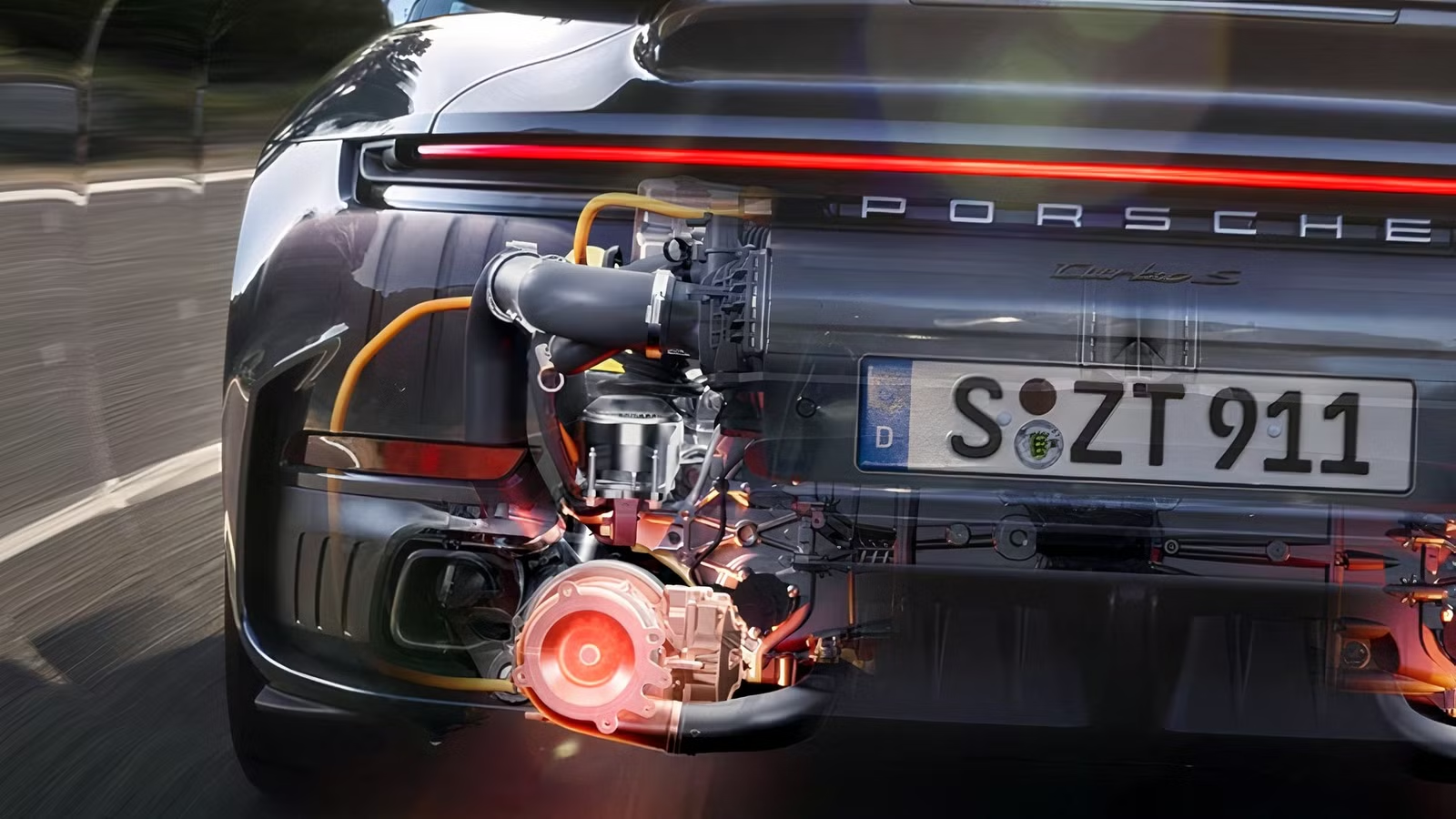
Old-school tuning still has its place in today’s world, but there is a far easier way of chasing higher outputs, as owners of turbocharged engines would surely be aware. Electronic control unit tuning acts as a shortcut for boosted car owners to access an easy 50 horsepower or more without having to so much as turn a wrench.
Horsepower Has Traditionally Been Quite An Expensive Metric To Chase
Modified 1955 Chevrolet Bel Air V8Bring A Trailer
Back in the days before the wide-scale rollout of ECUs for mass-market cars, everything was mechanically controlled. So, it simply wasn’t possible to plug into the vehicle, download a dose of extra horses, and be on your way. Instead, mechanical changes were necessary, and that’s the hardware folk had to shell out for.
Common ways to chase higher outputs included larger carburetors, high-flow air intake systems, performance-tuned exhausts, cylinder head work, mechanical fuel-injection upgrades, ignition timing adjustments, more aggressive camshafts, and so on. Fitting some of this gear was quite involved, and expensive, too. Adding horsepower required an investment in time and money.
For more serious builds, superchargers were a solid choice for achieving big numbers. This method of forced induction was already decades old by the time of the muscle car’s golden era in the 1960s and early 1970s. While rare on factory models, a crafty home mechanic could build something capable of sending the stock power levels soaring. Big power was certainly possible, but for the average motorist simply after an extra kick, engine mods were often too expensive or too involved.
ECU Tuning Changed The Game
Skyline GT-R Z-TuneNissan
As the 1960s rolled into the ’70s, and then into the ’80s, electronic ignition and other such wonderments went from being novelties to the norm. To control and monitor the ever-expanding list of electrified greatness under the average car’s hood, ECUs became commonplace. These computer modules monitored various aspects of the vehicle. For example, the engine control unit takes in information to tune elements such as fuel injection, ignition timing, and air/fuel mixture.
This tech was great for managing ever-stricter emissions regulations rolled out by the newly formed EPA, but it also gave enthusiasts an easy way to boost engine power. The idea wasn’t much different from adjusting a carb, but this time it was done through a computer. At first, instead of plugging in and making adjustments, tuners swapped the physical chip in the ECU for one with modified maps that altered fuel delivery and engine timing. It was a new way of doing things, but still heavily restricted, as parameters were set to match what was installed on the chip so that custom changes couldn’t be made for the most part.
‘Chipped’ E30 ECUHunterDirection / YouTube
As the years progressed, so did the technology and the approach. No doubt the biggest jump was the introduction of OBD2 as an industry-standard onboard diagnostics system. The architecture provided easy, reliable access to the vehicle’s ECU and its settings. Instead of physically cracking into the ECU and swapping chips in and out, tuners could make the changes via the OBD2 port.
Tuners could now read the factory map, make changes, reflash it to the ECU, and tweak the parameters as much as they liked. Specialist tuners could sell custom maps for different fuel qualities and adjust things like timing and fuel delivery for non-factory turbo builds. There was finally complete tuning freedom.
While ECU tuning was brilliant for custom car builders, it was also a game-changer for the everyday driver who wanted a little more power without resorting to turbo kits and physical changes deep within the engine. Instead of cracking open their daily driver’s engine and swapping in modified cams, a free-flowing exhaust, and big injectors, tuners could offer a simple map designed to boost the performance of an otherwise standard car. The same tune could then be sold to any other driver of the same model because there was no need to start from scratch and tune each car from zero.
Why Turbocharged Engines Are So Responsive To ECU Tuning
2013 VW Golf R Cabriolet I4 engine topVolkswagen
ECU tuning works on all cars, whether they are boosted or not, but the gains are typically negligible on naturally aspirated cars in terms of horsepower. Turbocharged cars can see substantial gains from a simple ‘stage one’ tune. This is because, in addition to tweaking ignition timing and fuel delivery, ECU tuning can also adjust the turbocharger’s wastegate or variable-geometry system to increase boost pressure, allowing more air and fuel into the engine.
This results in significant power gains, and naturally, that isn’t possible with naturally aspirated cars, although that doesn’t mean ECU tuning is a waste of time here. Tweaks to air/fuel ratios, ignition timing, and fuel delivery can still provide valuable results in how a car performs, although a turbocharged vehicle is generally the best starting point should power gains be the desired result when ECU tuning.
The Proof Is In The Pudding
2023 Honda Civic Type R getting some wheelspin on.Honda
It’s all well and good to say turbocharged cars respond well to ECU tuning, but real-world results and comparisons to non-turbocharged cars are what’s needed to drive the point home. One of the best examples is the Civic Type R, which was stubbornly naturally aspirated for most of its life before switching to forced induction just over 10 years ago, before it arrived in the US.
Reputable UK-based ECU tuning companies estimate around 15 hp gains from remapping a standard FN2 Civic Type R, which is fairly typical of a naturally aspirated engine with this level of stock power. However, a simple tune on an FK8-generation Type R, that’s the 2017 model which made its way onto US shores, and gains in the region of 40 to 50 hp are to be expected. So, that’s roughly a 7.5% increase in power for the naturally aspirated car, versus a 16% increase for the later car.
In the grand scheme of things, a 16% boost in power is also quite mild. Turbocharged cars from beneath the Volkswagen Group umbrella respond remarkably well to ECU tuning, to name but a few examples:
- ABT boasts increases of 60 hp to the current 8Y generation Audi S3
- Tuners boast up to 70 hp in gains on the earlier MK8 Golf R platform
- It’s possible to net 80+ hp from DAZA-powered RS3 and TT RS models
ECU tuning really is a secret cheat code when it comes to tuning turbocharged cars, and the gains aren’t reserved only for performance vehicles, either:
It’s little 10% to 20% boosts like this that really transform how a car behaves, and for most drivers, that’s enough. However, for the more adventurous enthusiast looking for an even bigger kick of power, some simple bolt-on mods can send these gains soaring even further.
Such impressive power gains are possible in part because automakers don’t tune engines to work at their absolute peak. They have to pick a setup that works across the entire country, at various altitudes and with different fuel blends. Tuning for more performance is likely going to affect fuel economy, and working the engine harder may affect the longevity of parts. If you’re tweaking the ECU, use the highest-octane fuel available and the best-quality oil when it’s time for a change.
Hardware Modifications Work To Multiply Software Gains
Burger Motorsports Tacoma Air IntakeBurger Motorsports
ECU tuning is more than enough for some because the extra 50 hp provides the grunt they need, and they’re satisfied. For others, it’s a gateway drug. Combining ECU tweaks with hardware modifications, such as free-flowing exhaust systems, cold-air intakes, larger turbochargers, intercoolers, and fueling upgrades is the best approach for getting the very best out of an engine.
These are bolt-on modifications. We’re still not stripping the engine down and getting too extreme at this stage, but it’s certainly more involved than just plugging in and installing a simple ECU tune. With hardware mods, you can install more aggressive tunes to better use the extra air and fuel flowing into the engine. From here, 50 hp gains can soon explode into gains of over 100 hp.
Sources: Volkswagen, Audi, Honda, Ford, ABT, Cobb Tuning, JoTech Performance.
