

Anyone who knows a thing or two about warranties will tell you that Hyundai is theundisputed leaderin standard coverage, and that extends to the Kia and Genesis brands, with a 10-year powertrain warranty up for grabs. Unfortunately, there’s a catch.
When you buy a used Hyundai, the powertrain warranty is downgraded to a five-year plan, and that’s from the initial sale date, not the date that you bought the car. So, if you’re buying a five-year-old Hyundai, and it’s not CPO, you’re covering everything out of pocket. Here’s what you need to know…
New Buyers Get A 10-Year Warranty. Used Buyers Get Half That – And The Clock Has Already Started
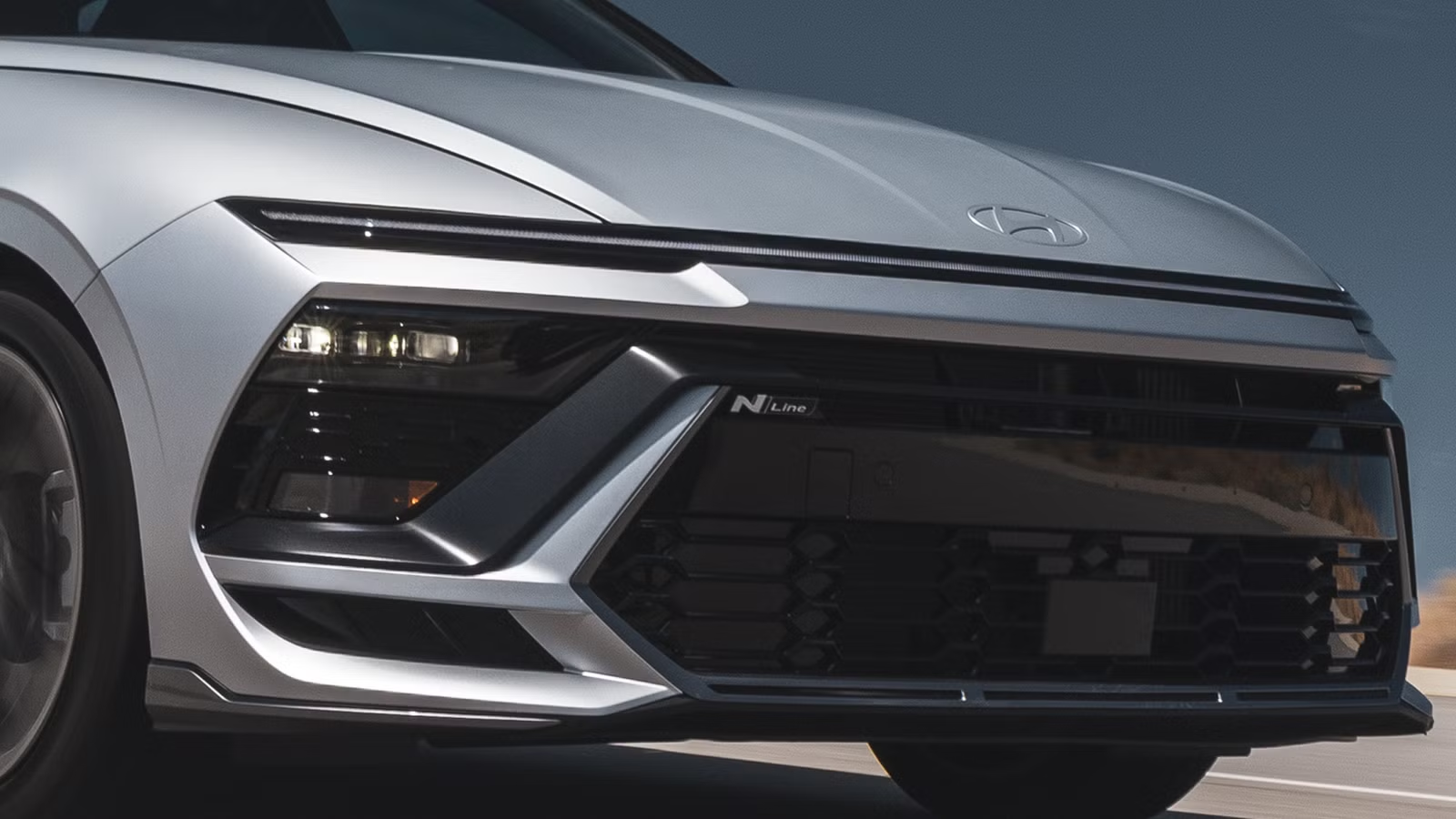
2024 – 2026 Hyundai Sonata 8th Gen (DN8) Facelift SedanHyundai
To understand what you’re giving up as a used buyer, here’s what the original owner walks away with. Go point by point, and it’s clear that Hyundai offers the best new car deal on the market.
- 10-year/100,000-mile powertrain warranty
- 10-year/100,000-mile EV/hybrid battery
- 5-year/60,000-mile bumper-to-bumper warranty
- 5-year/unlimited-mile 24-hour roadside assistance
- 7-year/unlimited-mile anti-perforation warranty
Simply put, these numbers are the very definition of industry-leading. Few automakers even come close to the protection Hyundai, Kia, and Genesis will extend to you just for buying the car.
That’s all well and good for the first owner, but, when you buy a Hyundai used, you only get a five-year/60,000-mile powertrain warranty, and that starts from the original in-service date, not your date of purchase. This means that if you’re buying a five-year-old Hyundai Elantra, or a model with 60,000 miles on the odometer, you’re going to be covering everything out of pocket.
To be clear, you don’t get to enjoy the remainder of the first buyer’s powertrain warranty. That’s the rule on paper – but what does it actually cost used buyers in practice, especially when engines start failing?
CPO Is The Only Loophole – But It Comes With Strict Age And Mileage Cutoffs
2021 Hyundai Sonata InteriorHyundai
The only real workaround when buying a used Hyundai is to go through a certified pre-owned dealer. CPO buyers get to keep the full 10-year/100,000-mile powertrain warranty.
You spend a little more on a CPO than you do on a non-certified used model, but a Hyundai Certified car has passed a 173-point inspection and a history check, and there’s a strict cut-off for any car that’s six years old or older, or has more than 80,000 miles on the odometer.
CPO is the safest path – but it only works if the car qualifies, and not every used Hyundai does. For the millions of buyers who go non-CPO, the reduced warranty isn’t just an inconvenience. It can mean being on the hook for repairs that Hyundai itself has been sued over.
A Reduced Warranty And A History Of Engine Lawsuits Is A Risky Combination
2020 Hyundai Elantra front offside quarter Hyundai
If you’re not going the CPO route — and many used buyers don’t — the warranty picture gets more complicated, and riskier, than just losing the powertrain coverage.
The powertrain warranty is the only one that gets cut in half when you buy used. If your new-to-you Hyundai is less than five years old, you still get the 24-hour roadside assistance, you still get the bumper-to-bumper plan, and, if you’re driving an EV, the battery actually retains all the same coverage it had for the first buyer.
So the main thing is that you’re going to be paying for typical repairs and parts yourself. Hopefully that’s the worst of it, but some class-action lawsuits suggest that it might not be.
Around Four Million Hyundais And Kias Were Involved In A Major Engine Settlement In 2021
Red 2018 Kia Optima frontKia
Back in 2019, Hyundai and Kia agreed to settle a class-action lawsuit alleging that the 2.0-liter and 2.4-liter Theta II engines with Gasoline Direct Injection (GDI) suffer from a defect that can result in stalling, engine fires, and total failure. Models covered by the lawsuit include, but are not limited to, the following.
The class action suit saw payouts to the tune of $1.3 billion in early 2021, once the agreement was finalized with court approval. Note that a settlement does not mean that Hyundai or Kia were found guilty of anything, and you can make of the court’s decision what you will.
A Couple Had Their Warranty Claim Denied On A Failed Engine – And Allege Hyundai Concealed A Secret Extended Plan
2019 Hyundai Santa Fe finished in blue with black interiorHyundai
A lawsuit filed by a couple in California alleges that their Santa Fe’s 3.3-liter Lambda II engine failed just before hitting 80,000 miles due to a defect that causes excessive internal wear and premature damage. The complaint alleges that failure could occur at any time, and that Hyundai has long known of the problem, but failed to issue a recall or disclose the risk.
The couple state that they tried to get the problem handled through their warranty, but the company denied the claim, despite the failure occurring within the powertrain warranty period, which left them paying thousands out of pocket. Additionally, the couple claim that Hyundai conceals a secret 15-year/150,000-mile extended warranty plan, in response to federal regulators investigating similar engine failures.
The couple were the second owners of the Hyundai, but they bought it with just 17,350 miles on the odometer in May 2019. The failure occurred in April 2024, at 79,966 miles. We’re not sure how long it had been since the first owner took the car off the lot, and whether this car was just under, or just over, the five-year limit, but 79,966 miles is well past the 60,000-mile cut-off.
At present, this is still a developing story, and we don’t want to jump to any conclusions. If the couple can prove that Hyundai knew about the problem, they may be entitled to compensation. But, in the meantime, they’re out the money they spent on repairs.
This is to say that, even if Hyundai decides to cover you later on down the road, it could be years from the time your engine gives out to the time you get your refund. After five years or 60,000 miles, you have to assume that you’re on your own.
Five Used Hyundais With Low Repair Costs – And What They’re Selling For Right Now
2018 Hyundai accentHyundai
It’s rare that we’ll hesitate to recommend a Hyundai. The brand builds some of the best cars ever made for the price. But, you have to go in knowing that you’ll probably be covering most repairs out of your own pocket.
So, it would benefit you to pick out one of the more reliable, low-maintenance Hyundais if you’re buying used. To list a few that we like:
- The Hyundai Elantra GT should only cost you around $397 a year to maintain, according to RepairPal. Our price-tracking tool sees a 2020 model trending at $13,845 from an MSRP of $20,650.
- The Hyundai Tucson should cost around $426 a year to repair, with severity and frequency both being reported below what is typical for the segment. We have the 2021 Tucson trending at $15,905 from an MSRP of $23,700.
- The Hyundai Sonata averages $458 a year in repair costs. The 2021 Sonata is trending at $15,574 from an MSRP of $23,950.
- The Hyundai Accent should cost you around $444 a year in maintenance. We have the 2021 model trending at $13,661 from an MSRP of $15,395.
- The Hyundai Elantra should cost you around $452 a year in maintenance. We have the 2021 model trending at $15,962 from an MSRP of $19,650.
If you’re going for a used Hyundai, our advice would be to simply put the warranty out of mind unless you’re going with a certified pre-owned model. Further, we wouldn’t advise buying a fresh-off-the-lot used car. If someone else has only been driving it for a year or less, you’re giving up five years of warranty coverage to save very little off the sticker price.
There are certain trade-offs that come with buying second-hand. You don’t get the new-car smell, you can never be 100% certain how well the previous owner maintained the car, and you don’t always get the protection that comes with buying it brand-new. On the other hand, you’re saving thousands, if not tens of thousands, of dollars off the price of purchase.
In short, you’re taking on a certain amount of risk in order to save a certain amount of money. There’s nothing necessarily wrong with that, just so long as you know what you’re getting yourself into.
Sources: Hyundai, About Lawsuits, RepairPal.
