

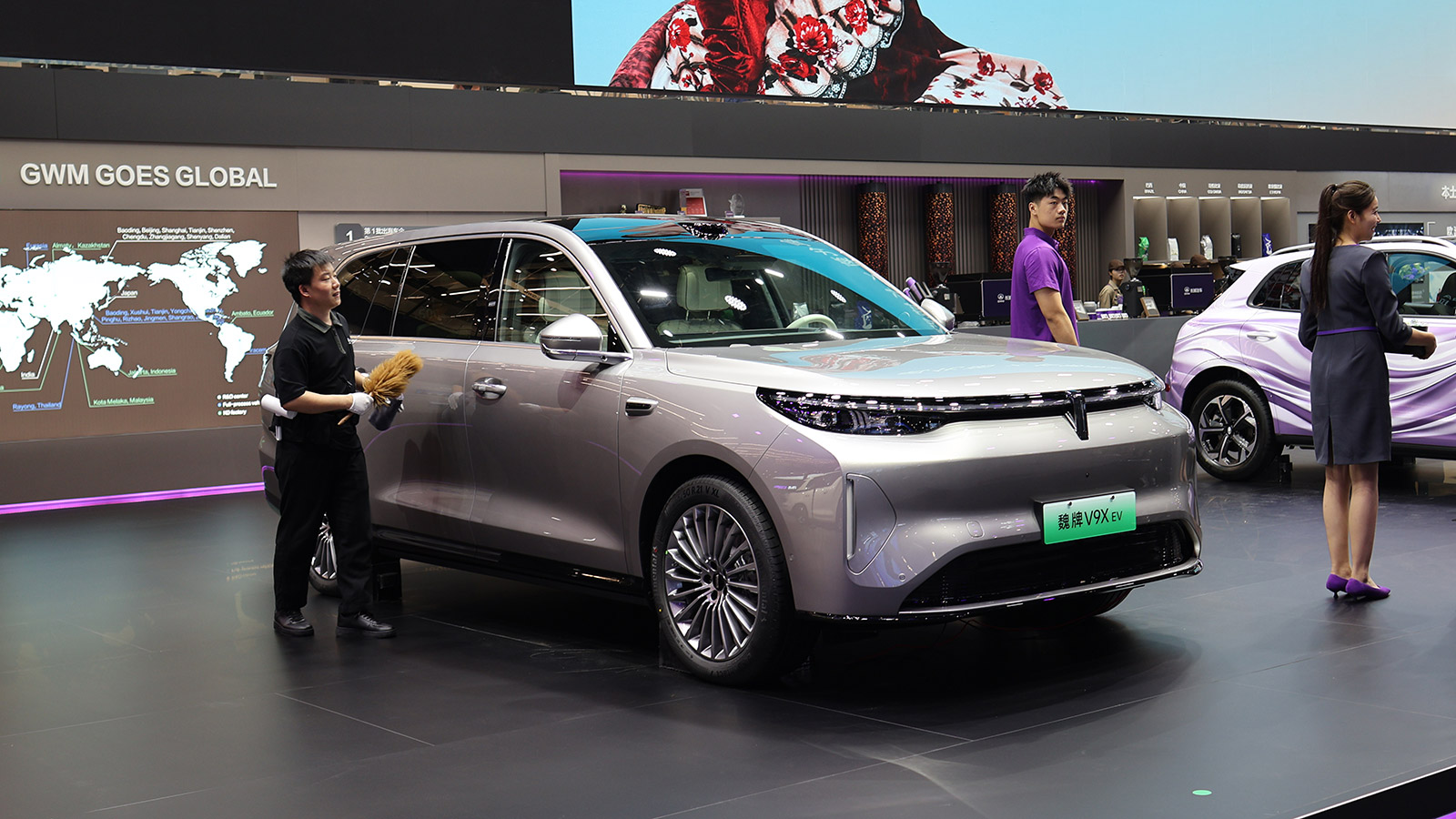
A GWM Wey V9X EV on display at the Beijing Auto Show in April 2026. Credit: CnEVPost.
- China will conduct nationwide inspections of intelligent connected vehicle safety, R&D and production capabilities, and product conformity.
- The campaign escalates recent scrutiny of automakers and testing organizations into a cross-agency, nationwide quality drive.
China has launched a 1-year campaign to improve automotive product quality, expanding oversight of intelligent connected vehicle safety and production conformity.
The Ministry of Industry and Information Technology (MIIT), Ministry of Public Security, Ministry of Ecology and Environment, and State Administration for Market Regulation jointly issued a notice announcing the campaign on Thursday, state broadcaster CCTV reported.
The campaign to improve the production conformity and quality of road motor vehicle products will be carried out nationwide.
Inspections will focus on areas including intelligent connected vehicle safety capabilities, companies’ design, development and production capabilities, and product conformity.
CCTV’s brief report provided no further details. The full text of the joint notice is not yet available.
The move is China’s latest effort to strengthen quality and safety oversight as the auto industry rapidly adopts new technologies.
It also brings earlier inspections of automakers, products and testing organizations under a cross-agency, nationwide campaign.
MIIT launched its 2026 production conformity inspection program in May, covering road motor vehicle manufacturers and products that have received market-access approval.
Inspectors can collect sample vehicles and key components from factories and dealerships, seal their hardware and software configurations, and send them to testing organizations.
Testing covers vehicle structure, crash safety, EV safety and traction battery-pack safety, with some samples also subject to cross-checks.
Under the annual inspection program, manufacturers that fail to continuously meet market-access requirements or whose products do not comply with national standards may be publicly named, have related products suspended from MIIT’s catalog, or be barred from filing new products.
After samples are sealed, automakers are also prohibited from improperly changing vehicle technical parameters through over-the-air (OTA) updates.
In July, MIIT inspected factories operated by GAC Aion, Xpeng (NYSE: XPEV), Nio Inc (NYSE: NIO), Chery (HKEX: 9973) and JAC.
Inspectors randomly selected sample vehicles and power batteries on-site and sent them to testing organizations for national standards compliance testing.
At a meeting on August 4, MIIT urged testing organizations to strengthen risk identification and test validation for “aggressive” innovative designs.
Regulators also called for stronger safety assessments of combined driving assistance and autonomous driving functions.
One day before the latest campaign was announced, MIIT Vice Minister Xin Guobin said some aggressive designs had been installed in vehicles without adequate validation, while isolated automotive product quality and autonomous driving safety incidents had raised public concern.
MIIT will tighten market-access reviews and test validation management for innovative automotive product designs while intensifying production conformity inspections, Xin said.
One week before the campaign was announced, Chinese regulators unveiled a wave of recalls involving more than 7 million vehicles.
Most of the defects involved interior emergency mechanical door-release handles that were difficult to identify, highlighting the safety risks that design details can pose after vehicles enter mass production.
Meanwhile, China is building a clearer technical and liability framework for autonomous driving.
A draft revision to the Road Traffic Safety Law would make automakers responsible for handling traffic violations committed while fully autonomous driving functions are activated. Related mandatory safety standards are scheduled to take effect on July 1, 2027.
MIIT said irrational competition remains a serious problem, with some aggressive designs installed in vehicles before adequate validation.
