

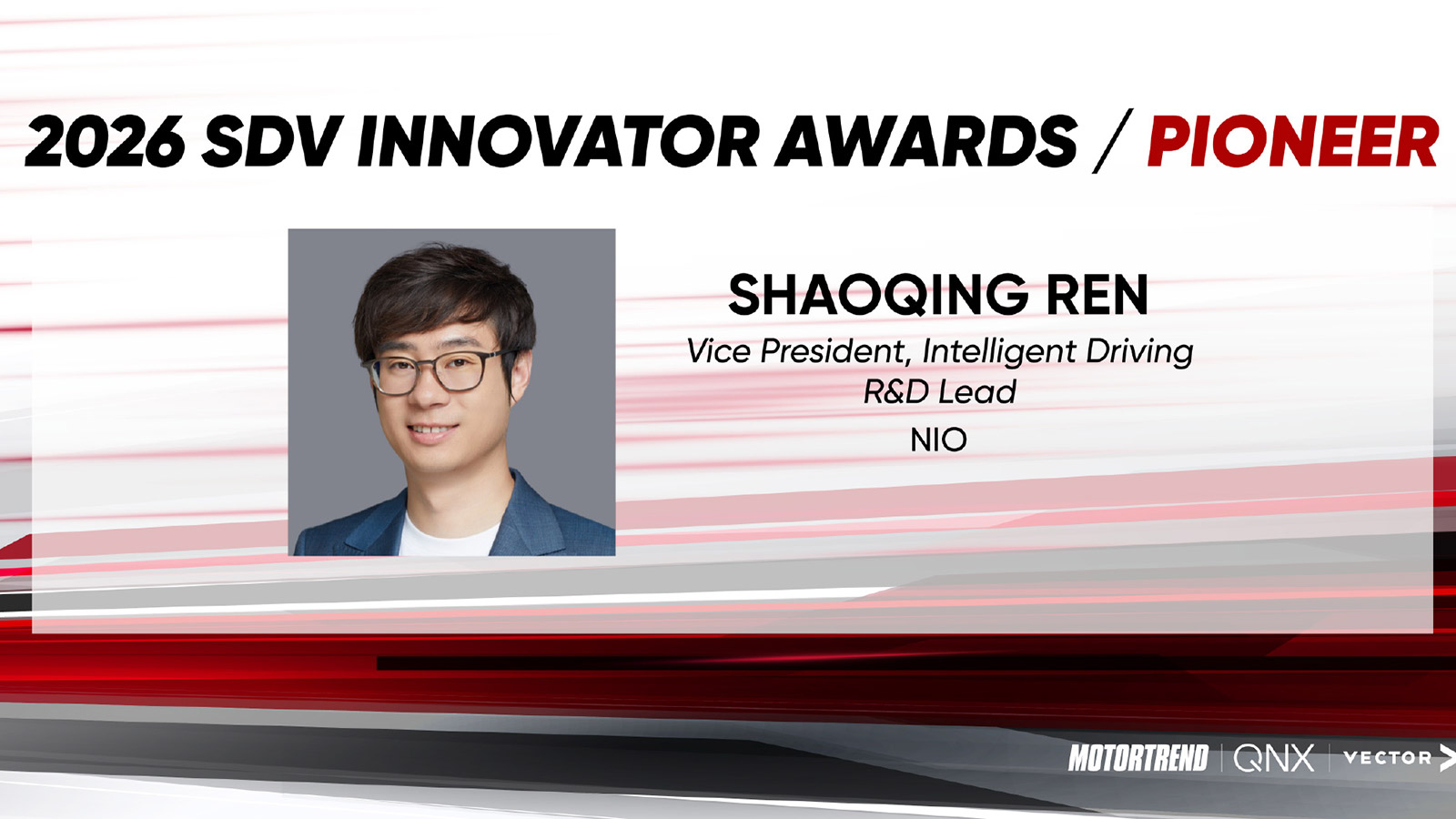
Nio vice president and intelligent driving R&D lead Shaoqing Ren was named a Pioneer in MotorTrend’s 2026 SDV Innovator Awards at CES on January 7, 2026. Credit: Nio
- Nio plans to make a strategic investment in the physical AI and embodied intelligence company founded by Ren and collaborate with it.
- Ren will continue leading Nio’s smart-driving operations, though how he divides his time between the 2 roles will be closely watched.
Nio Inc (NYSE: NIO) reportedly plans to make a strategic investment in an embodied intelligence startup founded by its smart-driving chief Ren Shaoqing, while keeping him in his current management role.
The arrangement allows Nio to maintain stability in its smart-driving team while staying connected to the rapidly developing embodied intelligence sector.
Nio founder, chairman and CEO William Li announced the decision at an all-hands meeting for smart-driving employees on Monday, Chinese media outlet LatePost reported today, citing people familiar with the matter.
Ren founded an independent company focused on physical AI foundation models and embodied intelligence, and Nio plans to collaborate with the startup, according to the report.
A person who attended the meeting said Li and Ren made it clear that Ren would continue serving as head of Nio’s smart-driving operations.
The meeting was brief and did not address any organizational changes. The new company has completed its registration and reached a unicorn-level valuation, according to LatePost.
A unicorn is a privately held startup that is typically less than 10 years old, valued at more than $1 billion and not yet listed on a stock exchange.
The report did not disclose the company’s name, the size of Nio’s investment or its specific valuation. It also did not say which projects the 2 companies plan to work on.
Another local media outlet, Red Probe, was the first to report on Friday that Ren Shaoqing had founded an embodied AI company, but did not provide further details.
Ren joined Nio in 2020 and is currently a senior vice president overseeing the company’s smart-driving research and development.
During his tenure, Nio’s smart-driving algorithms have shifted from a conventional modular approach to end-to-end and world-model architectures. The company has also brought its in-house developed Shenji NX9031 chip into mass production.
Nio has switched the smart-driving hardware in some models from 4 Nvidia Orin chips to a single Shenji NX9031 chip.
The company began developing its world model in 2023, unveiled the Nio World Model (NWM) in 2024 and started rolling it out to production vehicles in 2025.
Nio released a new version in June, covering more than 700,000 users. The technical framework was upgraded to combine a world model, supervised fine-tuning and closed-loop reinforcement learning.
Smart driving and embodied intelligence share many foundational technologies, including perception, prediction, planning, control and reinforcement learning.
This technological overlap is drawing more autonomous-driving talent into the robotics industry and making smart-driving executives with mass-production experience attractive to startup investors.
Earlier on Monday, Xpeng (NYSE: XPEV) announced that its robotics subsidiary Dogotix had secured about $900 million in funding commitments, implying a post-money valuation of about $6.3 billion.
Unlike Xpeng, which is carving out its in-house robotics business into a controlled subsidiary, Ren has chosen to establish an independent company outside Nio, with the EV maker participating as a strategic investor.
The model allows automakers to maintain ties with key AI talent and related technologies without incubating a full robotics business internally.
However, as the new company expands its research and operations, how Ren divides his time between the startup and Nio’s smart-driving business will be a key issue facing the arrangement.
William Li has ruled out an immediate entry into the currently trending robotics industry, focusing instead on selling more cars.
