

The entire US minivan market is served by just four primary models: the Chrysler Pacifica / Voyager, the Honda Odyssey, the Kia Carnival, and the Toyota Sienna. That’s it. If you’re buying a new minivan in 2026, it’ll be one of these four machines. For years, the conventional wisdom was often to just buy the default Sienna Hybrid because it was a Toyota, and the easiest minivan on fuel. The thing is, minivan shoppers purchase a vehicle for a multitude of reasons, and fuel economy is only one.
The Honda Odyssey has 280 hp under the hood.Honda
Today, as the segment experiences a resurgence in trendiness, minivans are seeing renewed energy: the Toyota Sienna is lately an all-hybrid affair with AWD available, the Chrysler Pacifica just got a flashy new styling update, and the Kia Carnival recently got two updated new engine options, including a next-generation gas V6 and a newly available hybrid.
Wide shot of the 2027 Chrysler Pacifica America250 dashboard and front seatsStellantis
The Honda Odyssey? Not so much. It just keeps plugging away. Sure, it’s had restyled bumpers, updated display screens, and minor trim-grade reshufflings in recent years, but mechanically, Honda hasn’t touched the recipe. If you’re a fan of old-school, naturally aspirated power and what’s arguably the best-handling and most responsive chassis in the minivan segment, that could be very good news.
Below, we’ll compare key metrics across the scene based on the latest updates to the Sienna and Carnival, and demonstrate why the Odyssey shouldn’t be overlooked, especially in driving dynamics and performance.
No Batteries Required: Honda’s Case For Keeping It Simple
2025 Honda OdysseyHonda
In the early 2020s, there wasn’t a four-cylinder engine in sight. Every minivan on the market ran a naturally aspirated V6. That started changing in 2021 when Toyota launched the latest-generation Sienna on an all-new TNGA-K platform and switched the model exclusively to a four-cylinder hybrid powertrain, making it the first minivan to abandon the V6 entirely. By this point, Stellantis had been selling the PHEV-powered Pacifica for four years, with the popular Pentastar V6 under the hood alongside some adaptations for hybrid duty.
2025 Honda Odyssey interior view of the front cabinHonda
In 2025, the Carnival’s aging 3.8-liter V6 was replaced by a more efficient 3.5-liter unit and joined by a new 1.6-liter turbo four-cylinder hybrid setup in the Carnival Hybrid, giving the segment its second four-cylinder hybrid offering. Chrysler, meanwhile, discontinued the Pacifica PHEV after 2026, leaving the 2027 Pacifica as a combustion-only model powered by the familiar Pentastar V6, and one of only two minivans with available AWD, alongside the Sienna.
2027 Kia Carnival Interior DashboardKia
During that same period, the Honda Odyssey stubbornly stayed the course, leaving the 3.5-liter naturally aspirated V6, 10-speed automatic transmission (standard since 2020), and overall platform untouched. That meant no hybrid power and no AWD, which likely didn’t help sales. Still, it also meant the market now had a new contender worth consideration by those after a minivan a little on the simpler and more old-school side.
Congratulations, you’re now up to speed on what’s under the hood of every minivan on sale in the US today. Now, let’s dig into the metrics.
Benchmarking The Big Four On Mileage And Muscle
2026 Toyota Sienna Platinum from the front three-quarter angleToyota
Welcome to the metrics! Every hybrid minivan on sale in the US today runs a four-cylinder engine. This includes the Toyota Sienna and Kia Carnival Hybrid, of which only the Sienna offers AWD, making it the only AWD hybrid minivan. Remember, the Pacifica PHEV is discontinued, and only non-hybrid Pacificas can be fitted with AWD anyway.
The Honda Odyssey has 280 hp under the hood.Honda
On performance, the Sienna Hybrid and Carnival Hybrid are separated by just 3 horsepower and less than half a second in the 0–60 mph sprint at 7.5 seconds and 7.8 seconds, respectively. Your results will vary. Both hybrid models easily clear 600 miles per tank, with the Sienna FWD delivering a 648-mile EPA total range, the highest on your page. It also posts the lowest annual fuel cost at $1,700.
Note that the Sienna Hybrid and Carnival Hybrid are separated by only $100 to $150 per year in fuel costs according to EPA data, so if you’re buying a hybrid minivan in 2026, budgeting roughly $1,750 per year for gas looks pretty reasonable for the average driver.
Next up are your standard V6 options. These start with the restyled Pacifica, pushing 287 hp from a highly familiar 3.6-liter V6 engine that will send the front-drive model to 60 mph in 7.3 seconds, and 7.8 seconds with AWD on board. That’s your second of just two AWD-equipped minivan options.
2027 Chrysler Pacifica America250 from the front three-quarter angleStellantis
With Pentastar power, the Pacifica FWD outruns the hybrid minivans to 60 mph by a few tenths of a second, while out-towing the Sienna by a 100-lb margin (3,600 lbs versus 3,500 lbs). With the V6 on board, the Pacifica’s full-tank driving range falls a few hundred miles behind the hybrid options, and it’ll cost you $1,100 to $1,350 more in gas annually. Actually, at $3,100 per year, an AWD-equipped Pacifica is the thirstiest machine on the page, putting away $1,350 more of your fuel dollars annually than an AWD-equipped Sienna, which can accelerate and tow virtually just as well.
2026 Kia Carnival LX front 3/4 angle in black configurator viewKia
Then there’s the non-hybrid Kia Carnival. Its 3.5-liter V6 ties the Pacifica on paper with 287 hp, though its 21 MPG combined rating makes it the thirstiest front-wheel-drive minivan on the page. The front-drive Carnival drinks $150 more gas annually than the front-drive Pacifica, despite the same power output.
2026 Toyota Sienna XSE interior photo showing the dashboardToyota
2027 Chrysler Pacifica FWD
2026 Toyota Sienna FWD
2027 Kia Carnival Hybrid
2026 Honda Odyssey
Engine
3.6L V6
2.5L I4 Hybrid
1.6L Turbo I4 Hybrid
3.5L V6
Power
287 hp
245 hp
242 hp
280 hp
Torque
262 lb-ft
176 lb-ft
(engine only)
271 lb-ft
262 lb-ft
0–60 mph
(approx)
7.3 seconds
7.5 seconds
7.8 seconds
6.4 seconds
Total Range
418 miles
648 miles
627 miles
429 miles
Annual Fuel Cost
$2,800
$1,700
$1,850
$2,800
That leaves the Honda Odyssey. Its 3.5-liter V6 packs a few less ponies (280 hp) than the Chrysler or Kia, yet it lays down the fastest 0–60 mph time on the page at just 6.4 seconds. That gives it a 0.6-second advantage over the V6-powered Carnival, makes it nearly a second quicker than the front-drive Pacifica, and puts it nearly 1.5 seconds ahead of the AWD Pacifica. That’s GTI territory. Despite impressive acceleration, the Odyssey’s $2,800 annual fuel cost ties the front-drive Pacifica for the lowest among non-hybrids, matching its 22 MPG combined rating despite more hustle on the stopwatch.
2026 Kia CarnivalJared Rosenholtz/CarBuzz/Valnet
On interior volume, there is no major tradeoff: the Odyssey offers 10.9% more maximum cargo volume than the Pacifica (155.8 cubic feet versus 140.5 cu ft), while coming just 4.9 cu ft shy of the Pacifica on passenger volume (160.1 cu ft vs. 165.0 cu ft).
If passenger volume is your primary metric of concern, the lowest figures on the page belong to the Toyota Sienna (159.7 cu ft), with the Odyssey in second-lowest position at 160.1 cu ft, followed by the Pacifica (165.0 cu ft) and the Carnival in top position at 168.2 cu ft
2027 Kia Carnival EX with Captains Chair Second RowKia
On maximum cargo volume, the Sienna sits at the bottom with 101.0 cu ft (due to non-removable second-row seats), while the Odyssey takes top honors with a class-leading 155.8 cu ft available with the second-row seats yanked.
It’s important to understand what’s behind these numbers, and why they’re not necessarily absolute. The Odyssey delivers a top-notch 155.8 cu ft of maximum cargo capacity because its second-row seats can be removed without tools.
2026 Toyota Sienna Woodland from the rear three-quarter angleToyota
Conversely, the Pacifica trades maximum volumetric space for convenience because its second-row seats fold into the floor via the Stow ‘n Go system, eating up a little volume in the process. The Sienna’s second row seating isn’t intended to be removable or stored within its floor, so it gets the lowest maximum cargo volume score overall.
Is The Odyssey The Hot Hatch Of Minivans?
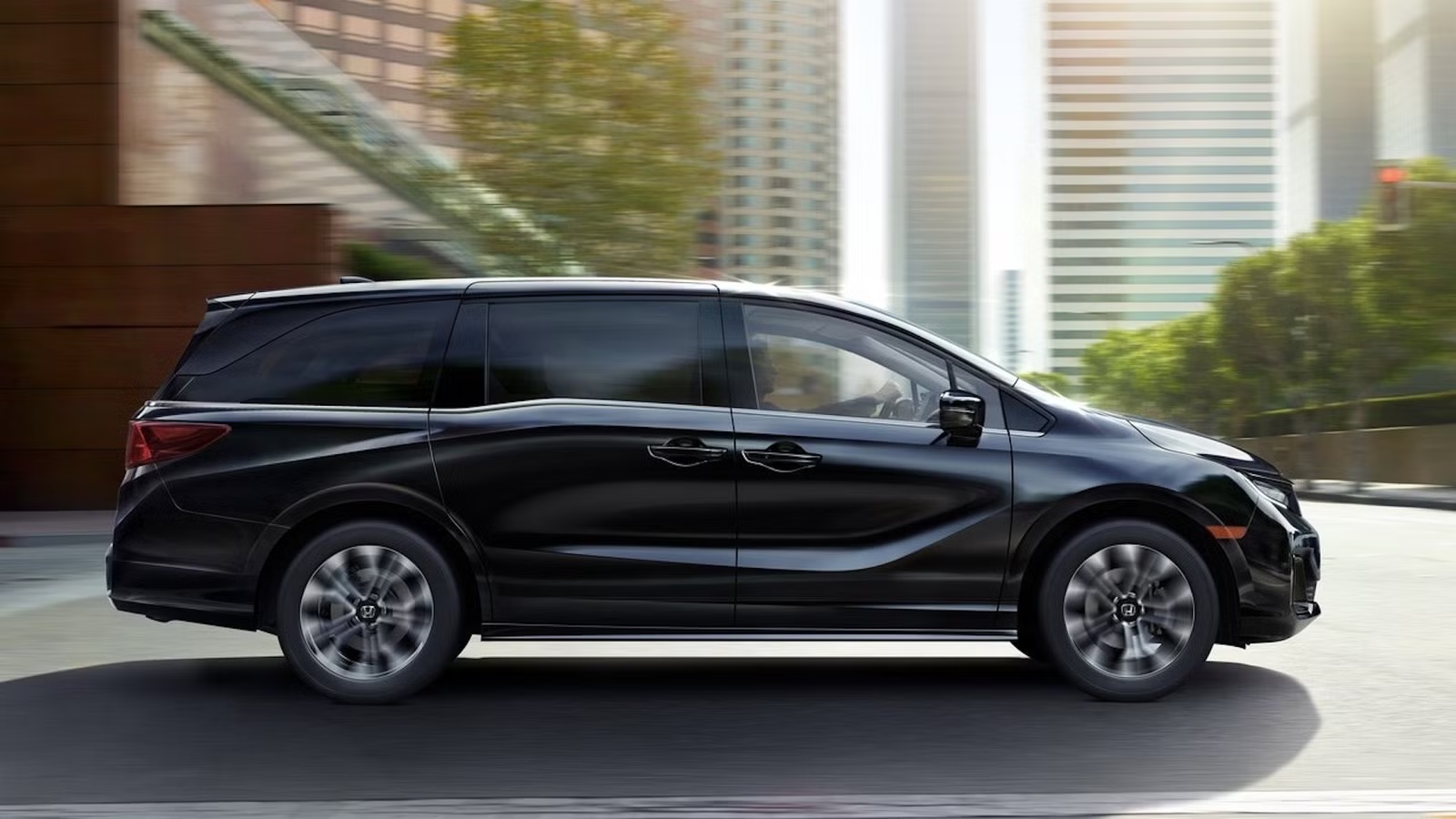
Side view of a 2025 Honda OdysseyHonda
It looks that way. According to reviewers, it seems like Honda tuned the Odyssey to deliver higher-than-average enjoyment than the minivan norm, by way of a quick steering system, a free-breathing V6 engine that loves to work, and a multi-link rear suspension to keep the dynamics on the more athletic side.
2025 Honda OdysseyHonda
Add in the fast-shifting 10-speed automatic that isn’t afraid to rapidly drop four or five gears for a quick highway pass, and you’ve got a recipe for some refreshing dynamics in comparison to the more comfort-tuned Pacifica, larger Carnival, and shift-free Sienna Hybrid with its e-CVT. Driving enthusiasts sometimes need minivans too, and for them, the Honda Odyssey is worth some serious consideration: just be sure to budget an extra $5,500 worth of fuel over five years versus that Sienna Hybrid FWD.
He went mentaal on the table again so decide if we need it at all and cut the crap out of it
Base Trim Engine
3.5-liter V6 Gas
Base Trim Transmission
10-Speed Automatic
Base Trim Drivetrain
Front-Wheel Drive
Base Trim Horsepower
280 HP @6000 RPM
Base Trim Torque
262 lb.-ft. @ 4700 RPM
Infotainment & Features
8 /10
Sources: Honda Info Center Eastcoastcars.net, MotorTrend, Honda, Toyota, Kia, Stellantis, EPA
