

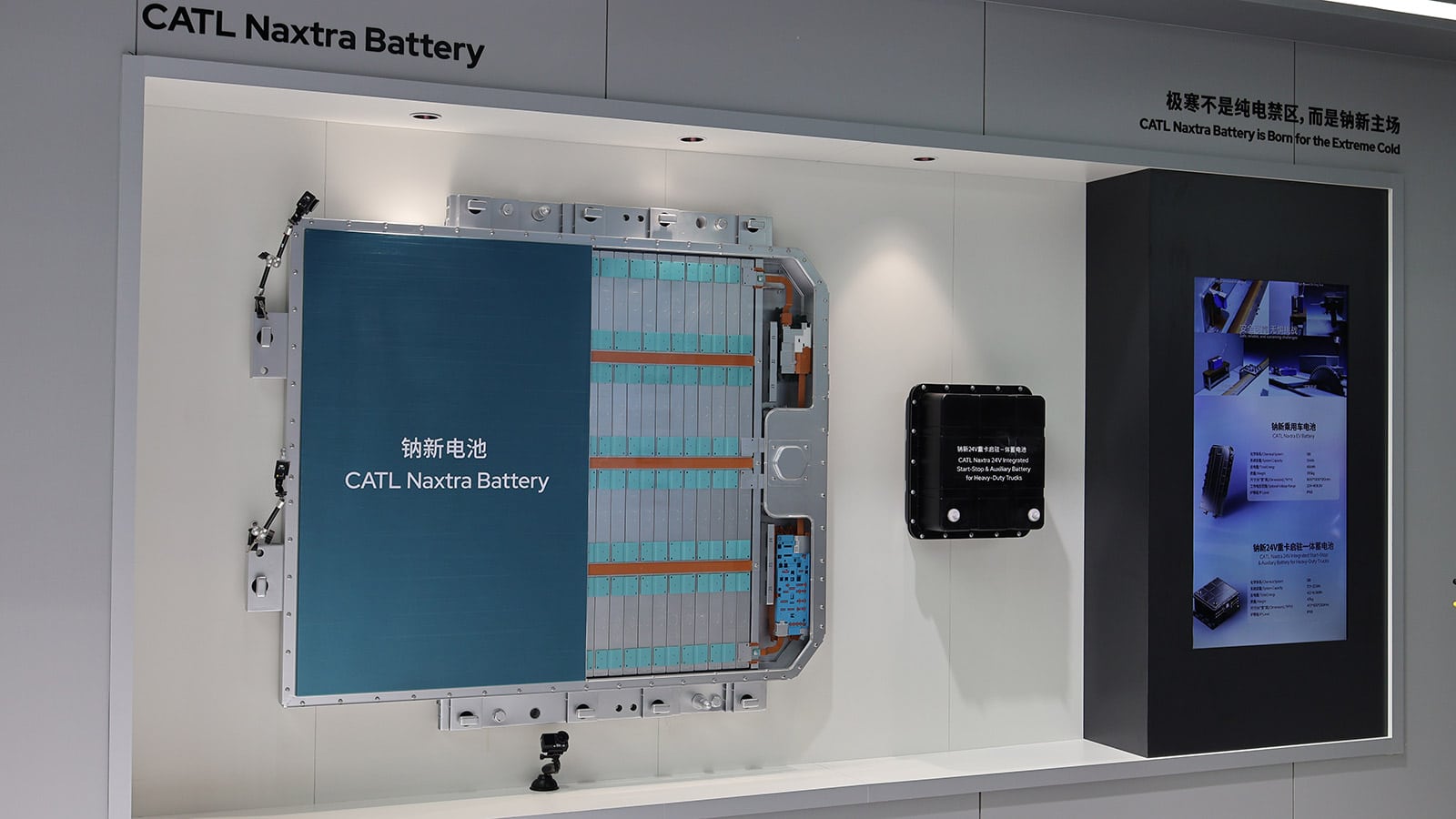
A CATL Naxtra Battery pack on display at the Beijing auto show in April 2026. Credit: CnEVPost.
- CATL said its supply chain accounts for more than 80% of its products’ carbon emissions, and it aims to achieve value-chain carbon neutrality by 2035.
- CATL’s chairman said batteries that are not zero-carbon will eventually be phased out by the times.
CATL (HKEX: 3750) said it achieved carbon neutrality across its core operations by the end of 2025 and, for the first time, systematically outlined a path toward value-chain carbon neutrality by 2035.
At an August 17 event in Ningde, Fujian province, where the company is headquartered, the world’s largest power battery maker said it is the only battery company globally to have achieved carbon neutrality in core operations while operating at TWh-scale shipment volumes.
Carbon neutrality in core operations means achieving net-zero carbon emissions from a company’s own production and operating activities, with emissions mainly coming from electricity and heat consumption at factories. The larger the manufacturing scale, the more difficult the target is to achieve.
By the end of 2025, 20 CATL battery plants had received ISO 14068-1 certification as zero-carbon factories, while zero-carbon electricity accounted for 100% of power used in its core operations.
The company has expanded production while reducing emissions. CATL produced 748 GWh of batteries in 2025, with sales 2.3 times higher than in 2022, accordign to a statement.
CATL said it has used more than 18 billion kWh of zero-carbon electricity since 2023. Energy consumption per unit of output at its battery production bases fell 28% in 2025 from 2022 levels, while carbon-emissions intensity declined about 77% over 2 years, resulting in cumulative emissions reductions of more than 10 million metric tons of carbon dioxide equivalent.
CATL unveiled its zero-carbon strategy in 2023, targeting carbon neutrality in core operations by 2025 and across its value chain by 2035. The biggest challenge in the next phase lies in the supply chain.
More than 80% of the lifecycle carbon emissions of CATL’s products come from the supply chain, with total supply-chain emissions exceeding those from its core operations by more than 5 times, the company said.
To address that, CATL has built a full-chain carbon data traceability platform covering mineral extraction, raw-material refining, material synthesis and component manufacturing, based on its Carbon Chain Management System (CCMS) launched in 2022.
The platform has completed calculations using real-world carbon data from more than 100 core tier-one suppliers and has built more than 1,000 product and raw-material models.
Bryan Huang, head of CATL’s procurement center, said the company will issue Green Procurement Guidelines that incorporate carbon footprints, renewable-energy usage ratios and energy consumption per unit of output into supplier qualification and review processes.
CATL launched a Zero-Carbon Supply Chain Empowerment Initiative, with an initial group of 30 core suppliers participating in deeper emissions-reduction collaboration. The company also proposed establishing a global zero-carbon ecosystem collaboration platform for the lithium battery industry.
At the event, CATL and suppliers of cathode materials, anode materials, current collectors and other components jointly launched an initiative aimed at achieving value-chain carbon neutrality by 2035.
CATL also entered into strategic cooperation agreements with the National Center for Climate Change Strategy and International Cooperation and the Shanghai Environment and Energy Exchange.
The zero-carbon economy has become a new model for growth and is opening up broad opportunities for industries and development, CATL chairman and CEO Robin Zeng said.
Batteries that are not zero-carbon will be phased out by the times in the future, Zeng added.
Technological advances are continuing to lower the cost of green energy, making the economics of zero-carbon development increasingly clear, he said.
Jiang Li, CATL’s vice president and board secretary, said the company is codifying the methodologies, data and technical expertise accumulated in developing zero-carbon factories, with the goal of turning zero-carbon practices from company-level initiatives into approaches that can be replicated across the industry.
Carbon footprints are increasingly becoming one of the thresholds battery makers must meet to enter overseas markets, with the European Union introducing requirements covering battery carbon-footprint declarations and limits.
CATL remains the world’s largest EV battery supplier. The company had a 39.9% share of the global market in the first half of 2026, up from 38.2% a year earlier, according to South Korean research firm SNE Research.
CATL’s net profit attributable to shareholders in the first half was 43.28 billion yuan ($6.37 billion), with a gross margin of 23.93%.
