

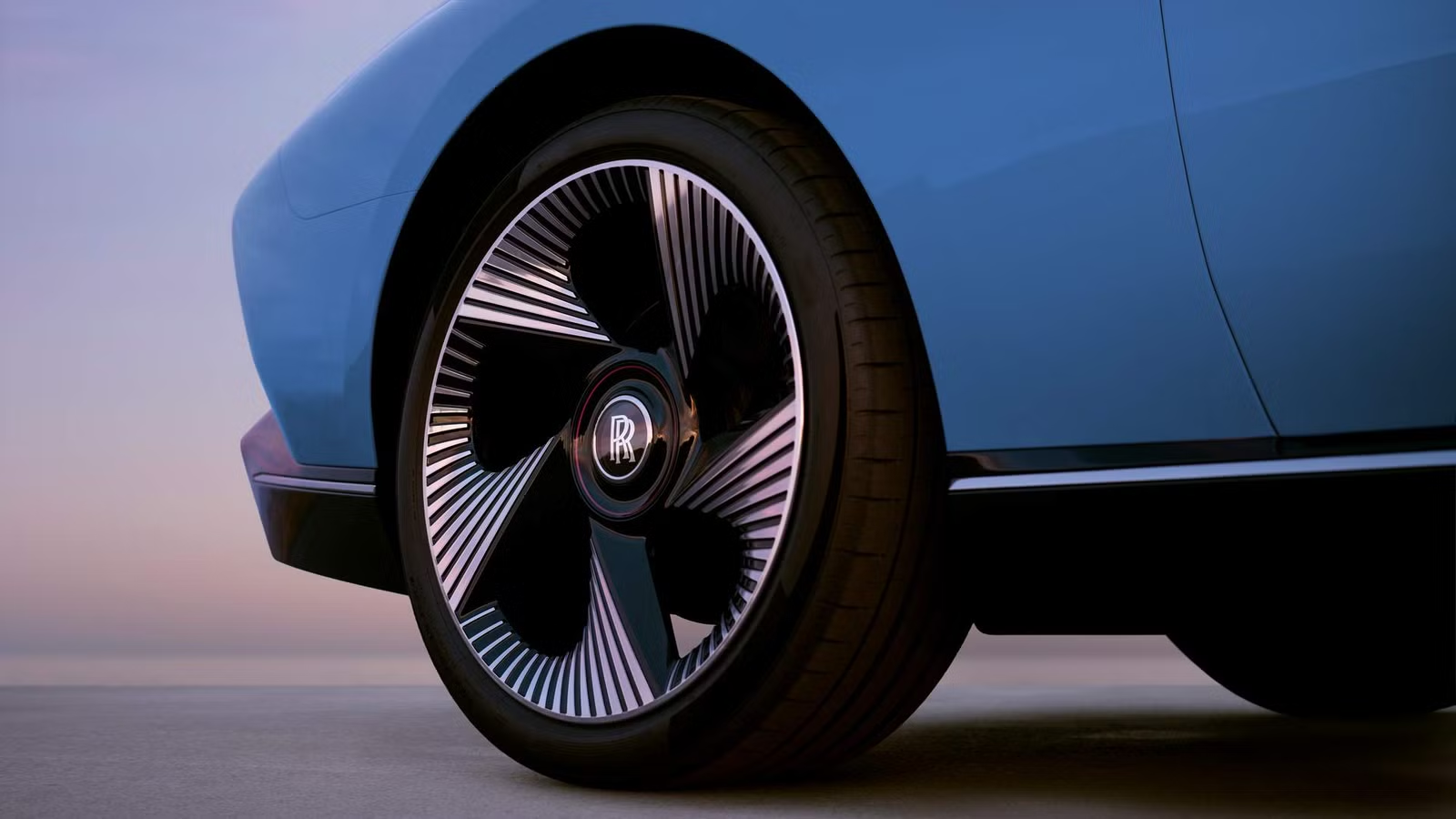
At the very highest echelons of the automotive industry, exclusivity has always been the name of the game. The world’s top luxury manufacturers lean into this heavily as they create products for those for whom exclusivity, and not money, is the proper keyword. Rolls-Royce is now taking that concept to the next level with its Project Nightingale.
This involves the company’s first fully electric coach-built convertible that’s not only expensive and covetable but also set behind some very stout gates. Rolls-Royce will only give the gate keys to 100 buyers and, interestingly, each one of them made a buying commitment on the basis of no more than a five-line sketch.
Rolls-Royce Chose The Buyers Before It Finished The Car
Rolls-Royce Project NightingaleRolls-Royce
Rolls-Royce describes Project Nightingale as a production concept rather than a completed showroom model. And it looks less like a conventional model launch than an admission to a private multi-year creative program. Global testing and validation are in the books for the summer of 2026, with eventual deliveries not before 2028, and a lot of anxious buyers in place.
Rolls-Royce CEO Chris Brownridge revealed that the company was able to persuade those buyers by showing them little more than a five-line sketch, about 18 months before the actual project reveal. And this means that those buyers did not have the opportunity to play with a configurator or inspect a finished prototype of any kind before making their commitment.
Rolls-Royce has only offered access to Project Nightingale by invitation through its private office network. It took this approach so it would only sell these cars to clients who had a particular affinity for the marque itself. Apparently, Rolls-Royce also wanted to find buyers who would actually drive the cars and hold on to them after purchase. While wealth was necessary, it was not necessarily enough of a qualifier just by itself. Being rich isn’t good enough.
The Real Product Is The Multi-Year Relationship
Rolls-Royce Project NightingaleRolls-Royce
Rolls-Royce has a separate program known as Coachbuild Collection, which involves the production of an extremely small and never-repeated series using a Rolls-Royce-authored body design. This is not where well-heeled individuals go to heavily option their Spectre or to commission a singular Droptail or Boat Tail. Instead, this is where chosen clients go to become part of the very ethos of Rolls-Royce.
Nightingale buyers will not only get access to one of these very special cars, but also get to tour the design studios, access testing facilities, meet engineers and craftspeople, and go to events in destinations that Rolls-Royce connects to the project. The company is effectively bundling this particular automobile along with a full multi-year itinerary. However, Rolls-Royce’s Coachbuild Collection is not the same as Ferrari’s Special Projects Program. In the latter program, Ferrari develops one-off cars around an individual client’s requirements, but here, Rolls-Royce is asking selected collectors to trust its imagination instead.
With Nightingale, the body itself comes out of the Rolls-Royce process, but the 100 owners get to individualize its colors, materials, and details. And as the car becomes the star of the show, the new owners represent an audience that’s subsequently invited backstage. Of course, the client is demonstrating a tremendous amount of faith in the company with this approach. After all, they’re not purchasing a finished design, but are committing based on some rather scant details instead.
Nightingale Uses Electricity To Make Its Heritage Louder
Rolls-Royce Project NightingaleRolls-Royce
Throughout its storied history, Rolls-Royce has never strayed too far from its fundamental underpinnings. And even though Project Nightingale represents a new and exciting model, it’s not about to erase much of that past heritage either. Instead, its proportions will draw from the 16EX and 17EX experimental cars that Rolls-Royce first created in 1928. These vehicles were lightweight-bodied Phantom-based cars with long hoods, compact cabins, and tapered tails. They give Rolls-Royce the visual language for Nightingale’s enormous two-seat form.
Expect the new car to measure about 18.9 ft, which would make it almost exactly as long as the Phantom sedan, despite carrying only a driver and one passenger. It’ll have an almost three-foot-wide interpretation of the Pantheon on the grille with vertical headlights, and a central fuselage body that tapers towards the rear. There’ll be a side-hinged “Piano Boot” luggage compartment too, which will turn the simple act of opening a trunk into something theatrical.
Meanwhile, Rolls-Royce hasn’t released much information about the new electric drivetrain, so there’s no data around its official horsepower, battery capacity, acceleration, charging, or range figures. But the company does emphasize what it is able to do without a combustion engine by eliminating exhaust hardware, reducing cooling openings, and shaping an uninterrupted rear diffuser. Perhaps most crucial of all, it’s been able to make an open cabin quiet enough for occupants who appreciate the silence.
Inside, the Starlight Breeze installation features 10,500 individual points of light based on sound wave patterns created by recorded nightingales. The illumination runs around the occupants via a structure that Rolls-Royce calls the “Horseshoe”, and the soft top combines cashmere fabric and composite sound-deadening material. The Goodwood-based company is clearly leaning on comfort and silence rather than acceleration in its interpretation of electric performance.
The $9.5 Million Figure Is A Report And Not A Sticker
Rolls-Royce Project NightingaleRolls-Royce
Some industry outlets have suggested that this new car could go on sale for around £7 million, or roughly $9.5 million, before further personalization, but the company hasn’t given an official figure. However, some significant rumors also point to a much lower entry point. For example, other respectable outlets suggest between $3.5 million and $5 million, and it remains to be seen where the actual numbers land. The final invoices will probably differ substantially from one particular car to another in any case.
Rolls-Royce has said that one-third of its production will head to the US, while none are likely to ship to China. Apparently, Rolls-Royce could not homologate the vehicle there because of electric vehicle and energy efficiency requirements. It may well be that the new car simply doesn’t meet China’s EV efficiency regulations, but as Rolls-Royce hasn’t released any specific specifications and figures, it’s difficult to know the true story.
Coachbuilding Is Becoming The New Hypercar Arms Race
Rolls-Royce Project NightingaleRolls-Royce
It’s likely that hypercars will always have a very specific allure for the ultrarich, but the way that manufacturers design, build, and sell those hypercars may yet be changing. Several hypercar and luxury manufacturers are creating distinct programs. For example, Bugatti has its Programme Solitaire, and it will build as many as two one-off cars per year. Bentley’s Mulliner division produces limited coach-built models, including the 16-car Batur Convertible. Ferrari has also operated its Special Projects Program for years.
These programs share some commonality in that they are increasingly exclusive and restrictive. Their companies are essentially designing a story around their top products, building a relationship with buyers, and creating objects that another buyer cannot simply reproduce. Meanwhile, Rolls-Royce is taking a slightly different view by creating intimacy without turning the Nightingale into a regular limited-edition model. Certainly, 100 cars is a large run when you compare it to a one-off Bugatti or a four-car Droptail series. But it’s still tiny when compared to production luxury models elsewhere.
In this case, Rolls-Royce is also selling its lucky owners the first chapter of a new Rolls-Royce institution and a place in its development history. Those owners will be granted years of special access before they take delivery, and the company’s approach is clearly working. After all, Rolls-Royce was able to allocate all 100 Nightingales before the public reveal even though those clients won’t get their finished cars until 2028. So, whatever the final price turns out to be, the real transaction actually began years earlier. These buyers didn’t just purchase a very high-end electric convertible; they were actually selected to take part in the making of one.
Sources: Rolls-Royce, Bugatti, Ferrari, Bentley.
