

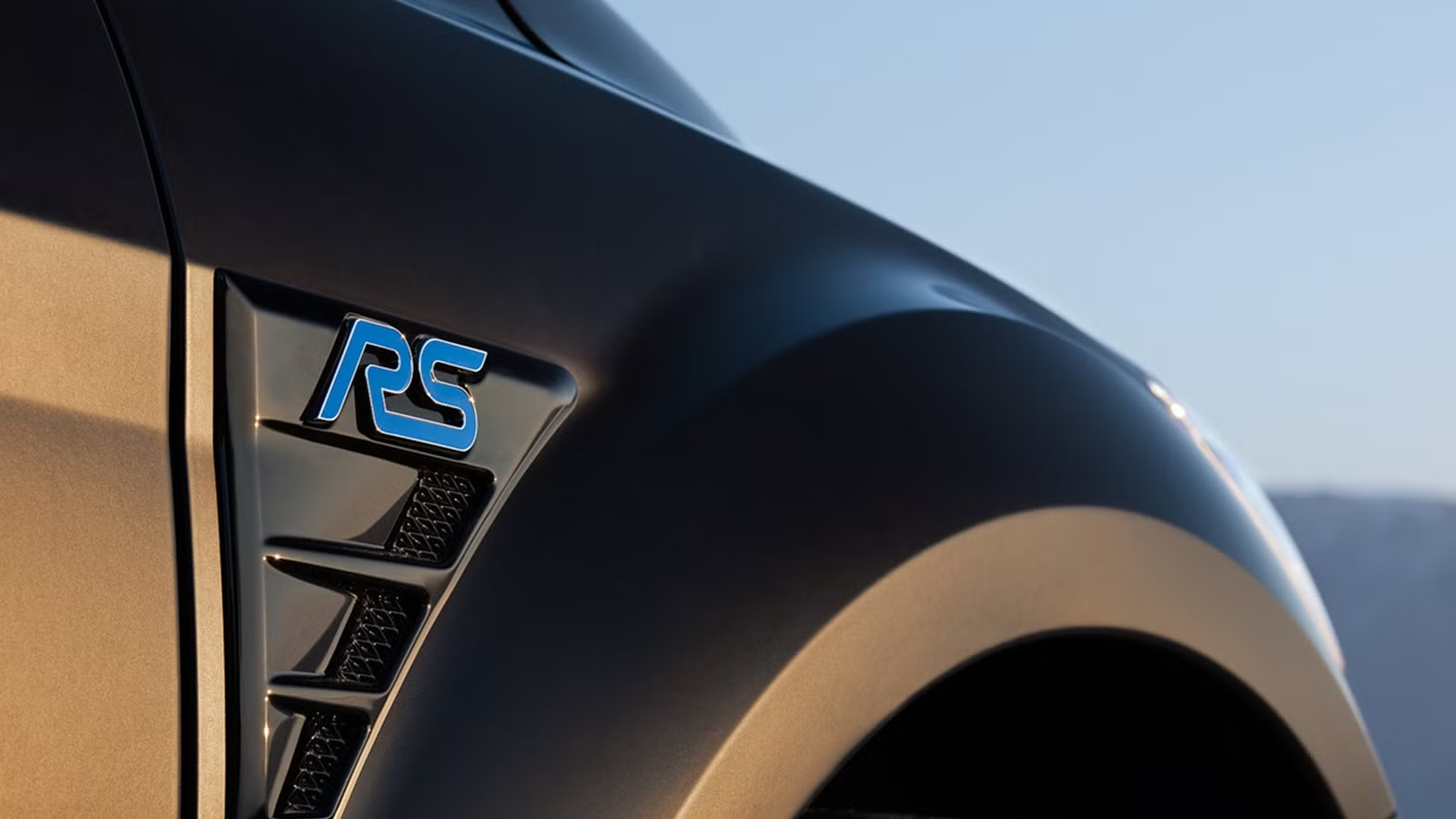
Front-wheel drive and big power have always made uneasy bedfellows. When the front axle is already responsible for steering and braking, piling on serious horsepower creates a recipe for wheelspin, torque steer, and frayed nerves — especially mid-corner with any steering lock dialed in. Taming that chaos without a clever limited-slip differential is a tall order, and engineers have spent decades trying to crack it.
Pair a high-powered FWD platform with a manual gearbox, though, and the result can be something genuinely thrilling. We set out to find the most powerful front-wheel-drive production car ever offered with a manual transmission — and the answer might surprise you.
It’s A Front-Wheel Drive Ford Focus
Ford Focus RS500 driving through a tunnel Ford
2010 Ford Focus RS500 Specifications
Engine
Turbocharged 2.5-liter inline-five
Power
345 hp
Torque
339 lb-ft
0-60 mph
5.6 seconds
Top Speed
163 mph
The most powerful FWD car to ever feature a manual gearbox is the 2010 Ford Focus RS500, the most extreme version of the second-generation Focus RS. Ford has only applied the RS badge to its most driver-focused models, such as the Escort RS Cosworth and the Sierra RS Cosworth. The Focus first received the RS treatment in 2002, with the first-generation model packing a turbocharged 2.0-liter four-cylinder producing 212 hp.
The second-generation variant, based on the Mk.2 Focus platform, arrived in 2009. The four-cylinder was gone, replaced by a Volvo-sourced turbocharged 2.5-liter inline-five. That howling engine brought 301 hp to the party, all of it routed through the front wheels. To keep torque steer from launching the car into the nearest barrier, Ford fitted a Quaife limited-slip differential and a bespoke MacPherson strut front suspension setup called RevoKnuckle.
2010 Ford Focus RS500 Matte Black Rear AngleFord
Despite those efforts, some torque steer still remained — though far less than it would have been without the engineering. In 2010, Ford decided to push the already-potent Focus RS even further. The result was the RS500: a blacked-out hot hatch that became, and remains to this day, the most powerful manual-equipped FWD car ever built. It was also the last of its breed to be front-wheel-drive, with the follow-up 2017 Focus RS switching to all-wheel drive.
The Five-Cylinder Engine Was Given A Substantial Boost
2010 Ford Focus RS500 Black FrontFord
The RS500 took its name from the production run: just 500 examples were built, marking the end of the short-lived Focus RS line. Externally, they stood apart from the standard Focus RS thanks to a matte black body paint scheme and black wheels. Each car also received a metal plaque on the center console bearing a hand-engraved number identifying its place in the 500-unit run.
Rather than treat the RS500 as a mere badge-engineering exercise, Ford’s Performance engineers dug into the 2.5-liter five-cylinder to find more power. The outcome was one of the coolest five-cylinder cars ever produced. While they were satisfied with the engine’s low-end delivery, they felt its mid- and top-end power and torque could be substantially improved. A larger intercooler was added to manage temperatures under hard use, enabling higher output, while a bigger air filter box improved airflow into the engine.
2010 Ford Focus RS500 Black Rear Angle Driving at DuskFord
The fuel pump was upgraded to match the increased airflow, and a larger-diameter exhaust system was fitted to reduce back-pressure. Ford also revised the engine management software to fully exploit the additional power unlocked by the hardware changes.
To ensure long-term reliability, updated pistons and connecting rods were fitted alongside more durable cylinder bores and a new head gasket. The net result was roughly 45 hp over the standard car, bringing peak output to 345 hp — enough to hustle the front-wheel-drive hatch from 0–60 mph in just 5.6 seconds. The six-speed manual gearbox from the base Focus RS was carried over unchanged.
The Rest Of The Focus RS Was Left Alone
Black 2010 Ford Focus RS500 back endFord
Despite extracting around 15% more power from the Focus RS’s engine, Ford elected to leave the rest of the car untouched. The RS500 retained the same suspension and braking systems as the standard car, and the chassis was left completely alone. Pre-release testing confirmed that the stock Focus RS setup was more than capable of handling the extra power, so those areas were left well enough alone.
The Focus RS500 Came Fully Loaded
2010 Ford Focus RS500 interior seats from sideFord
Beyond the bespoke paint scheme and numbered plaque, the RS500 received special interior trim featuring red stitching and a carbon-effect center console. Red leather Recaro seats were also available as an optional extra. Ford kept the options list deliberately short by bundling most of its available equipment as standard, including a heated windshield, a tire deflation detection system, and automatic headlights and wipers.
The only factory options were those red leather Recaro seats and a touchscreen DVD infotainment system — technology that Ford has developed significantly over the years. If you’re hunting down an RS500, look for examples that still carry these options, as they add meaningful value to an already collectible machine.
Focus RS500’s Are Worth A Fortune In 2026
2010 Ford Focus RS500 interior center console metal plaque viewFord
As an ultra-exclusive 500-unit limited run, the 2010 Mk2 Ford Focus RS500 has solidified its status as a premier hot-hatch investment. While well-maintained examples generally sell between $70,000 and $85,000, pristine, ultra-low-mileage collector cars have fetched up to $120,000 at auction. Bringing one to the United States requires navigating federal import restrictions.
Because the RS500 was manufactured for 2010, it remains subject to the 25-year import rule until 2035. American buyers wanting one today must apply for NHTSA “Show or Display” status—an exemption reserved for rare, historically significant vehicles that limits road use to 2,500 miles annually. Alternatively, it can be imported as a non-registered track or museum piece.
Otherwise, U.S. buyers will have to wait until 2035 to legally register and drive this 345-hp front-wheel-drive icon. Until the, the Focus ST will have to do, or you can go another route…
The Honda Civic Type R FL5 Is Another Powerful Manual FWD Weapon
2026 Honda Civic Type R FL5 Specifications
Engine
Turbocharged 2.0-liter inline-four
Power
315 hp
Torque
310 lb-ft
0-60 mph
4.9 seconds
Top Speed
170 mph
Should the Focus RS500 prove a little too expensive, the Honda Civic Type R FL5 makes a compelling alternative. Like the RS500, it pairs its performance with a six-speed manual transmission, though its power comes from a different source. Honda’s exceptionally reliable K20C1 — a turbocharged 2.0-liter inline-four — sends 315 hp to the front wheels. As with the Ford, an advanced limited-slip differential helps keep the front tires in check.
The Type R also features dual-axis front MacPherson strut suspension, which contributes to its agile handling and helps minimize torque steer. Unlike the Ford, the Type R adds an adaptive damper setup that manages body pitch and roll whether you’re hard on the throttle or threading through corners.
The Civic Type R is also considerably more accessible than the RS500. Used FL5 examples can be found for around $41,500, while a brand-new model is only $7,000 more.
The Most Powerful FWD Ever Made Is Quite Old, But It Had A 3-Speed Automatic
The 1970 Cadillac Eldorado, large, loud and fast, thanks to an 8.2-liter V8 engine producing 400 hp.Bring A Trailer
The title of the most powerful front-wheel-drive production car ever made belongs to a classic American luxury cruiser: the 1970 Cadillac Eldorado. Under its long hood sat a massive 8.2-liter (500 cubic-inch) naturally aspirated V8 engine that channeled an astonishing 400 horsepower and 550 lb-ft of torque directly to the front axle through GM’s heavy-duty Turbo Hydra-Matic 425 transmission.
Shared on the same front-wheel-drive platform as its corporate cousin, the 1970 Oldsmobile Toronado GT (which matched its 400-hp rating), the Eldorado prioritized effortless high-speed cruising and winter traction over tight cornering dynamics. Without modern traction control or electronic torque-steer mitigation, putting down 400 horses through the front wheels was an engineering anomaly.
More than half a century later, even modern hot hatches like the Civic Type R and Focus RS500 fall short of the Eldorado’s sheer output.
Sources: Ford, Honda, Classic.com, Kelley Blue Book
