

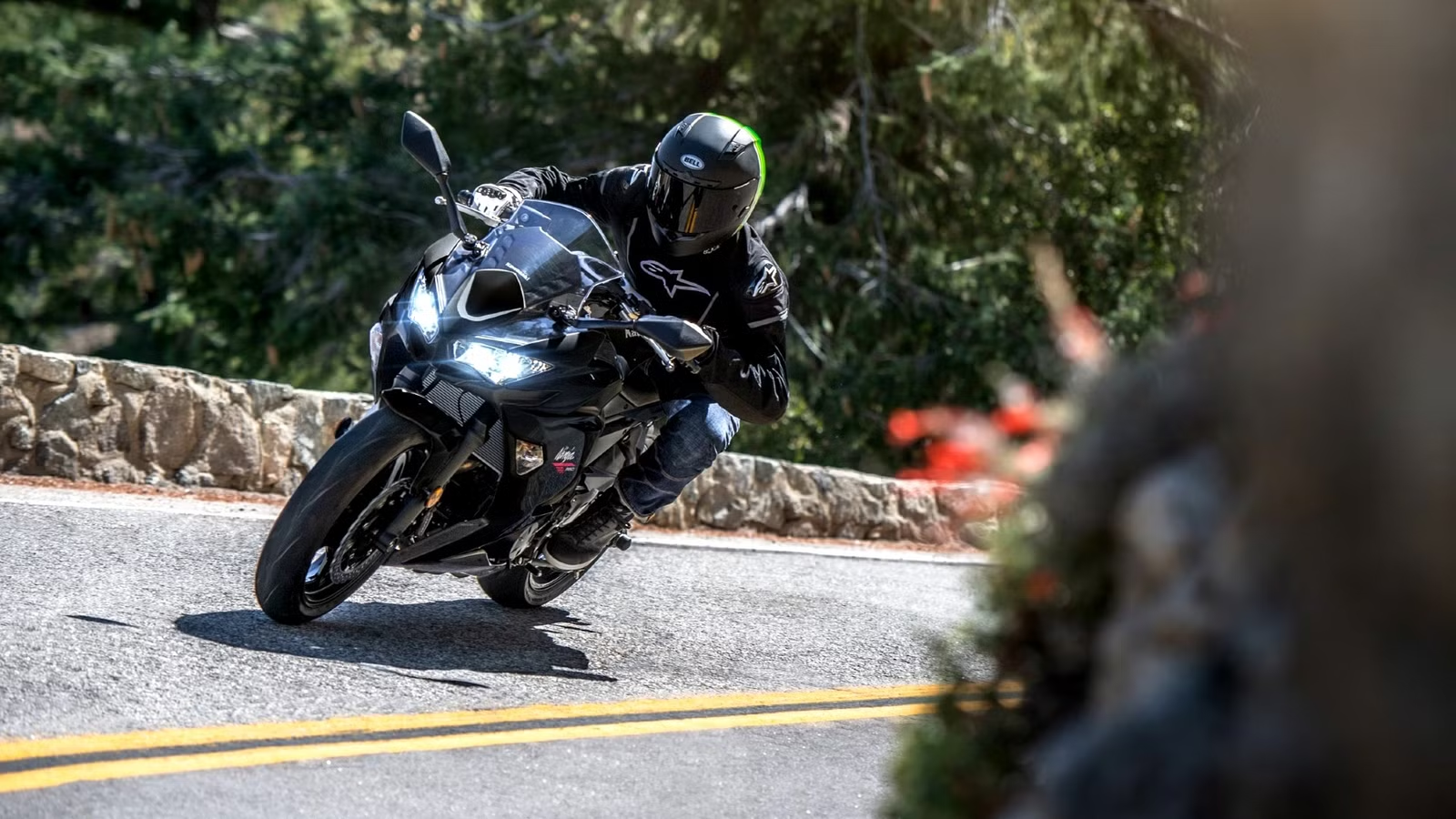
Sport bikes have a strange habit of making an excellent first impression and a much less convincing second one. Low clip-ons, high footpegs, stiff suspension, and aggressive riding positions look and work brilliantly when you’re chasing lap times, but those same ingredients can become increasingly difficult to appreciate an hour into a highway ride. Most owners aren’t spending every weekend at a racetrack, either.
They’re commuting, running errands, exploring back roads, and occasionally trying to cover a few hundred miles without needing a chiropractor afterward. What do you do then? Leave the sports bike dream to track aficionados? Well, no. You pick one of the comfortable sports bikes on sale, just like the Kawasaki Ninja we’re about to discuss.
Sport Bikes Don’t Have To Punish Their Riders
2026 Yamaha YZF-R1 Cornering On TrackYamaha Motorsports
For decades, discomfort almost became part of the sport bike experience. The logic made sense. Putting more weight over the front wheel improves feedback, high pegs increase cornering clearance, and a tucked riding position reduces aerodynamic drag. Those priorities matter when every fraction of a second counts. They’re considerably harder to justify when you’re crawling through traffic on a Tuesday afternoon or droning down an interstate with another two hours before the next fuel stop.
A road-focused sport bike needs a different balance. The bars can sit higher without turning the motorcycle into a cruiser, while a more natural peg position lets your knees breathe without destroying cornering clearance. A reasonably low seat makes stops less intimidating, and fairings can provide useful wind protection instead of serving purely as aerodynamic bodywork. None of that removes the fun. If anything, a motorcycle that’s comfortable enough to ride longer gives you more opportunities to actually enjoy its performance.
The Sweet Spot Is Somewhere Between Supersport And Sport-Touring
A 2024 Triumph Daytona 660 cornering on a mountain roadTriumph
Going to the opposite extreme doesn’t necessarily solve the problem. Full-size sport-tourers are magnificent mile-eaters, but they can also bring considerably more weight, physical size, electronics, luggage hardware, and cost than someone wanting a simple everyday sport bike actually needs. They’re designed to cross states with a passenger and luggage, which isn’t quite the same mission as making the morning commute enjoyable and then disappearing into the hills on Sunday.
The sweet spot sits between those two worlds. It needs enough power to make highway passes effortless and back roads entertaining, but not so much that most of the engine’s potential is inaccessible outside a racetrack. It should steer lightly, remain manageable at parking-lot speeds, and offer enough wind protection for longer rides. Most importantly, comfort should come from smart packaging rather than simply making the motorcycle larger, heavier, and more complicated.
The Kawasaki Ninja 650 Finally Gets Sports Bike Comfort Right
Kawasaki
Enter the Kawasaki Ninja 650. It wears the angular bodywork, upswept tail, twin LED headlights, and unmistakable visual identity associated with Kawasaki’s Ninja family, but underneath those fairings is a motorcycle designed primarily around road riding. Rather than imitate the company’s ZX supersports, it combines that styling with an upright riding position, a thick passenger seat that also supports the rider’s hips, and a low windshield positioned to provide useful protection at speed.
It’s also relatively accessible budget-wise. The 2026 Ninja 650 carries an MSRP of $7,599 without ABS or $8,199 with ABS. Seat height is a manageable 31.1 inches, while the bike measures 80.9 inches long, 29.1 inches wide, and 45.1 inches tall. Ground clearance is 5.1 inches, and the wheelbase spans 55.5 inches. Depending on emissions specification and ABS, curb weight ranges from 421.2 to 425.6 pounds, keeping it well short of heavyweight sport-touring territory.
There’s Still Enough Performance To Keep You Entertained
Graphenesteel Gray 2023 Kawasaki Ninja 650 cruising on a mountain roadKawasaki
Comfort wouldn’t matter much if the result were boring, and the Ninja 650 still has enough muscle to make its bodywork more than cosplay. Its liquid-cooled, DOHC, eight-valve 649cc parallel twin produces 67 horsepower at 8,000 rpm and 48.5 pound-feet at 6,700 rpm. Bore and stroke measure 83.0 x 60.0mm, compression ratio is 10.8:1, and fueling comes through dual 36mm Keihin throttle bodies. Power reaches the rear wheel through a six-speed gearbox.
Those numbers aren’t intended to threaten a ZX-6R. And you could argue that that’s actually the point. The twin is built around responsive midrange performance, giving riders useful acceleration without demanding that they constantly chase the upper end of the tachometer. An assist-and-slipper clutch lightens lever effort while helping reduce rear-wheel chatter during aggressive downshifts. Kawasaki Traction Control adds two selectable intervention levels, with Mode 1 intended for sportier riding, Mode 2 providing more assistance in difficult conditions, and the option to switch KTRC off entirely.
The Chassis Prioritizes Confidence Over Lap Times
An orange 2025 Kawasaki Ninja 650 mid-cornerKawasaki
Underneath the bodywork sits a high-tensile-steel trellis frame with a 24-degree rake and 3.9 inches of trail. Suspension is similarly straightforward, with a 41mm hydraulic telescopic fork offering 4.9 inches of travel and a horizontal back-link rear setup providing 5.1 inches, plus adjustable spring preload. There are no semi-active dampers or pages of suspension menus to navigate. Instead, Kawasaki sticks to relatively simple hardware aimed at predictable handling and everyday usability.
Braking comes from twin 300mm petal-type front discs with two-piston calipers, backed by a single 220mm petal disc and single-piston caliper at the rear. ABS is fitted to the higher-spec version. 17-inch wheels wearing Dunlop Sportmax RoadSport 2 rubber, sized 120/70 up front and 160/60 at the rear, round off the underpinnings. It’s a conventional package by modern standards, but that’s also part of the appeal. Nothing here adds complexity merely to pad the specifications sheet.
Its Biggest Strength Is That You Can Actually Use It Every Day
The Ninja 650’s practicality extends well beyond its riding position. Its 4.0-gallon fuel tank gives it useful range without making the motorcycle bulky, while the full-color TFT display provides a digital speedometer, bar-style tachometer, gear-position indicator, fuel level, range, coolant temperature, battery voltage, trip information, current and average fuel consumption, service reminders, and Kawasaki’s Eco Riding Indicator. The display can switch between black and white backgrounds and automatically adjusts brightness to suit ambient light.
Graphenesteel Gray 2023 Kawasaki Ninja 650 coming out of a curveKawasaki
Bluetooth connectivity through Kawasaki’s Rideology app adds access to vehicle information, riding logs, phone notifications, and certain settings. There’s also the convenience of twin LED headlights, a comfortable passenger perch, and the option of ABS without forcing buyers into a more expensive equipment package.
The Kawasaki Ninja 650 Has Good Competition
Side angle static shot of the Suzuki GSX-8R parked on the racetrack.Suzuki
The Kawasaki Ninja 650 doesn’t have many competitors, but those that rival it are still excellent options. The closest one is the Suzuki GSX-8R, which is also powered by a parallel-twin engine. This Gixxer pumps out over 80 horses, delivers a punchier mid-range, and offers relaxed yet sporty ergonomics. The catch: it’s considerably heavier than the Ninja 650 and the design is not something many will like.
Triumph Motorcycles
The next rival is the Triumph Daytona 660, which adds one more cylinder for an inline-triple experience, with 95 horsepower on tap and a four-banger-like top-end rush. Like the Ninja 650, this sports bike also combines versatile ergonomics with sporty looks, but starting at $9,395, it’s a bit more expensive. And given the bike’s performance, it’s less approachable than the Ninja 650 and, being a Euro bike, maintenance will be more expensive.
Honda Powersports
The final rival for the Ninja 650 is the Honda CBR650R E-Clutch, which offers versatile ergonomics and a proper inline-four experience. It also features Honda’s E-Clutch system, which adds another layer of practicality to the bike. Like the Daytona, the CBR650R is expensive and less approachable than the Ninja 650. Plus, the bike’s higher-end underpinnings and four-cylinder layout result in higher maintenance costs compared to the Ninja 650.
Kawasaki
All four sports bikes here have something that no other rival offers. The Gixxer offers bulletproof reliability and punchy mid-range, the Daytona combines the best of both worlds, and the CBR is for those looking for an authentic inline-four experience. Where the Ninja 650 sticks out is by being a no-nonsense, comfortable, and versatile sports bike. And the bike nails that right on the head. There’s a reason why, despite being the least powerful and relatively basic bike in the segment, the Ninja 650 still has many buyers.
Less Is More With The Ninja 650
Kawasaki
None of those individual features makes the Ninja 650 revolutionary, and that’s arguably why the formula continues to make so much sense nearly two decades after it first debuted. Faster motorcycles exist. More sophisticated motorcycles exist. There are certainly machines better suited to a racetrack or a cross-country tour. But the Ninja rarely asks its rider to suffer for the privilege of owning something sporty. It delivers enough performance to stay entertaining, enough comfort to keep going when the road stretches out, and enough practicality to become transportation rather than a weekend toy.
Maybe that’s the part of sport-bike performance that’s too easy to overlook. Horsepower and lap times are easy to measure, but so is the number of miles you’re actually willing to ride. A motorcycle that leaves you fresh enough to take the long way home can be more rewarding in the real world than one that wins every spec sheet comparo. The Ninja 650 doesn’t make comfort an apology for reduced ambition. It treats comfort as one more reason to keep riding, which might be the most useful performance advantage of all.
Source: Kawasaki
