

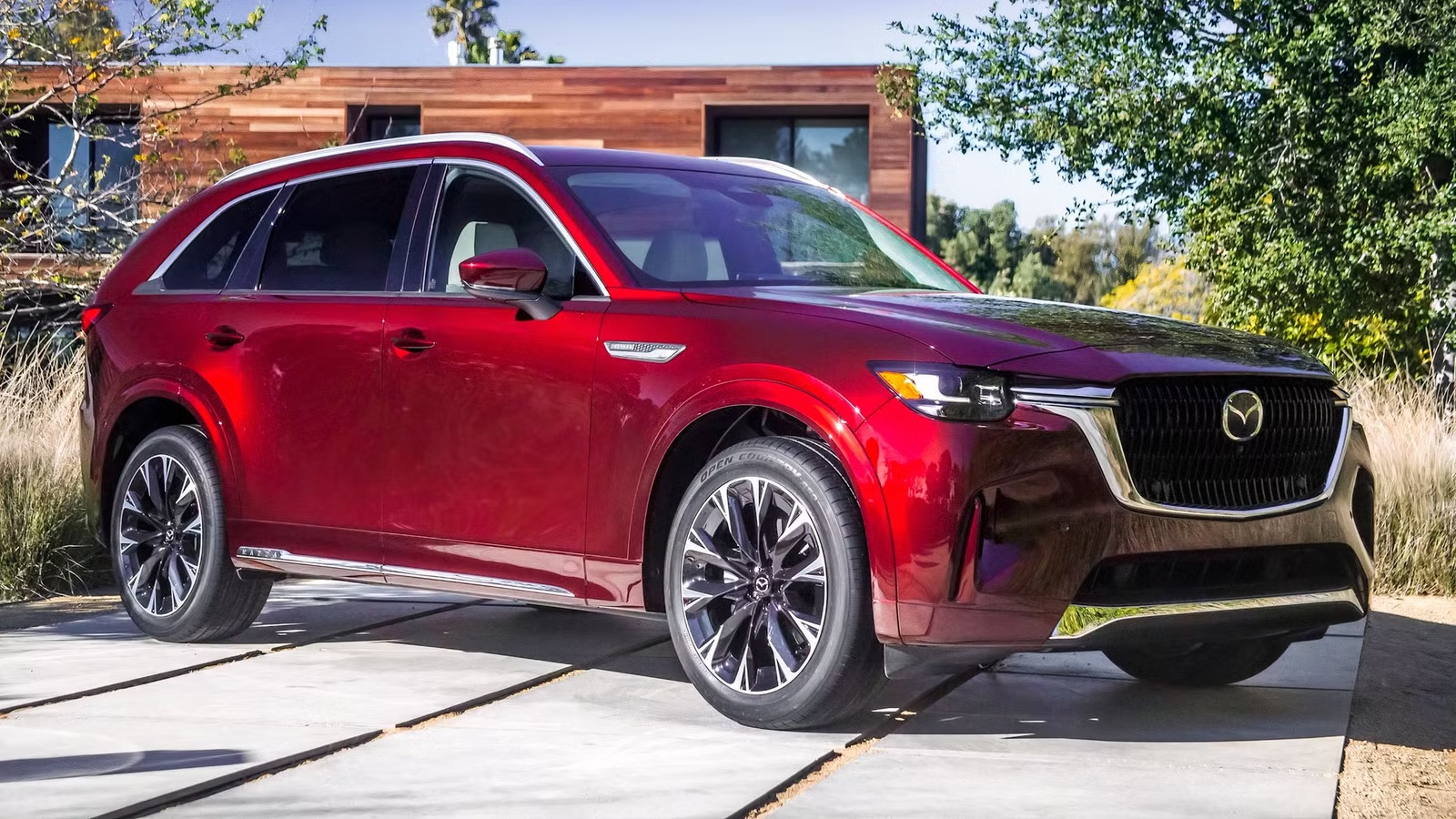
Mazda’s two flagship SUVs are in trouble, and the company knows it. Through the first seven months of 2026, the three-row CX-90 has sold 26,102 units — down 25 percent year over year — while the two-row CX-70 has fared even worse, sliding 28.1 percent to just 7,161 deliveries. CFO Jeffrey Guyton said plainly during Mazda’s latest quarterly earnings call that “that situation is not acceptable to us.”
What Guyton outlined as a response, however, is drawing skepticism. Rather than adjusting pricing, rethinking the plug-in hybrid lineup, or addressing powertrain concerns, Mazda’s rescue plan centers on safety messaging and unspecified “product enhancements” with no timeline attached. For buyers currently cross-shopping the CX-90 against a Toyota Highlander or Honda Pilot, that may not be the answer they were looking for.
Why the CX-70 and CX-90 Are Losing Ground
Front 3/4 action shot of 2026 Mazda CX-70 PHEV driving on roadMazda
The CX-90 launched for the 2024 model year on Mazda’s new rear-wheel-drive Large Architecture platform — a significant engineering investment built specifically with American buyers in mind. Early results were encouraging, with roughly 54,700 CX-90s delivered in its first full year. The CX-70 followed for 2025. Both models earned strong reviews for their turbocharged inline-six engines, premium interiors, and sharp handling.
But several headwinds arrived at once. Because both SUVs are built in Japan, they carry import tariffs — initially 27.5 percent before being reduced to 15 percent in September 2025. That same month, federal tax credits for plug-in hybrids expired, removing a meaningful purchase incentive from the CX-90 PHEV and CX-70 PHEV variants. The plug-in CX-90 starts at $50,695, which edges into luxury-brand territory at a moment when buyers are increasingly prioritizing value. Early reliability concerns, flagged by outlets including Consumer Reports, didn’t help either. Nor did packaging trade-offs inherent to the rear-wheel-drive platform: a higher cabin floor than front-wheel-drive rivals and a sloping roofline that compromises third-row space and cargo capacity relative to key competitors.
Mazda has responded with incentives — the 2026 CX-90 PHEV currently carries $5,000 customer cash plus $1,000 dealer bonus cash, or zero-percent financing for up to 72 months. The CX-70 PHEV matches that structure. Those are aggressive numbers, but they haven’t been enough to reverse the trend.
The Safety Bet — And What It Doesn’t Address
Profile shot of 2026 Mazda CX-90 parkedMazda
Guyton’s stated strategy leans on one of Mazda’s genuine strengths. The brand recently became only the third automaker — alongside Toyota and Hyundai — to earn 100 or more IIHS Top Safety Pick awards since the program launched in 2008. The redesigned CX-5 earned the institute’s highest Top Safety Pick Plus rating, and Mazda now claims more of those awards across its lineup than any competitor.
The plan is to transfer that safety credibility to the CX-70 and CX-90 through expanded marketing, while simultaneously rolling out unspecified product enhancements. Guyton said Mazda “intends to expand both the awareness and product appeal of large platform vehicles” but declined to provide details or a timeline for the updates.
What the plan conspicuously omits is any mention of powertrain changes, pricing restructuring, or a rethink of where the PHEV variants sit in the lineup. In a segment where the Toyota Highlander Hybrid, Honda Pilot, and Kia Sorento compete aggressively on value and practicality, telling buyers that the CX-90 is very safe may not move the needle. Safety ratings are table stakes in this segment — most mainstream three-row SUVs score well — and the CX-90’s problem has never been that buyers thought it was dangerous.
The Mazda3 Counterpoint Raises Uncomfortable Questions
While the flagships stumble, one of Mazda’s oldest models is having a breakout year. The Mazda3 — riding a platform that debuted in 2018 and now approaching its tenth birthday with relatively few meaningful changes — posted an 87.5 percent sales jump in July alone. The sedan variant surged 91.8 percent year over year; the hatchback climbed 77.4 percent. Year to date, the Mazda3 is up 28 percent.
The contrast is hard to ignore. With average new vehicle transaction prices hovering near $50,000 and interest rates still elevated, buyers are gravitating toward the Mazda3’s lower entry cost, better fuel economy, and lower total ownership costs. The CX-30 — essentially a raised Mazda3 hatchback — was the only Mazda crossover to avoid a July sales decline.
For buyers weighing the CX-70 or CX-90, the Mazda3’s resurgence raises a pointed question: is the problem with the flagships a matter of execution, or is it simply that the market has shifted in a direction that $40,000-plus SUVs with plug-in complexity are ill-positioned to follow? Mazda’s safety campaign doesn’t answer that. Neither does a vague promise of product enhancements with no delivery date.
For buyers currently cross-shopping in this segment, the practical read is straightforward. The CX-90 and CX-70 remain genuinely well-engineered vehicles with strong safety credentials and compelling interiors — and the current incentive structure makes them more accessible than their MSRPs suggest. Whether Mazda’s promised updates address the real friction points will depend on what those updates actually are. Until the brand provides specifics, shoppers comparing these models against the Highlander or Pilot should factor in that the product roadmap remains undefined.
