

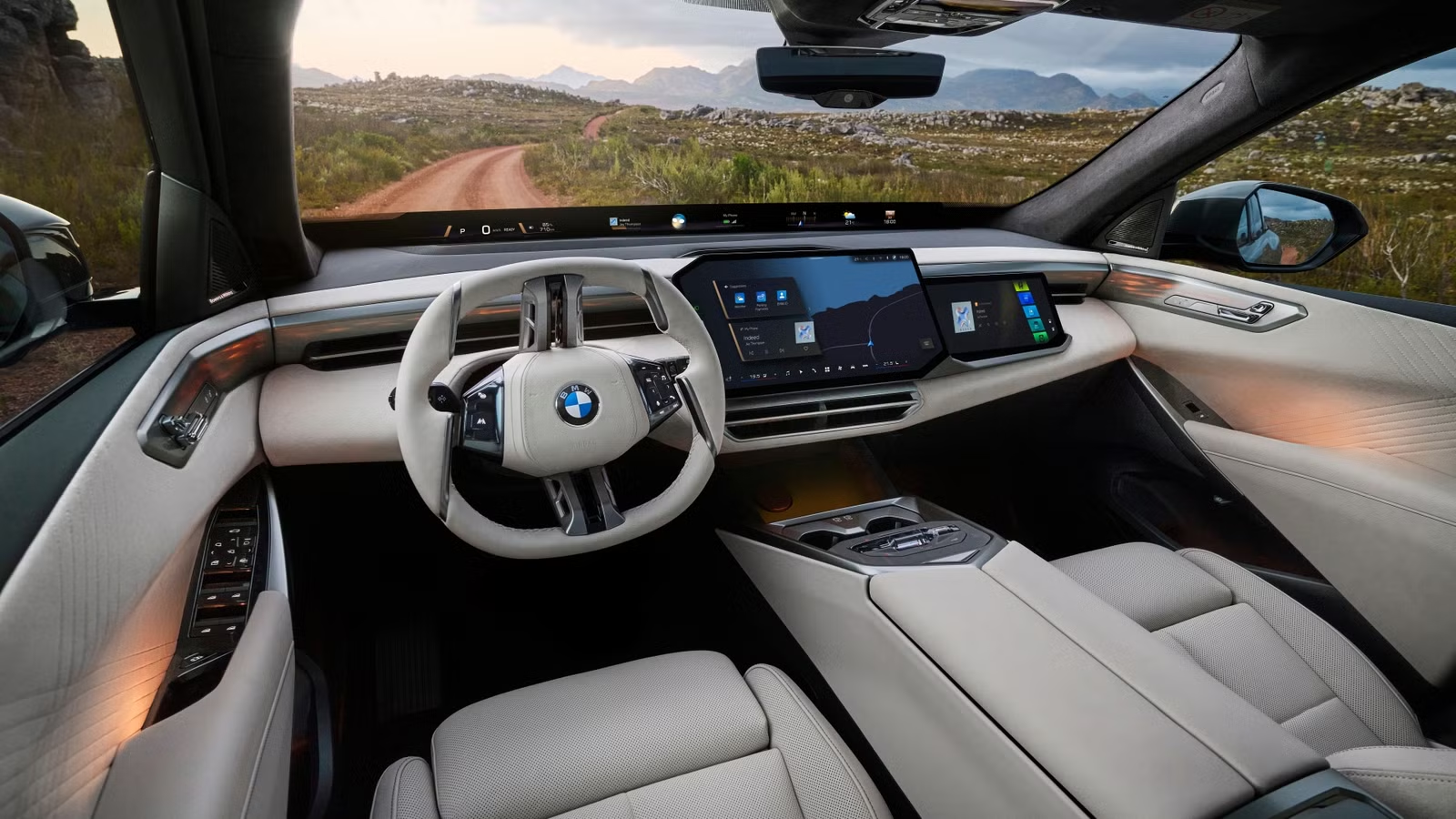
You know there’s trouble in River City when Americans who could afford to buy a luxury car not long ago are opting for mainstream brands today. How bad must a household financial event be when a person who owned a luxury car is willing to show their neighbors that such an extravagance is no longer on the table? Or are they merely making a smarter purchase decision?
Some owners of premium SUVs are shopping downmarket for their next vehicle.JD Power
That’s a tough question, but apparently one that US households are facing with increasing regularity as the average price of a new car continues hovering near the $50,000 mark, as average gasoline prices top $4 per gallon for several months, and as economic uncertainty has everyone on edge. But price alone isn’t pushing the Joneses to stop keeping up.
‘Emotional-Satisfaction Gap’ Is Growing
The latest sales trend analysis, as part of a JD Power Automotive OEM Intelligence Report, suggests the bloom is coming off the luxury car rose. The study finds that owners of premium vehicles are increasingly replacing them with mainstream midsize and compact SUVs, and that the “emotional-satisfaction gap” between premium and mass-market brands has narrowed sharply, as noted in the JD Power 2026 APEAL Study.
2024 – 2026 Buick Envista side angle in gray while parkedBuick
“Mainstream-brand vehicles have improved markedly, and they now deliver many of the technologies, conveniences and sensory details that once separated premium products from the rest of the market. Vehicle buyers are increasingly noticing this trend and acting on it.”
While JD Power notes “a measurable migration,” it also sees premium owners “simply choosing a different class of vehicle. Affordability is shaping what they buy rather than whether they buy.”
JD Power chart showing premium car shoppers by ageJD Power
Adaptive Cruise Control No Longer A Luxury
And it’s no surprise that the highest defection rates are among younger and lower-income buyers (see chart above). Perhaps they really wanted the cachet of a luxury brand but then realized it wasn’t worth more than $1,000 a month – a common payment in this segment.
Mainstream vehicles priced much lower are coming very well equipped with a raft of high-tech standard driver-assistance technologies that years ago were reserved for luxury cars. For instance, the 1999 Mercedes-Benz S-Class launched Distronic, the first radar-based adaptive cruise control. Today, you can spend less than $25,000 on a Kia K4 LX, Nissan Sentra S, and Toyota Corolla LE for technology that is better than what was on the old Benz.
Chart shows how some owners of premium SUVs shopped downmarket for their next vehicle.JD Power
Who Really Needs The Premium Badge?
It’s not just young people who are questioning whether a luxury badge is worth it. The JD Power chart above shows that even shoppers with an annual household income over $500,000 traded their premium midsize SUV for a mainstream one. These shoppers are saving big bucks, trading their premium vehicle that costs on average $70,600 for a mainstream alternative costing an average $51,500. JD Power says these customers discovered that “the mainstream-brand vehicle provides enough of the desired experience to justify giving up the premium badge.”
For the auto industry, this sales trend represents a double-edged sword: Lincoln, Cadillac, Audi, Acura, Lexus, Infiniti, and Genesis are among the luxury brands with certain vehicles that share underpinnings with mainstream brands owned by the same parent company.
2027 Mercedes-Maybach S-ClassMercedes-Benz
BMW, Mercedes Execs Must Be Losing Sleep
It’s smart engineering to develop another vehicle from one platform and charge more money for it, but that’s clearly risky, as the latest research confirms. It’s quite possible that smart shoppers who bought a Cadillac XT6 a few years ago know they could be perfectly happy with its sibling Chevrolet Traverse or Buick Enclave, while saving money. In this case, General Motors can at least be glad the customer stayed in the fold, rather than bolting for another brand.
The other edge of this sword cuts more deeply for the dedicated luxury brands – namely BMW and Mercedes-Benz – that have no mainstream platform feeder marque to which their customers can retreat and save money. If BMW and Mercedes-Benz shoppers can no longer afford German luxury, then their money will go further with Volkswagen or another mainstream brand.
2026 Lexus RX 500h F Sport PerformanceLexus
CarBuzz Insight – Why This Matters:
Even people with full bank accounts want to save money. The latest JD Power report suggests many well-financed shoppers are discovering that luxury brands aren’t all that special, and that there’s nothing wrong with shopping downmarket for their next vehicle. Who cares what the neighbors think of your new Honda Accord?
The brand execs in Munich and Stuttgart must be losing sleep over this study, even if their own research has been painting a similar picture for years. In response, their product development teams need to think more about mainstream brands as rivals, which means offering gotta-have styling, technology, or performance that can’t be found in common cars. Priced competitively, of course.
Source: JD Power
