

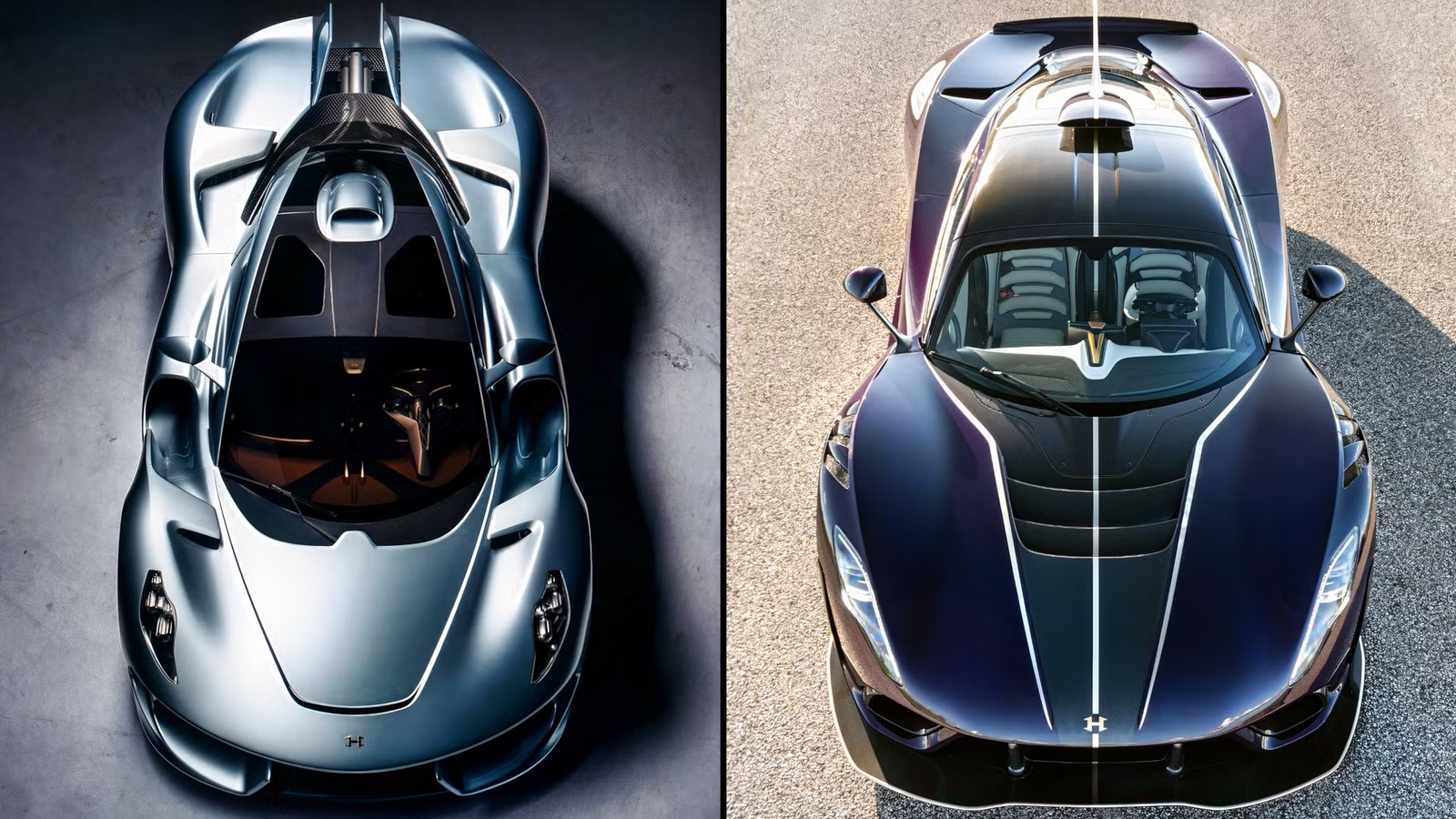
Hennessey Special Vehicles rewrote the rulebook when it introduced the Venom F5. The carbon-clad Texan missile has gone on to produce north of 2,000 horsepower, hit speeds in excess of 270 mph, and dart from 0 to 60 mph in less than three seconds, proving that smaller manufacturers without decades of proven success can still arrive and disrupt the industry.
Surprisingly though, Hennessey’s next chapter shoots off in an entirely different direction. The recently announced Blackbird doesn’t care for speed records and blistering track times, and so naturally, there are some key differentiators between it and the mighty Venom F5.
Hennessey Drops The Turbos
Powering the Venom F5 is a twin-turbocharged 6.6-liter V8, best known as the Fury V8, which even in its most docile state produces an other-worldly 1,817 horsepower. Step up to the Evolution or F5-M grade of the model, and that output soars to a scarcely believable 2,031 horsepower, seeing it pinch the title as the world’s most powerful manual-equipped production car, in F5-M guise.
Instead of building upon these figures, which Hennessey Director of Design Nathan Malinick admitted was likely the most expected route for the firm, Hennessey instead decided to turn things down a notch or two for the Blackbird.
“I think the expected thing for us would be like 3,000+ horsepower and 400 miles an hour and just more ridiculous numbers. But right off the bat, that kind of got eliminated as the path forward because it would sort of make the F5 irrelevant and do a disservice to our customers”
– Nathan Malinick, Hennessey Director of Design
In place of that expected-yet-fictitious 3,000-horsepower V8 lies a boost-free 6.2-liter unit, developed with assistance from IndyCar builder Ilmor Engineering specifically for the Blackbird. The naturally aspirated mill does away with four-figure horsepower, and instead zeros in on linear throttle response, instant engine feedback, and a redline that sits somewhere north of 9,000 rpm.
The expected final output is to be somewhere in the region of 800 to 850 horsepower, so the Blackbird is certainly no fancy paperweight, but the lack of turbochargers and distinctly lower output jumps out as one of the more obvious differences between these two hypercars.
Three Pedals And A Gated Shifter
Hennessey Blackbird interiorHennessey
Now, it’s worth clarifying that yes, Hennessey did equip 12 Venom F5-M Roadsters with manual transmissions, so the three-pedal setup isn’t totally exclusive to the all-new Blackbird. However, the Venom F5 was initially designed with a paddle-shift transmission, designed to handle the insane four-figure horsepower and lb-ft outputs that it’s capable of producing. Bar those 12 F5-M models, this is the transmission sending grunt to the wheels in all Venom F5 models.
The Blackbird, in its ever-relevant search for analog driver engagement, instead swaps the capable paddle-shift setup for a real six-speed manual. That’s right, there are no drive-by-wire or simulated setups here, just a good old-fashioned gated six-speed ‘box, with three pedals at the driver’s feet, with exposed linkages thrown in for good measure. It’s probably not as quick or as clever as the automated alternative, but that’s not what the Blackbird is about, as this piece touches on shortly.
Hennessey Takes The Blackbird’s Cabin In A Distinctly Different Direction
Hennessey Blackbird interiorHennessey
There isn’t an awful lot going on inside the cockpit on a Hennessey Venom F5, and that’s no slight either. Think about it; in a 1,800+ horsepower hypercar with a theoretical top speed somewhere around 300 mph, the last thing a driver needs is an immensely complicated interior. So, for that reason, the F5’s minimalist and digital approach makes sense.
Similarly, the Blackbird has a cockpit tailored for its ultimate intended purpose of driving enjoyment. Touchscreens might be space-savvy and cost-effective, but neither of those traits drives driver enjoyment. So, Hennessey has removed all screens from the interior – save for a homologation-required back-up screen in the rearview mirror – and opted for a far more analog approach.
Hennessey Blackbird interiorHennessey
A large analog central tachometer sits front-and-center, complemented by physical dials, an unadorned steering wheel, and a real key the driver has to physically insert and turn in the ignition barrel. Some might call it old and outdated, but they would be wrong. This is a very deliberate choice, one that provides the Blackbird with oodles of character, and a far more inviting overall cabin feel.
Comfort, Touring And Practicality
Whereas the Venom is a stiff and noisy vehicle that offends the senses, aimed solely at providing high-speed thrills, the Blackbird will boast an entirely different on-road character. It will absolutely prove to be a hoot on track and indeed in a straight line — we have no doubt — but it’s been built with real-world usability in mind as well. Helping it to achieve that goal is its all-new carbon tub, purpose-built for the application, and wider than the Venom’s which precedes it.
Hennessey Blackbird exterior detailsHennessey
As a result, fortunate owners can expect to find considerably lower NVH levels inside, an adaptive suspension setup more geared toward comfort and long-distance touring, and even an abundance of cupholders; this could almost be a daily driver. Furthermore, nestled within the rear fenders is dedicated storage space ideal for a couple of weekend bags, while two full-size carry-on bags can fit within the frunk. There’s even space to stow a cowboy hat behind the seats.
The overall structure of the vehicle has been designed with grand touring in mind, so 800 miles in a single day should be achievable in comfort; a prospect that would likely shake the teeth out of Venom owners.
Aerodynamic And Styling Differences
Hennessey Blackbird exterior detailsHennessey
Once again, everything that features upon the Venom F5 has to be geared toward ultimate performance, whereas the designers have been able to express themselves differently with the all-new Blackbird. In place of the Venom’s gargantuan wings and high-speed splitters are design cues drawn from the Blackbird’s Lockheed SR-71 namesake.
Hennessey Blackbird exterior detailsHennessey
Its streamlined body sports active twin rear stabilizers that pop up automatically at 71 mph, angled at 71 degrees, while out the back pokes a diamond-shaped quad exhaust, itself inspired by the early Bell X-1 rocket plane. Another nod to the SR-71 can be found in the form of a speed-form of the aircraft worked into the dash top.
Hennessey Blackbird interiorHennessey
The Blackbird’s design also draws from the world of motorsport, in addition to aviation. The side pods on the doors clearly take inspiration from Formula 1, for example, as does the front splitter, which rises in the center.
In the end, Hennessey’s goal was not to create a technically efficient masterpiece, but to build something genuinely beautiful to look at. Malinick drew inspiration from various masters of automotive design when putting pen to paper on the Blackbird, citing Giorgetto Giugiaro, Marcello Gandini, Giovanni Michelotti, and Sergio Scaglietti as influences. Hennessey ensured storytelling and heritage were woven into the Blackbird’s design, rather than letting outright aero performance take the lead.
Production Philosophy And Customer Experience
Hennessey Blackbird exterior detailsHennessey
One was designed as a technological masterpiece, set to destroy records and place Hennessey on the map as a serious contender in the hypercar world, and not ‘just another’ tuning company with a healthy arsenal of big turbos and lofty goals. In complete contrast, the Blackbird purposefully ignores such aspirations, in an attempt to both avoid stepping on its big brother’s toes, thus disgruntling current customers, and to instead deliver a driving experience that’s largely ignored in modern hypercar circles.
Hennessey Blackbird exterior detailsHennessey
This story of differences is told not only in the direction of the build, but in real tangible differences, such as outputs, and interior features. Hennessey did not wish to build a car to out-Venom the Venom, as that would immediately render the predecessor redundant. Instead, the firm set out to produce the perfect complement to the Venom: a pure driver’s car capable of crossing great distances in great comfort, while ensuring immense enjoyment for anyone fortunate enough to find themselves at the controls.
Sources: Hennessey Special Vehicles.
