

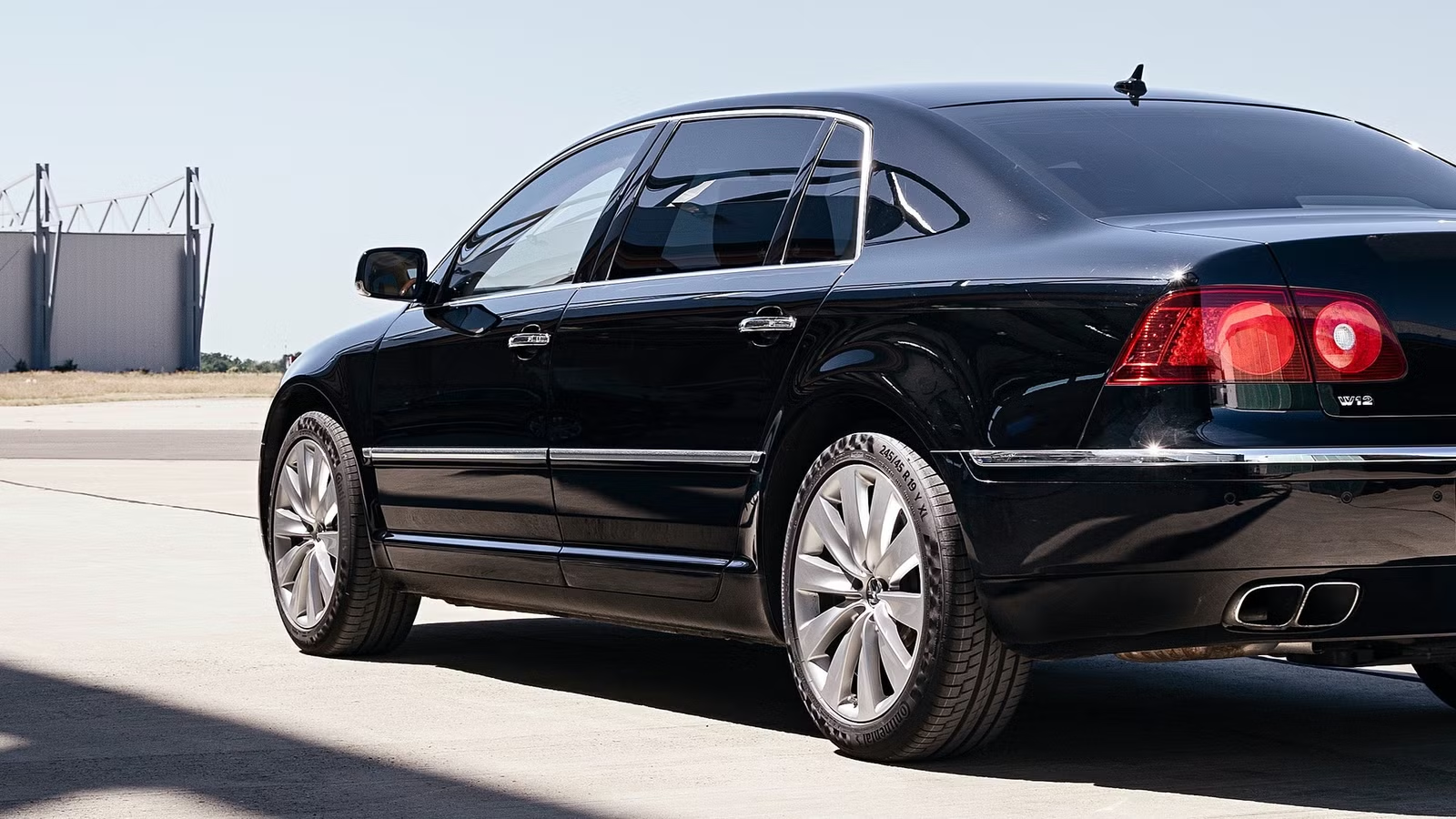
Best known for affordable icons like the Golf and Beetle, Volkswagen attempted the unthinkable at the turn of the millennium: building a world-class luxury flagship. The result was the Phaeton—a masterpiece of over-engineering that ultimately proved a sales disaster. Today, VW’s forgotten luxury experiment stands as one of the ultimate bargains on the used market. Let’s look at how Volkswagen’s boldest gamble unfolded.
Why Volkswagen Felt The Need To Challenge The Mercedes S-Class
2004 – 2006 Volkswagen PhaetonVolkswagen
The Phaeton was the brainchild of VW Chairman Ferdinand Piëch, built to counter Mercedes and BMW while elevating Volkswagen’s image. Named after a fast, agile horse-drawn carriage, Piëch envisioned an uncompromising flagship. His demands were legendary: absolute sleekness, extreme structural rigidity, and the ability to cruise all day at 186 mph in 122°F heat while keeping the cabin at a perfect 72°.
The Phaeton’s Crown Jewel: The W12 Engine
2007 Volkswagen Touareg in black W12 engine bayBringATrailer
At the heart of the Phaeton is a type of engine rarely seen in the automotive world, which stands out from the crowd thanks to its unique layout. The W12 was not the only engine available in the Phaeton’s lineup, which included a variety of different layouts, such as VR6, V8, V6, and V10.
Made by joining two VR6 engines on one crankshaft, the W12 was a high-performing, highly adaptable engine, which delivered power smoothly and lent itself well to luxury vehicles. It offered several advantages over other 12-cylinder units such as the V12, as its dimensions were more compact thanks to a shorter engine block.
It wasn’t the first VW to be equipped with a W engine, however. The Passat W8 was the first, and it failed for the same reasons the Phaeton did. At least VW had the opportunity to be the test bed for other brands. A twin-turbocharged W12 would go on to power several Bentleys, while the famous W16 turned Bugatti into the performance monster it is today.
From $100,000 Volkswagen, To $10,000 Budget Car
2004 – 2006 Volkswagen PhaetonVolkswagen
In the US, used values for the W12-powered Volkswagen Phaeton typically range between $10,000 and $25,000, depending heavily on mileage, service history, and condition. High-mileage or project-grade examples occasionally change hands below $10,000, but pristine, low-mileage W12 models sold on enthusiast auction platforms like Bring a Trailer can fetch between $20,000 and $35,000. That’s the same sort of money you’d spend on sedans like the Toyota Corolla and Honda Civic.
Considering the W12 originally carried a sticker price near $100,000, its depreciation curve has been staggering. However, this upfront affordability is deceptive. The 6.0-liter engine shares its mechanical architecture with Bentley models, meaning parts and maintenance remain exorbitantly expensive.
A single major electrical or mechanical failure can easily exceed the entire resale value of the car. Consequently, while the W12 Phaeton offers incredible luxury per dollar on paper, secondary market prices stay subdued because only brave enthusiast mechanics are willing to take on the risk of ownership.
The Major Mechanical Risks
2005 Volkswagen Phaeton sideVolkswagen
Maintaining a W12 Phaeton is notorious for eye-watering repair bills, primarily because the massive 6.0-liter engine leaves virtually no clearance.
- “Engine-Out” Labor: Simple repairs—like replacing oxygen sensors, alternators, or timing chain components—often require pulling the entire engine, triggering $3,000 to $7,000+ in labor costs alone.
- Air Suspension: Leaking air struts or compressor failures typically cost $2,000 to $4,500 to overhaul.
- Electrical Gremlins: Complex dual-battery systems and failing comfort control modules frequently cause phantom drains and electronic glitches, running $1,000 to $3,000 to diagnose and repair.
Why America Gave The Phaeton A Hard Pass
Volkswagen
The main reason the Phaeton failed in the US comes down to a fundamental conflict in brand identity. “Volkswagen” literally translates to “the people’s car,” and American consumers simply refused to spend $70,000 to $100,000+ on a vehicle carrying the same badge as an entry-level Golf or Jetta.
Beyond “badge snobbery,” the Phaeton suffered from understated styling. Despite its Bentley-derived platform and incredible engineering, it closely resembled a scaled-up Passat, failing to deliver the visual prestige luxury buyers expected. Additionally, Volkswagen’s dealership infrastructure was unequipped for ultra-luxury customers. Buyers paying six figures were subjected to mass-market service bays alongside economy cars rather than the white-glove treatment offered by Mercedes-Benz, BMW, or VW’s own sister brand, Audi.
Plagued by poor sales—moving roughly 3,350 units total—VW pulled the flagship from the US market after just two years.
Sources: Volkswagen
