

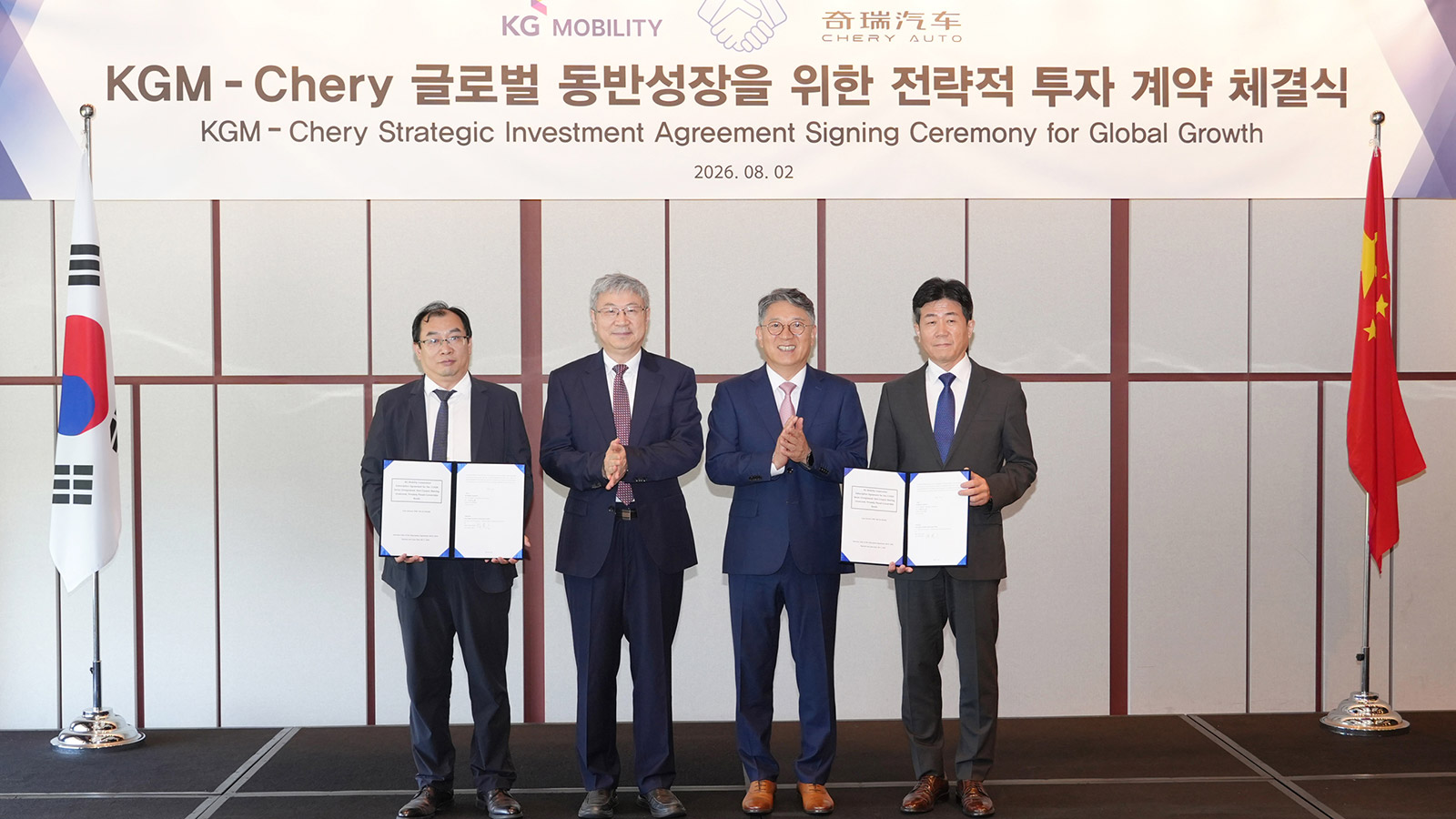
Chery and South Korean automaker KG Mobility Corp (KGM) signed a strategic investment agreement in Seoul on August 2, 2026. Credit: KGM
- Chery will invest $75 million via convertible bonds, which would give it about a 10% stake in KG Mobility if converted.
- The two will share overseas capacity and channels, extending cooperation into semiconductors, robotics and autonomous driving.
Chery (HKEX: 9973), China’s largest car exporter, has agreed to invest $75 million in South Korean automaker KG Mobility Corp (KGM), seeking a stronger presence in South Korea and a joint push into overseas markets.
KGM said Monday that the investment will be made through convertible bonds, which would give Chery a stake of about 10% if fully converted.
The signing ceremony was held in Seoul on August 2. It was attended by KGM chairman Kwak Jae-sun, CEO Hwang Ki-young, Chery Automobile chairman Yin Tongyue and Chery International president Zhang Guibing. Chinese Ambassador to South Korea Dai Bing was also present.
Chery has many manufacturing bases around the world, and these locations could become key areas for future cooperation between the two companies, Zhang said in Seoul. He said the two sides could explore sharing global production capacity.
Opportunities also include distribution channels and even brand-related collaboration, he added.
The deal is the latest example of Chinese automakers teaming up with established overseas carmakers. Through equity stakes or contract manufacturing, Chinese companies can tap underutilized local capacity and get around trade barriers.
One of Chery’s key objectives is to strengthen its presence in overseas markets, Zhang said.
KGM, formerly known as SsangYong Motor, ranks behind Hyundai, Kia and General Motors in the South Korean market.
The SUV maker sold more than 55,000 vehicles in South Korea and overseas in the first half, with exports accounting for about 60% of the total.
The first result of the partnership is a mid-size SUV codenamed SE-10, developed on Chery’s T2X platform.
Positioned as the successor to the KGM Rexton, the model is scheduled to launch in early 2027 with 2.0-liter gasoline and plug-in hybrid (PHEV) versions.
The investment follows a platform license agreement in October 2024 and a joint development agreement for mid to large-size SUVs in April 2025.
The two companies have also decided to pursue a second joint development project, aiming to develop strategic models that can be sold in major markets including South Korea, China and Europe.
Beyond vehicles, they will set up task forces involving top management to explore cooperation in semiconductors, robotics, raw materials and steel. In automotive semiconductors, the two agreed to discuss joint investment and development.
The companies also agreed to discuss joint investment in overseas production and business bases, mutually utilizing each other’s production facilities, supply chains, and sales and service networks.
Chery sold about 2.8 million vehicles globally last year and exported about 1.34 million, up 17.4% year-on-year, ranking as China’s No. 1 passenger car exporter for the 23rd consecutive year.
Its export momentum is still accelerating. Chery Group exported 202,533 vehicles in July, up 70.1% year-on-year, becoming the first Chinese automaker to top 200,000 exports in a single month, according to data released yesterday.
Chery Group Monthly Overseas Sales 2024-2026
Month
2024
2025
2026
January
89,665
64,176
119,605
February
95,047
104,875
124,929
March
68,706
86,414
148,777
April
89,377
87,738
177,573
May
92,481
100,737
181,871
June
97,034
106,330
191,062
July
90,281
119,090
202,533
August
97,866
129,472
September
109,048
131,374
October
111,922
126,434
November
104,911
136,728
December
98,402
144,430
Chery Group monthly overseas sales
2024
2025
2026
Almost all of the growth came from overseas, however. Exports accounted for 73% of July sales, compared with 53% a year earlier. That implies domestic deliveries in July fell about 30% year-on-year.
Chery Group exported 943,817 vehicles in the first half of this year, up 71.5% year-on-year.
