

The biggest car news and reviews, no BS
Our free daily newsletter sends the stories that really matter directly to you, every weekday.
IndyCar is going through a renaissance in just about every aspect, from a changing and growing audience to new race additions, new teams, and perhaps the most impactful of them all, a new TV network partner. In fact, you could say the series has been slowly reinventing itself since Roger Penske took it (and the Indianapolis Motor Speedway) over in 2019. Last week, the debut of the IR28 marked the peak of this renaissance.
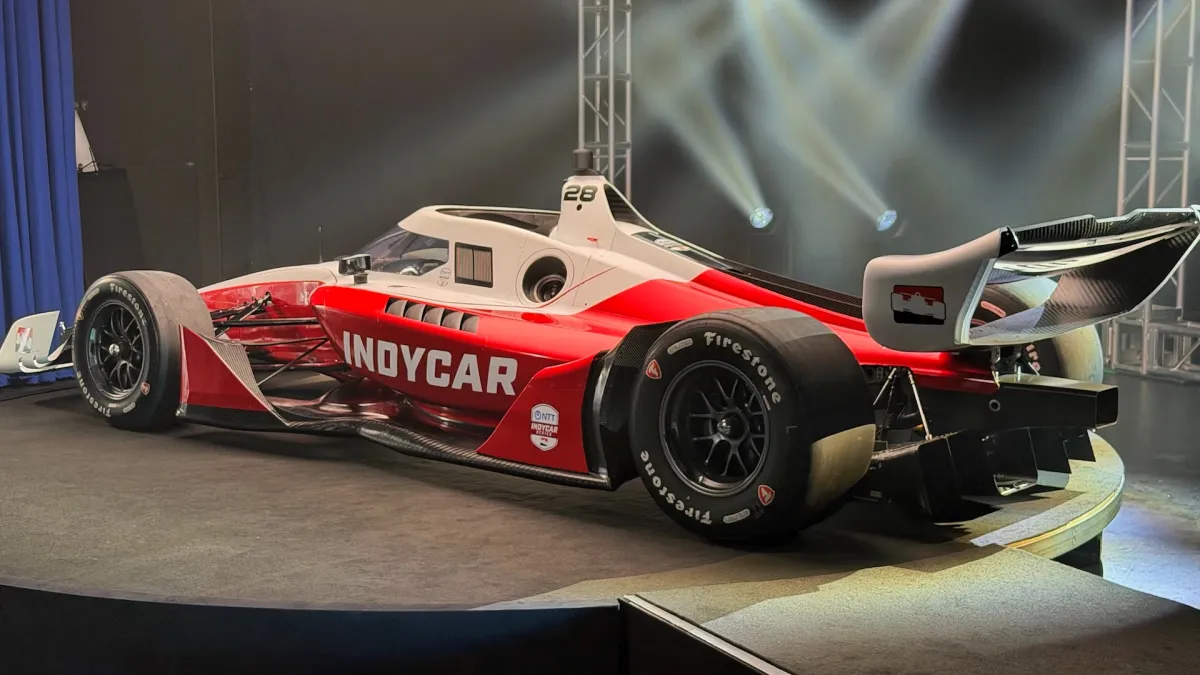
I had the opportunity to get up close and personal with the series’ 2028 racer over the weekend and can confirm that it’s an extreme departure from the current IR18, which, in itself, is an evolution of the DW12 made by Italian chassis maker Dallara. I can also confirm that it looks quite different (re: better) than the renderings released last week. In the metal, the IR28 is an extremely good-looking race car, but more importantly, it’s a safer, lighter, more advanced, and more moldable platform that will undoubtedly usher IndyCar into a whole new era—a better one.
Jerry Perez
Despite the series’ growth, its roster of famous racers who are slowly becoming nationwide stars (and in some cases, international), and headline-grabbing flagship races like the Arlington GP in Texas and the Freedom 250 in Washington D.C., there’s a feeling that IndyCar is still playing catch-up to other series like NASCAR and Formula 1, and that, at times, it’s just walking around in the dark.
The IR28 should go a long way in fixing that, bringing some fresh eye candy for all those new TV viewers, but also giving IndyCar some credibility by showing that top leadership is willing to invest in the sport long-term. I caught up with Mark Sibla, IndyCar’s senior vice president of competition and operations, to talk about why the sport needed a new racer, and why now?
“The biggest reason is: we’ve got a great product, but I think this can make it even better,” Sibla told The Drive.
“There can be more exciting racing, and that’s a key thing that fans will notice. I also think it gives us a reset not only on the chassis but on the engines, and that gives us a chance to go out and have some discussions with other engine manufacturers and see if we can get more folks participating,” he added.
Jerry Perez
Sibla hit the nail on the head. As the always spot-on Elizabeth Blackstock explained earlier this year, the partnership between IndyCar, Honda, and Chevrolet is likely the strongest it’s ever been—after all, they’ve agreed to continue investing in each other and the future—but it’s safe to say that all parties would love it if the throuple turned into a quad.
The IR28, Sibla explained, will have a three-year cycle of sorts, which should see “visual updates” to enhance the appearance and on-track action “to keep fans excited.” It should also appeal to potential incoming engine manufacturers, whether it be Toyota, Mercedes, or someone else. In 2028, the chassis will race as delivered; in subsequent years, the series may open up, or “unlock,” various components for team customization. This will be done to keep the racing fair, maintaining a relatively similar learning curve for all teams, and reducing the “haves and have-nots” that motorsport is so famous for.
New track records are another goal IndyCar is betting on. Whether it be the lap record around Laguna Seca or Long Beach, or a four-lap average qualifying speed around the Indianapolis Motor Speedway, improving on historic records will let everyone know that the IR28 is a proper race car worthy of carrying on the series’ legacy.
“I think people also love challenging track records,” Sibla added. “Fans love seeing things like that and seeing historical moments—and that’s what that car is designed to do. And while visually everything’s subjective, I think [having a new look] is exciting and interesting to fans.”
Jerry Perez
Of course, beyond the hope that fans will like the look of the car, that it will break records, and that it will appeal to a currently non-existent third engine manufacturer, there are more tangible reasons IndyCar needed a new race car. Safety is, per usual, at the top of the list. The new car incorporates all of the DW12’s safety elements into its core package rather than offering them as “add-ons,” like before. Things like underbody air ducts, flaps, and spines to keep cars from spinning, tumbling, or flipping.
The new cockpit is considerably larger, allowing for a wider variety of drivers, more padding for safety and comfort, and one aspect all competitors will love: better cooling. There’s even a dedicated spot for a driver’s coolbox (for the cool suit). And lastly, my two favorite features: the aeroscreen, which, for the first time, has been fully integrated into the chassis from the get-go, and the lighting elements (built-in flashing lights in the rear wing and the digital number panel on the side of the car).
The IR28 made an appearance this weekend at the Indianapolis Motor Speedway’s road course with the series’ two Alexes: Rossi and Palou. These tests were merely shakedowns and not representative of any performance margins, as the engine powering the one-off chassis (for now) is not the spec that will run in 2028. IndyCar will hold three more tests this year at various tracks to get a feel for the chassis on a road course, short oval, and street circuit.
Got a tip? Email us at tips@thedrive.com
As deputy editor, Jerry draws on a decade of industry experience and a lifelong passion for motorsports to guide The Drive’s short- and long-term coverage.
