

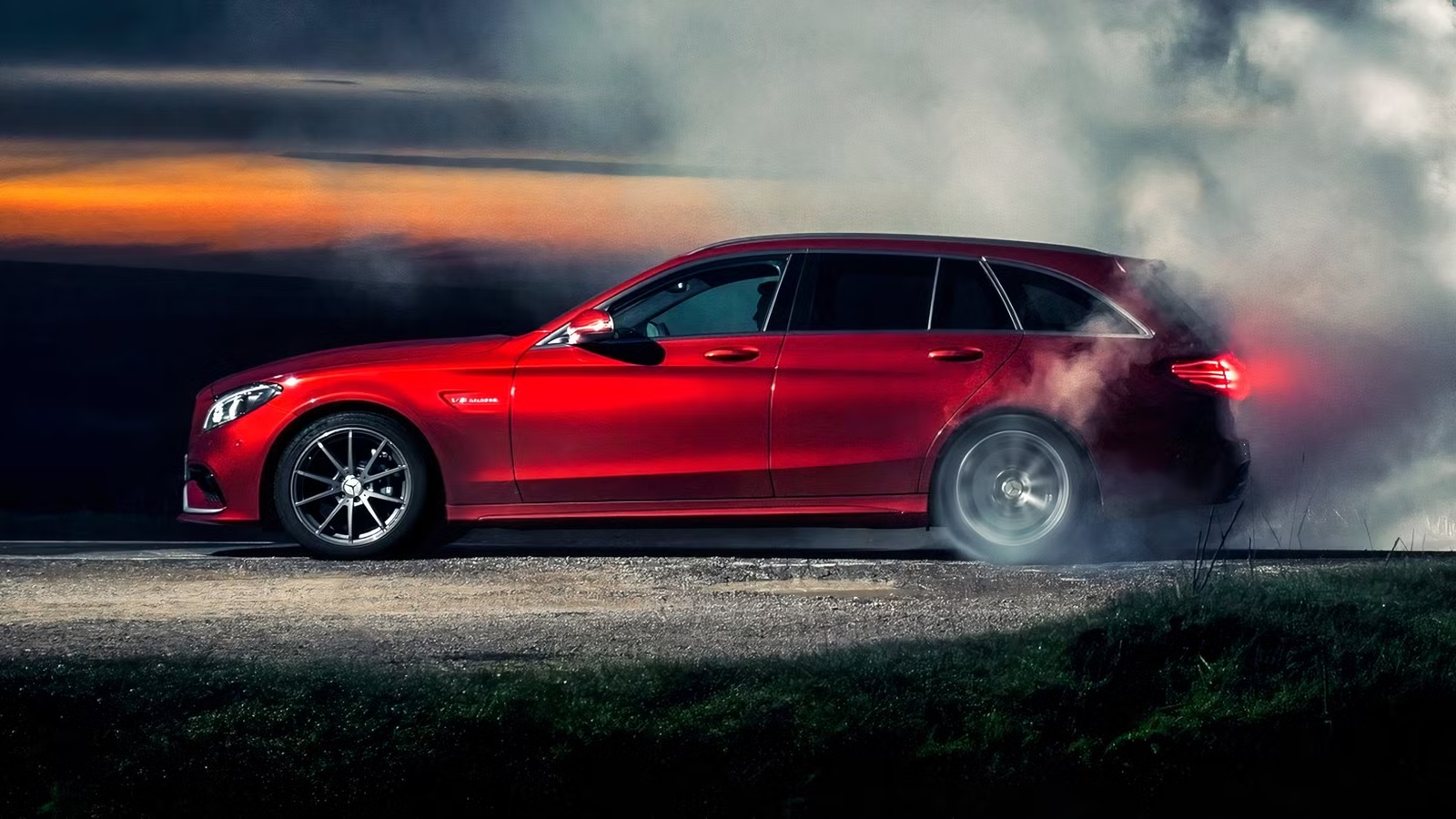
Performance wagons have never stopped being cool. They couple everything that’s desirable about a fast sedan or coupe – powerful engines, a low center of gravity, and an array of lap-time-improving mechanical tweaks – with a body style capable of ferrying the kids to school with a trunk full of groceries.
While US automakers have certainly dabbled in the world of fast wagons, it would be hard to argue that the Europeans don’t do a better job of it. Rather than one-hit wonders like the CTS-V and Magnum SRT8, Europe has blessed us with multiple generations of RS Avants, AMG-tuned monsters, Bavarian powerhouses, and Swedish surprises. While America moved on from its wagon ways, Europe never gave up, and here’s why.
Wagons Never Got Boring In Europe
The iconic Volvo 850 T5-R station wagon. It was not only a practical and fast road car, it attracted a huge following when it went racing too.Volvo
In the US, wagons developed a real image problem. They used to be pretty cool, certainly in the 1960s and 70s, but as the years progressed, the wagon quickly became the go-to family hauler which only cared about practicality. Style and performance stepped aside as comfort and efficiency stepped in, and by the 80s onward, the majority of wagons were devoid of any real personality, although they remained a sensible choice for commuters and families.
Over in Europe, practicality remained at the forefront of the wagon’s appeal, but premium automakers kept the segment desirable, ensuring driving enjoyment and style never left the conversation. There were still plenty of cost-conscious options on the market, which are easily forgotten today, but automakers such as Mercedes, Volvo, and BMW ensured the segment never got too dull. Upscale interiors, enticing inline-six powertrains, and driver-focused handling setups kept enthusiasts interested.
Cultural differences between European and North American motorists had an impact, too, with the latter preferring trucks and SUVs, while the former kept such vehicle types reserved for agricultural use almost exclusively, up until the late 1990s and early 2000s.Cultural differences explain part of the story – but the real reason Europe’s wagons never died is what their engineers did next.
Performance Wagons Transitioned Into Engineering Showcases
Performance wagons weren’t required to keep the segment alive in Europe, but they certainly helped to boost enthusiast interest. The Porsche-developed Audi RS 2 got there first, slotting a boosted inline-five turbo engine under the hood of an otherwise totally practical and perfectly sensible 80 Avant. Quite famously, the Audi RS 2 Avant was quicker to 30 mph than a McLaren F1, and it proved that blistering performance need not be reserved for impractical two-seat sports cars.
A short while afterward, Volvo helped pioneer the formula with a motorsport take on everyone’s favorite sensible family car. The modest 850 was transformed into the venerable T5-R, with the introduction of the Swede’s own turbocharged inline-five, which kicked out 240 horses –some way behind the RS 2’s 311, but it was still a formula that impressed. The 850 Estate (note, not the T5-R guise) then went on to enjoy some success on the track too, as part of the ever-popular British Touring Car Championship.
While many other automakers certainly dipped their toes into the performance estate waters, it was the Germans who really took the formula and ran with it, transforming everyday practical family cars into powerhouses that would eventually be capable enough to run on a par with supercars.
The Audi RS 6 and RS 5 Avant are prime examples, producing 621 and 639 horsepower, respectively, while the mighty BMW M5 Touring goes even further, with 717 hp on tap, courtesy of its plug-in hybrid power plant. In today’s world of soaring car prices, a supercar-rivaling fast wagon makes more sense than owning both a daily and a supercar; just save the cash and have both rolled into one.
Here’s What You’ll Spend Buying A Flagship Wagon In 2026
The supercar-wagon combination is certainly a tempting one, but it’s not within reach of many. A brand-new M5 Touring will set buyers back $123,900 before delivery charges and options, whereas pricing for the all-new RS 5 Avant hasn’t yet been announced, although it’s expected to be quite similar to that of the M5.
Shopping on the used market is a great way to save some cash, but modern super-wagons still command significant sums, even after a few years of depreciation. Our own Price Trends tool on the CarBuzz Marketplace reveals that a 2021 Audi RS 6 Avant still commands north of $80,000, putting it far out of reach for many.
Other alternatives are available, such as the Panamera Sport Turismo and E63 S Wagon, but finding a smart example that’s local could prove a challenge, given the relative scarcity of these cars.
America Walked Away From Wagons In Favor Of SUVs
rav4 hybridToyota
Wagons once used to line the suburban streets of America, but the reality of today’s roads is far different. Instead, crossovers like the Toyota RAV4 and Honda CR-V fill every parking space and driveway – at least the spaces that aren’t occupied by pickup trucks.
The rise of the crossover coincided with the decline in wagon sales, and the death of the minivan for that matter. Wagons just could not shake that minivans-before-minivans image in the US, and so performance wagons just didn’t make all that much sense, unlike in Europe, where they retained a premium image. Why would automakers bother investing heavily in developing high-performance wagons and trying to turn public opinion, when crossovers and SUVs were what buyers were demanding? Of course, wagons didn’t disappear completely, but fewer American automakers were bothering with them, while sales in other segments only seemed to explode.
2026 Cadillac Escalade IQL side angle in gray while parkedCadillac
Furthermore, with wider roads, bigger parking bays, spacious garages, and more room on the driveway, American motorists just didn’t have to prioritize space efficiency like Europeans did. Wagons were clever in how they packaged extra seats and cargo storage, whereas full-size SUVs could simply be big, and buyers enjoyed that no-compromise approach to practical motoring.
Enthusiast Support Keeps The Wagon Alive
2010 Mercedes-Benz C63 DR520 Wagon Exterior Finished In BlackMercedes-Benz
Fast wagons, and indeed wagons in general, haven’t gone anywhere in Europe. Sure, crossovers and SUVs are very much having their say, and are far more popular than wagons, but there still remains a smattering of both affordable and premium wagons for buyers to choose from in 2026. Furthermore, collector interest in notable models has been on the rise, and perhaps more interestingly, that interest is mirrored by US audiences.
Domestic models like the CTS-V Wagon and earlier Corvette-powered Buick Roadmaster have been gaining interest in recent years, with both now commanding significantly more than any sedan or coupe counterparts. Clearly, the appeal of an all-American performance wagon is high at the moment, and buyers are willing to pay tens of thousands more in some instances, rather than settle for more obvious alternatives.
2014 Cadillac CTS-V Sports Wagon Red Front Angled View Track DrivingCadillac
The same is true over in Europe. Not necessarily for American models, as they are simply too scarce to build mass desirability over there, but everything from the aforementioned 90s performance wagons to the latest and greatest options are commanding serious money. Whether it’s a manual-equipped V8-powered RS 4 Avant, an AMG-tweaked C- or E-Class Wagon, or an M-tuned Touring, enthusiasts are competing to own the finest examples at all price points.
For those with less ambitious sights, well-specified wagons in lesser trims are still hugely desirable. A regular 3 Series or A4 might not be able to match the brutish performance of an M or RS model, but the well-equipped cabins, accessible price points, and enjoyable driving dynamics ensure they continue to tempt buyers in their droves each year. Put simply, Europe never abandoned the wagon – fast or not. It has always existed as the more enthusiast-oriented alternative to cookie-cutter crossovers and unnecessary SUV ownership.
Sources: Mercedes-AMG, Volvo, Audi, BMW, Classic.com.
