

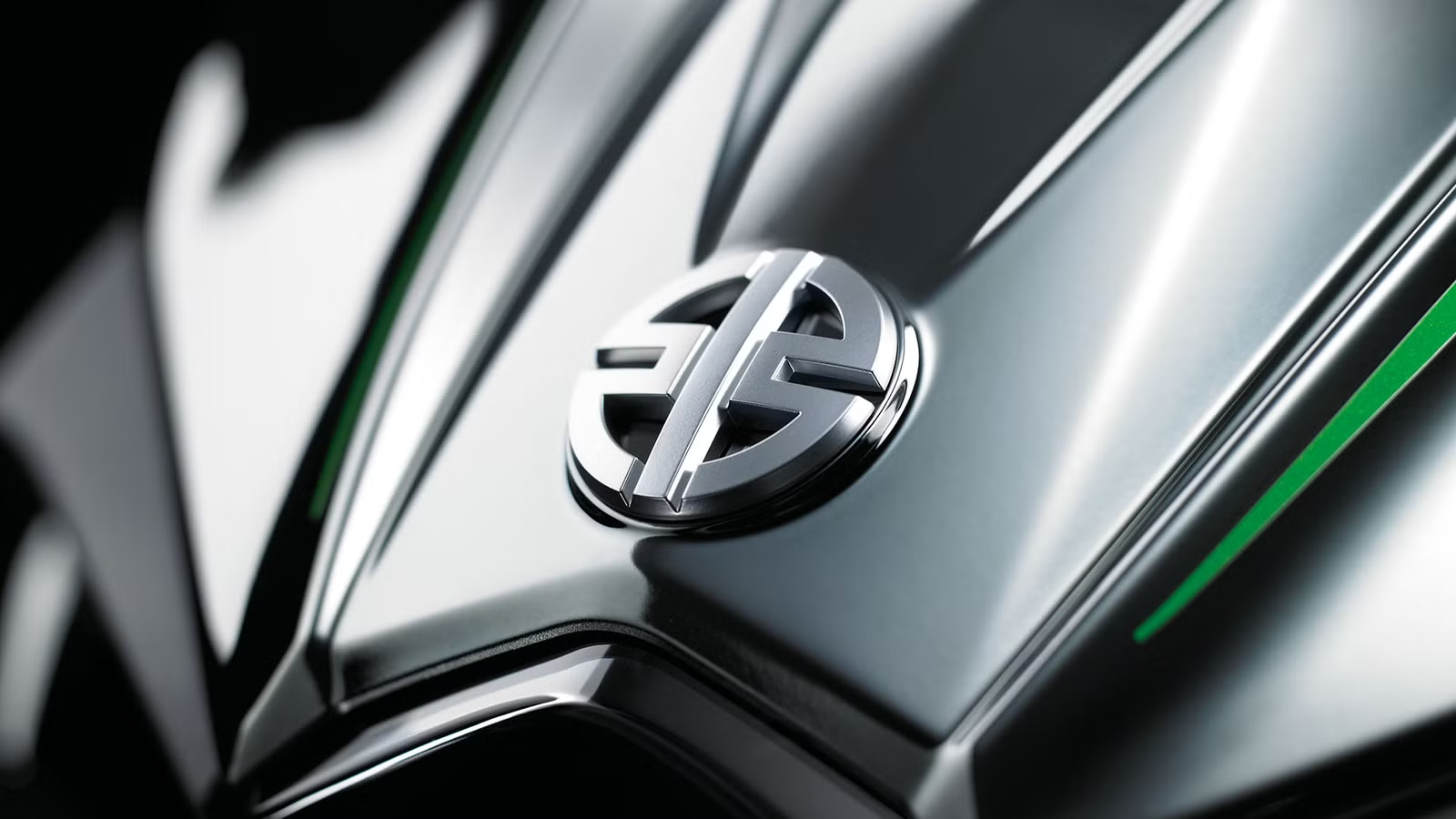
There was a time when manufacturers would squeeze out more performance with each generational update on their motorcycles. That world, however, is long gone. Today, manufacturers have a hard time keeping the performance output the same while meeting stringent emission norms. Even if they do manage to squeeze out more power, it comes at the cost of added exhaust system weight.
It’s no surprise these days that emission norms are choking motorcycles, particularly sports bikes. We’ve lost plenty of amazing motorcycles to such norms already, like the Yamaha YZF-R6. And those that have managed to stick around, manufacturers no longer see the point of spending resources and money on updating them. It seems the Kawasaki Ninja H2 and H2 Carbon are the latest victims of said emission norms.
The Kawasaki Ninja H2 Has Long Been The Most Powerful Superbike On Sale
A rider tucked-in and accelerating the 2026 Kawasaki Ninja H2 hard, side profile rolling shotKawasaki
The Kawasaki Ninja H2 is the pinnacle of performance as far as production motorcycles are concerned. It was designed to offer riders something they’ve never experienced before: ultimate performance. It had to deliver intense acceleration, a high top speed, and supersport-level circuit performance. To that end, Kawasaki had to develop something from the ground up, and with the help of Kawasaki Heavy Industries (KHI) Group, it developed a supercharged liter-class four-cylinder engine for the bike.
Kawasaki Ninja H2 SX close up engine shotKawasaki
Using its knowledge and database, KHI Group and Kawasaki motorcycles developed the supercharged inline-four engine that would go on to rewrite the rules of performance bikes. In its most performance-oriented state of tune on the H2 R, the engine delivers a mind-numbing 322 horsepower, sending the bike from 0 to 248.548 miles per hour in just 20 seconds.
The Kawasaki Ninja H2’s Supercharger impeller in detailKawasaki
For being road legal, the engine was tuned down for the H2, and it still managed to be the fastest two-wheeled thing you could buy with license plates. But as the Ninja H2 nears its 12th anniversary, that performance is going to be choked down for the first time ever. While Kawasaki is still keeping the H2 alive, the latest emission norms paint a bleak picture for what the bike will represent now and, by extension, the place of forced-induction engines in motorcycles.
The Kawasaki Ninja H2 Will Lose A Whopping 31 Horsepower For 2027
2026 Kawasaki Ninja H2 accelerating hard on the highwayKawasaki
Ever since Kawasaki unveiled the Ninja H2, its purpose was clear: to be the fastest bike in the world. For that, it has always been tuned to be more powerful with every update. In its first 2015 version, it produced 200 horsepower, followed by 204 horsepower in 2018, and then 228 horsepower in 2019. But for the first time ever, the Ninja H2 will backtrack on it due to the latest emission standards.
Right-hand side view of Kawasaki Ninja H2’s Engine, studio shotKawasaki
New documents have surfaced from both the Environmental Protection Agency (EPA) and the California Air Resources Board (CARB) that give us this clue. Both agencies have certified the H2 and H2 Carbon for the 2027 model year, and the leaked homologation documents indicate that the bike’s supercharged 998cc inline-four engine will drop roughly 31 horsepower to meet Euro5+ emission standards. This will take the bike’s performance from 228 horsepower to 197 horsepower, with peak power coming at 1,000 RPM lower.
Front view shot of the Kawasaki Ninja H2 riding on a bridge.Kawasaki
A point to note here is that Kawasaki quotes a peak power output of 240 horsepower for the current H2. However, its certification papers indicate that it produced 228 horsepower, a discrepancy that likely comes down to different testing procedures used by Kawasaki versus the agencies. So, to keep the comparison accurate, we are comparing the previous certified figure with the new one, not what Kawasaki claims.
The Reason The H2 Will Lose 31 Horsepower For MY27
Kawasaki
The reduction in power traces back to the exhaust system. As shown by the leaked documents, the upcoming H2 adopts the exhaust system of its naked sibling, the Z H2 SE, which features a second catalytic converter to handle the higher exhaust temperatures and dense exhaust streams that the supercharged inline-four engine produces.
Front angle shot of the Kawasaki Ninja H2 ABS riding on the roadKawasaki
Essentially, forced induction engines compress more air into the combustion chamber, which results in hotter and denser exhaust gases. That requires more aggressive catalytic treatment, which necessitates additional flow restrictions. That, thereby, restricts horsepower. The H2’s naturally aspirated rivals don’t have to face the same issue, as their exhaust volumes and temperatures are relatively lower and can be handled by a single catalytic converter to meet Tier 4 standards.
Emissions Might Not Be The Full Picture, Though
Guy Prickrell/TopSpeedKawasaki
Emission standards may not be the only reason for the H2’s power drop, though. By using the Z H2 SE’s engine and exhaust specifications, Kawasaki no longer has to manufacture and, more importantly, certify two very similar supercharged engines with different tunes and performance output. For Kawasaki, this should cut costs and simplify production. So, using the same exhaust system with a second catalytic converter makes the entire H2 lineup more unified.
New homologation codes (ZXT02W for the H2 and ZXT02X for the H2 Carbon) also confirm that Kawasaki is treating the 2027 model year as a new generation of the H2. As of right now, the manufacturer hasn’t disclosed any details, so we’ll have to wait to see if anything else will be changed on the next H2 and H2 Carbon.
Supercharges Are No Longer The Horsepower Cheatcodes They Once Were
Link Image
This is the first time Kawasaki’s halo supercharged platform has been dialed down for emission norms. And it comes exactly when the H2 nears its 12th birthday, which shows that not even the creme-de-la-creme hyperbikes are immune to ever-tightening emission standards. Even if they feature forced induction, which was once thought to be a cheat code of the horsepower wars. Today, it seems like Kawasaki’s supercharger has become a liability that its naturally-aspirated superbikes don’t share.
Back To Square One For The Ninja H2
Front three-quarter angle shot of the Kawasaki Ninja H2 ABS riding on an urban street.Kawasaki
Between its original power output and the 2027 model year, the Kawasaki H2 is making a full circle, making almost exactly the same power figures as the original H2. After significant power gains over a decade, the H2, in its 12th year, will return to having an engine that can only produce about 200 horsepower again. That’s a pity because it’s a serious 31 horsepower drop. A few ponies here and there wouldn’t have been noticeable on the road, but 31 horsepower is a little too much to ignore.
That brings us to the meat of the matter: the Kawasaki Ninja H2 will no longer be the top dog of the liter-class sports bike world. With just 197 horsepower at 10,500 RPM, the next H2 will drop lower than many of its naturally-aspirated rivals, which it was designed to beat in the first place. For instance, the Aprilia RSV4 1100 makes 220 horsepower, the Honda CBR1000RR-R Fireblade SP makes 214 horsepower, the Ducati Panigale V4 makes 213 horsepower, and the BMW S 1000 RR makes 210 horsepower. The H2 will now sit below all of them.
Other Supercharged Motorcycles Might Go Under The Knife Soon
Rider on a Kawasaki Ninja H2 Carbon riding on city road, front third quarter rolling shotKawasaki
It makes you question which forced-induction motorcycle will go under the knife soon? Fortunately (or rather, unfortunately), it’s not hard to guess. Kawasaki is the only manufacturer to make forced-induction motorcycles, including the H2 SX and the Z H2 SE. So far, they are safe, as only the H2 has been dialed down to match the Z H2’s output. It wouldn’t come as a surprise if the rest of the supercharged lineup goes under the knife in the next year or so.
Kawasaki Ninja H2 side profile studio shotKawasaki
Back when we wrote about the engineering secrets of this supercharged engine in December 2025, we predicted that superchargers (or forced induction) might save internal combustion engines. That hope is no longer visible. The not-so-restricted H2 might become a blip in motorcycling history as the ultimate motorcycling experience. Ask anyone who’s ridden one, and they’ll tell you about it.
With 30 ponies less, that will change. Will anyone top this? Definitely, manufacturers have always figured out how to make their production bikes more powerful. Only this time, it likely wouldn’t be a forced induction platform. It might be an N/A engine or something different… Perhaps a hybrid? That remains to be seen.
Source: Kawasaki
