

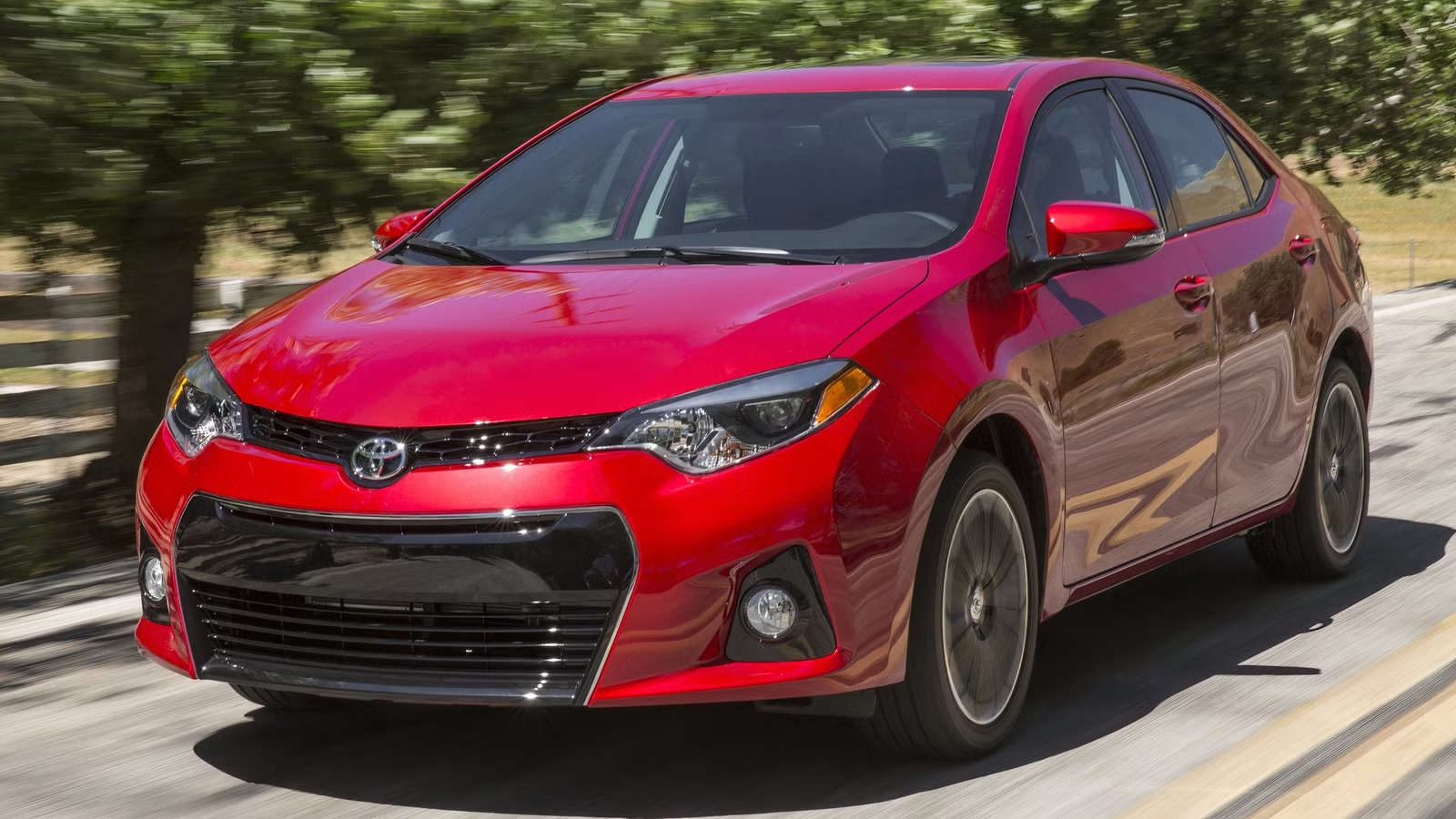
Many people have told us they don’t buy used cars because of the slim difference in price between new and used vehicles. Fair enough, but we think the times are changing fast. The average new car costs $50,900, countered only by the average price of used cars, which is just over $30,000.
If the new cars south of the posted average don’t work for you, there’s surely something available at the near-$21,000 discount on the used market to choose from. Tight on a budget? Don’t want to pay more than a car is worth? An older Toyota just might be the answer.
New Cars Now Cost More Than $50,000 On Average – And Tariffs Are Making It Worse
2026 Toyota bZ front quarterToyota
CarGurus’ Mid-Year Review for 2026 gives clear details on what sort of pressure is squeezing the car market enough to push the average price of a new car past $50,000. The average cost of a new car has risen 3.3% since December, according to the report, which also notes that the market had been hovering around this number since 2022. Digital Dealer, a dealership media resource, confirms the rising costs and discusses how a third of new cars carry an estimated monthly payment in excess of $1,000.
Before thechip shortagecaused by the COVID-19 pandemic, nearly half of all new cars had sticker prices at or below $35,000. In 2026, more new cars cost more than $50,000 than cost less. Driving forces include tariffs, which have raised the import duties on all vehicles with final assembly points outside the US, market preferences, and gradual phasing-out of cheaper models like sedans.
2017 Toyota Prius Prime exteriorToyota
Pushing the average new cost upwards are hybrid and electric vehicles, cars that automakers charge a small premium for compared to their conventional variants. On the used market, those premiums don’t carry over. Used EVs are everywhere, available at a significant discount compared to their original MSRPs.
Sure, there are still plenty of options below the $50,000 mark, but there are two issues that might arise depending on the type of car you need. Cheaper sedans and compact crossovers don’t fill the need as well as other types of vehicles might, like pickups, three-row crossover SUVs, and full-size SUVs (of which none start below $50,000). Either there are no cars cheap enough to justify buying new, or there are none that adequately fulfill your needs.
But rising prices alone don’t explain why used cars have become structurally superior — the real advantage is what you can actually buy for $30,000 today.
Discontinued Models Like The Yaris And Versa Are Your Secret Weapon On The Used Market
The Toyota Yaris iA is really a Mazda 2.Toyota
Not only will shopping for a used car offer more variety for the same price, but it opens the door to more models that either don’t exist on the new market or have been replaced with more expensive versions. A combination of buyer preference and attrition of models without replacements has caused some of our favorite nameplates to disappear from showrooms, but a plethora is still around for decent value.
Vehicles like the Toyota Yaris and Nissan Versa used to be the go-to options for basic transportation, but once those cars were discontinued in the US, no replacements were offered, forcing buyers into theCorollaor theSentra. Other marques that have done away with sedans altogether have forced returning customers into crossovers instead, where brands find the most profitability.
Pickups are also a commodity on the used market, something people are more than willing to pay a premium for when new. Trucks that hold their value exceptionally well become cheaper over time depending on overall condition and mileage, which is where things become complicated for shoppers who want reliable transportation on a budget and don’t want to overpay.
So if variety is on the used market’s side, the question becomes which brand is worth betting your reliability concerns on – and one name keeps coming up.
Why Older Toyota Models Are Your Best Bet
2016 Toyota Avalon Limited front 3/4 angle in blue while parkedToyota
Even if we presented you with all the figures fromToyota’s recalls over the last three years, they would paint a strong enough picture to get you to consider used models with proven track records. But recalls happen and aside from any growing pains brand-new models experience, the issue of cost is chief among the rest. A brand we’ve always presented as being one of the most reliable choices out there still holds that place in our hearts, and where it will help you most is on the used car lot.
If you could go back a decade and have your choice of new Toyota models, which would you take? The Avalon with its magic carpet ride? The Prius V and its 34 cubic-feet of cargo space? Maybe you’d like a Sienna with a 3.5-liter V6 and more cabin space than the latest hybrid-only variant? Point is, there was quite literally a Toyota for every conceivable need, and there still is if you’re looking for one at a discount. We even reported on a2016 Camrywith over 500k miles on the odometer and found out how these cars were built to last.
At this point in the lifecycle of each model offered in the mid-2010s, reliability was not in question. TheTacomaand4Runnerrelied on proven 3.5-liter and 4.0-liter V6 engines that showed no signs of trouble, the 7th-generationCamrywas about to enter its final year of production before being redesigned for 2018, and theTundrawas still soldiering on with a 5.7-liter V8. In case you haven’t picked up on it, Toyota was building cars that didn’t taint its decades-long tradition of building reliable cars.
That New Car Payment Is Too Good To Be True
2026 Toyota CamryToyota
Just to prove our point, let’s use Toyota as our example. A brand new Camry starts at $29,600 before destination and taxes. All Camry models are hybrid-only and come in two distinct flavors: luxury or sport. Base LE models earn the highest EPA fuel economy rating of 51 MPG combined, thanks to their limited features, which keep the weight comparatively low. Fabric seats and 16-inch wheels certainly help with that, but options like AWD, sunroof, and electronic features such as heated seats and auto-dimming rear-view mirror all cost extra and pinch fuel economy.
Jump up to the SE, which costs an extra $2,500 over the LE, and faux-leather seats, black 18-inch wheels, available larger infotainment screen, and rear-passenger vents seem like a deal compared to the bare-bones one. For an extra $2,700, you could jump up to the XLE where Toyota throws in leather seats and that large 12.3-inch center screen as standard. Don’t like the way the XLE looks? The XSE is just another $1,200 and puts a meaner face on the Camry and unlocks even more options.
Toyota Dealership At NightWikimedia Commons: Gennady Grachev
This is how most companies get buyers to look at the next trim levels, by spacing them out just enough that the more expensive model seems like better value for what you’re getting. Toyota isn’t the only brand to do this, and it is not exempt from the other tactics used by dealers to focus attention on monthly payments rather than the total cost of the car. When negotiating deals for new cars, it’s not always clear which features are standard and which cost extra, causing some confusion when you finally get the bill.
Used cars are almost always straightforward as to how much they cost and which features are present. Added features might not even affect the overall price of the car, something we try to remind new-car buyers who think a few optional features will hurt resale values.
Buying a used car might mean getting a car with far more features than a new one for less money, the trade-off being buying an older vehicle with some miles on it, but that doesn’t always mean the worst is lurking underneath. A used Camry, on the other hand, costs half as much and might even come fully equipped, depending on price and mileage.
For A $21,000 Discount, What’s The Catch?
2017 Toyota Highlander, front quarter view, silverToyota
The catch? In short, there isn’t one. It’s a decision based on comfort and preference, which is different for everyone, but the biggest misconceptions about used cars are reliability and warranty issues. Manufacturer-backed extended warranties are available for used vehicles, especially certified used vehicles which are required to pass specific inspections by the dealership.
Cars with miles on them are like shoes that have already been broken in. You’re likely to find a vehicle that has routine maintenance records and has been kept in good condition if you search thoroughly. As of 2025, the average age of cars on the road today was between 12–13 years old, and that’s not by accident.
More people are hanging on to their cars or buying older vehicles to cut back on ownership costs. No monthly payment, no paying interest on a depreciating asset. More life is left in a vehicle than people assume, and one of the brands out there that has proven to be worth the investment has always been Toyota.
Sources: Toyota, CarGurus, Digital Dealer, Kelley Blue Book
