

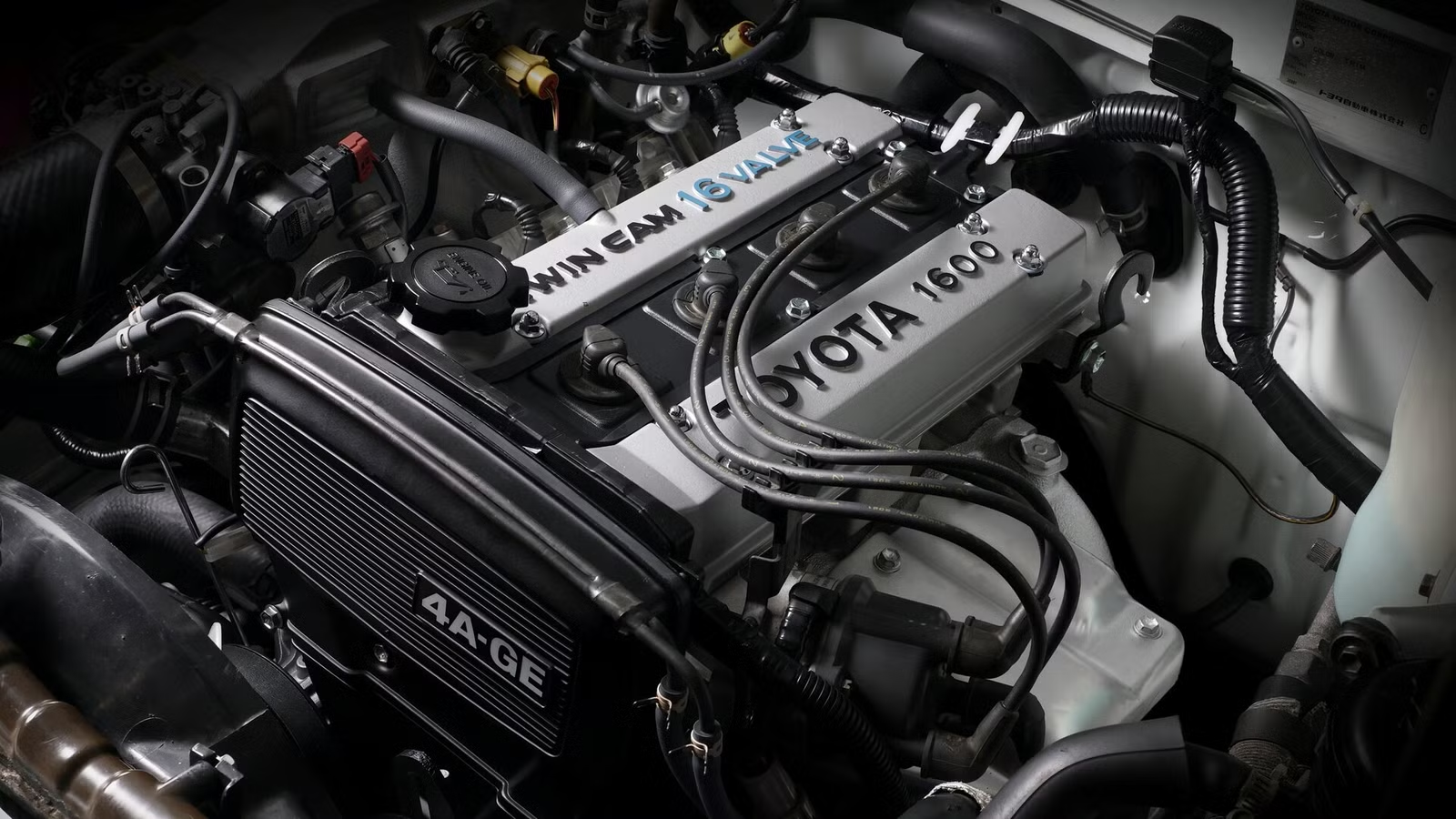
From Initial D to Hot Version, the legendary Toyota AE86 is a staple for many tuners and racers, and equally deserving of admiration among enthusiasts is what powers it: the iconic Toyota 4A-GE engine. It’s a lightweight, reliable, and high-revving engine that boasts a sharp throttle response and smooth power delivery that demands you to rev it all the way out to redline if you want to get the most out of it. Mechanically, then, it’s a bit different from the Boxer engine you’ll find in the new Toyota GR86.
Plus, the Toyota 4A-GE is a fantastic testbed to tune and modify to your heart’s content, with a thriving aftermarket modding scene and loads of pliability to eke more power out of it. The more time you spend looking at the Toyota 4A-GE specs, the more you realize that its horsepower and torque might not be outstanding on paper, even if you’re being generous. Rather, it’s how it creates and delivers all that power, and the way it tickles your heartstrings, that makes it such a special and beloved engine.
Toyota 4A-GE Specs, Features, & Technical Highlights
Toyota 4A-GE Engine Gazoo Racing (GR) Heritage PartsToyota
Produced from 1983 to 2000, there are five generations of the Toyota 4A-GE engine, all of which share a common base, one that makes it such a popular powertrain to this day. These are smooth, responsive, high-revving, high-performance 1.6-liter, inline-four twin-cam mills that boast exceptional reliability and tunability.
1st-generation Toyota 4A-GE Engine: Blue Top
One easy way to tell if you’re looking at the 1st-gen 4A-GE engine is the silver cam covers with black and blue lettering on the upper cover (“Blue Top”). It’s also referred to as the “Bigport,” as its intake ports occupy a notably large cross-section, which is ideal for race engines or highly modified engines that run at higher rpms. The downside is that at lower rpms, the decreased air speeds caused a significant drop in low-end torque.
Toyota 4A-GE Engine Gazoo Racing (GR) Heritage PartsToyota
To fix this, the Blue Top engines came with T-VIS (Toyota Variable Induction System), so at lower rpms, half of the dual intake runners remain closed, forcing the engine to draw in all of its air through just four runners in the intake manifold, raising its air speed. This way, the torque curve was kept intact in the low to mid rpms, letting you enjoy better drivability and performance across the entire power band, with a broad, flat torque curve.
North American Blue Top engines were less powerful thanks to strict emissions rules, as they cranked out a modest 112 hp at 6,600 rpm and 100 lb-ft of torque at 4,800 rpm. Meanwhile, the JDM-spec Blue Top 4A-GE engines were the most powerful, producing a much healthier 128 hp at 6,600 rpm and 110 lb-ft of torque at 5,200 rpm. Either way, you’re getting a screeching 7,600 rpm redline, pretty high for the 1980s.
The hero car of Initial D is the Toyota Sprinter Trueno GT-APEX (AE86) “Hachi Roku” three-door hatchback, driven by Takumi Fujiwara (though it was first owned by his father, Bunta). Specs-wise, the “Panda Trueno” originally appeared with a 1.6-liter, 16-valve 1st-gen “Blue Top” 4A-GE. It apparently had a light tune that gave it 150 PS (~148 hp), with a 7,800 rpm redline.
2nd-generation Toyota 4A-GE Engine: Red & Black Top
Toyota 4A-GE Engine Gazoo Racing (GR) Heritage PartsToyota
Improvements to the 1st-gen engine culminated in the 2nd-gen 4A-GE, and visually, the upper cam covers normally came with red and black lettering (“Red & Black Top”). Some of the major changes you’ll find include larger diameter bearings for the connecting-rod big ends, and four additional reinforcing ribs on the engine block (versus three in the Blue Top). Sadly, torque was actually slightly down across the board compared to the Blue Top.
North American Red & Black Top engines were still the least powerful, with power being raised slightly to 115 hp at 6,400 rpm and 97 lb-ft of torque at 6,800 rpm. On the other hand, the JDM-spec engines made 118 hp at 6,600 rpm and 105 lb-ft of torque at 5,200 rpm. These 1st- and 2nd-gen 4A-GE engines are highly desirable among tuners thanks to their wide availability, ease of modification, simple design, and lightness.
Close
3rd-generation Toyota 4A-GE Engine: Red Top
An easy visual identifier of the 3rd-gen Toyota 4A-GE engine is the silver cam covers with red lettering (“Red Top”). This marked the end of the 16-valve 4A-GE engine, notably with a high 10.3:1 compression ratio, raised from 9.4:1 in the earlier generations. Toyota also gave it redesigned intake ports in the cylinder head with a smaller cross-section to fix the air speed problems from before, hence its other nickname – the “Smallport.”
This also meant that T-VIS was gone, replaced with a simple single-runner intake manifold. Other revisions include new under-piston cooling oil squirters, thicker connecting rods, fully-floating gudgeon piston pins, and different piston ring sizes. This gave the Red Top an improved lifespan and better reliability, along with a power boost. North American Red Tops produced 130 hp at 6,800 rpm and 105 lb-ft of torque at 6,000 rpm, while JDM Red Top engines put out 138 hp at 7,200 rpm and 108 lb-ft of torque at 6,000 rpm.
Close
4th-generation Toyota 4A-GE Engine: Silver Top
You can spot a 4th-gen 4A-GE engine very easily with the silver cam covers and chrome letters (“Silver Top”). The biggest upgrade with the Silver Top was a new cylinder head that used five valves per cylinder instead of four, making this a 20-valve engine. On the intake cam of the 4th-gen 4A-GE, you’d now find Toyota’s VVT (Variable Valve Timing) system, along with a higher compression ratio of 10.5:1.
Look more closely, and you may notice the revised intake system, now boasting a short manifold with individual throttle bodies and velocity stacks. One welcome feature for any enthusiast’s ears is the slightly raised redline, now up to 7,800 rpm. Additionally, power is now up a bit further to a much healthier 158 hp at 7,400 rpm and 119 lb-ft of torque at 5,200 rpm.
After Takumi blew the original engine, Bunta’s mechanic friend, Masashi Suzuki, went and replaced the original Panda Trueno’s engine with a 1.6-liter 4th-gen “Silver Top” 20-valve 4A-GE found in the later Toyota AE101, apparently with a carburetor and a dry sump oiling system. This was also a TRD (Toyota Racing Development) Group A touring car race engine, estimated to have around 240 PS (~237 hp) and an 11,000 rpm redline. Technically, since it’s a race engine, it would not have been road-legal.
5th-generation Toyota 4A-GE Engine: Black Top
The recognizable silver cam covers of the previous engines were replaced with all-black ones (“Black Top”) in the 5th-gen Toyota 4A-GE. Along with the base design of the 4th-gen engine, the Black Tops came with a myriad of upgrades. The compression ratio was raised to 11.0:1, the diameter of the four ITBs was increased (from 43 mm to 45 mm), the exhaust port diameter was upped by three mm, and the intake cam lift was raised to 8.2 mm, in addition to a wider opening at the cylinder head and redesigned intake ports.
Pair these with the lighter flywheel, a larger intake plenum, lighter connecting rods, and new rubber velocity stacks, and you were able to experience even more power. Keeping it naturally aspirated, the Black Top 4A-GE produced a respectable 163 hp at 7,800 rpm and 119 lb-ft of torque at 5,600 rpm. Plus, the redline saw an increase, now up to 8,200 rpm, and in 1997, a new six-speed manual transmission brought that up to 8,400 rpm.
The Black Tops are a favorite among tuners, as they fit snugly into any of the early 16-valve Toyota Corolla models (for example, the popular AE86 Corolla Levin & Sprinter Trueno). With the higher base output, it’s a very easy power upgrade. The stock engines already feature a relatively high state of tune straight from the factory, and if you want even more power, a set of higher-lift cams and a new ECU is pretty easy to install once you complete the engine swap.
Toyota 4A-GZE Engine
It wouldn’t be a complete guide on the Toyota 4A-GE engine without at least touching on the mechanically interesting 4A-GZE, usually forgotten and overlooked compared to its naturally aspirated sister engine. The 4A-GZE stands apart as being one of the few supercharged engines ever built by Toyota. All 4A-GZE engines share the same forged and ceramic-coated piston design, an SC12 Roots-type supercharger, and a seven-rib reinforced engine block and crankshaft, similar to the Red & Black Top 4A-GE engine.
The 1st-gen 4A-GZE engine took the 16-valve 4A-GE and made massive changes to it. It includes new casting holes for a knock sensor, cooling bypass pipes, lower duration cam timing, upgraded pistons, different valve covers, and the omission of T-VIS. Putting out a decent 143 hp at 6,400 rpm and 140 lb-ft of torque at 4,400 rpm, with a compression ratio of 8.0:1, the most well-known use of the 4A-GZE was powering the 1st-gen MR2.
Close
Meanwhile, the 2nd-gen 4A-GZE raised the compression ratio to 8.9:1, and other additions included a Bosch D-Jetronic manifold pressure sensor to measure engine loads, along with a smaller supercharger pulley that produces 10 psi of boost. It made a fairly healthy 163 hp at 6,400 rpm and 153 lb-ft of torque at 4,400 rpm, and you can tell it apart from the 1st-gen 4A-GZE by the gray cam cover on the top-mounted intercooler with a badge that reads “Twin Cam 16 Supercharger.”
Finally, there was the 3rd-gen 4A-GZE, using the Smallport cylinder head, and the engine block came with piston skirt oil jets for better cooling. These upgrades helped to raise the power output to 168 hp at 6,400 rpm, though torque was kept the same at 153 lb-ft at 4,400 rpm. The easiest way to tell it apart from the 2nd-gen 4A-GZE is its use of an all-black cam cover on the top-mounted intercooler with a badge emblazoned with Toyota’s then-new logo and the word “Supercharger.”
Which Cars Were Powered By The Toyota 4A-GE Engine?
Close
Some of the earliest Toyotas powered by the 16-valve 4A-GE engine were the Carina, as well as its sportier, two-door coupe sister car, the 3rd- and 4th-generation Celica, and let’s not forget the Corona, too. This was followed by the AE82 Corolla and Sprinter, the FWD version of the famed AE86 Corolla Levin and Sprinter Trueno. This was succeeded by the AE92 Corolla and Sprinter, and then you get the AW11 MR2, the only production example of a mid-engined 4A-GE, which was optionally offered with the supercharged 4A-GZE.
Interestingly, the 4A-GE wasn’t just restricted to JDM cars. Back in the late 1980s and early 1990s, GM collaborated with Toyota on a joint venture that rebadged and rebodieed some of Toyota’s cars, had them assembled in the US, and resold these badge-engineered cars under General Motors’ own brands, under Chevrolet or Geo. This was how “USDM” variants of the 4A-GE came to be, powering either the 5th-gen Chevy Nova Twin Cam (based on the AE82 Sprinter platform) or the 1st-gen Geo Prizm GSi (based on the AE92 Sprinter platform).
Moving onwards to the 90s and the 20-valve 4A-GE engines, the best examples include the E100 Corolla lineup. Although not as well-remembered today as the AE86, likely because they are front-wheel drive rather than RWD, the criminally underrated AE101- and AE111-generation Corollas shouldn’t be overlooked. You can find 4A-GE engines in this generation’s Corolla Levin and Sprinter Trueno, as well as their 4-door sedan variants, the Corolla Ceres and Sprinter Marino, in addition to the AE101G Corolla BZ wagon.
Close
Toyota 4A-GE Tuning Guide
20-valve 4A-GE Engine: Turbo Or Supercharger
Toyota 4A-GE Engine Gazoo Racing (GR) Heritage PartsToyota
While some prefer a 4A-GE kept in its bone-stock form, if you desire more power, its malleable nature means that it’s one of the easier engines to modify and tune. If forced to choose, the 20-valve Toyota 4A-GE engines offer more headroom to work with compared to the 16-valve designs, and forced induction is an effective shortcut to building a 200+ horsepower 4A-GE.
The most straightforward mod would be adding a turbocharger to it. It won’t be cheap, nor is it suitable for amateurs and newbies without at least some good understanding of the 4A-GE’s limits. It’s still doable, however. You’ll need a new manifold, retuned ECU, beefier injectors, a larger capacity fuel pump, along with a bigger radiator for additional cooling, an intercooler, some low-compression pistons, and a boost controller.
Or, you could build a DIY 4A-GZE by taking a 20-valve 4A-GE and adding an aftermarket supercharger kit. This is arguably a lot more difficult than turbocharging, as the stock 20-valve 4A-GE comes with a really high compression ratio (10.5:1 and 11.0:1 for the Silver Top and Black Top, respectively), so some extra work is needed to lower the compression ratio to make it tolerable for supercharging.
16-valve 4A-GE Engine: Carburetors Or Turbo Power
Toyota 4A-GE Engine Gazoo Racing (GR) Heritage PartsToyota
Nevertheless, the earlier 16-valve Toyota 4A-GE engines are quite tempting to mod due to their widespread availability compared to the newer and rarer 20-valve engines. The 16-valve engines are just as tunable, with tons of creative options if you want to get more power out of them. The most popular and well-documented route is either going with turbocharging or swapping out the stock EFI with carburetors.
The ‘E’ in 4A-GE is for electronic fuel injection (EFI), but you can convert this to carburetors. Carbs can be finicky to work with compared to EFI, but there is logic to the approach. Carburetors offer more flexibility, sound glorious when properly tuned, and a surprising number of conversion kits are available for the 4A-GE. Mikuni-Solex and Weber carbs are common, and some have even swapped in Keihin FCR carburetors from motorcycles for even more power and a higher redline past 8,500 rpm.
Turbocharging a 16-valve 4A-GE has always been one of the most popular options, and it’s surprisingly easy to do. If you want to go further down the rabbit hole, there’s always the 5A-GE, as it’s called. It’s actually a stroker kit from HKS for the 4A-GE, and instead of 1.6 liters, the 5A-GE displaces 1.7 liters, and the original 80s turbo kit from HKS can get you upwards of 250 horsepower reliably without turning your engine into a grenade. It gains you a flat torque curve and excellent day-to-day usability.
Toyota 4A-GE Engine Reliability
Toyota 4A-GE Engine Gazoo Racing (GR) Heritage PartsToyota
The Toyota 4A-GE engine is well-regarded for its reliability, and if you want to maintain its bulletproof dependability, keeping it as stock as possible is often the best way to do so. If you do plan on rebuilding it, consider doing so with OEM components, like new-old stock 4A-GE parts. Alternatively, you can get brand-new 4A-GE heritage reproduction engine parts or Corolla Levin and Sprinter Trueno bits straight from Toyota, courtesy of Gazoo Racing’s heritage restoration program.
The primary weak point of the Toyota 4A-GE’s reliability is its age, since you’re buying an engine from as early as 1983. This isn’t a criticism of the 4A-GE engine, but it’s a natural side effect of age when buying a 40+-year-old engine. The wiring and electronics are common sore points that need replacing, as is the chassis to which it’s bolted. Rot and wear on the wiring or rust on the subframe are much more prevalent than aging issues with the core of the 4A-GE engine itself, which is far more robust.
Another factor that seriously affects the reliability of a 4A-GE is when you start bolting on aftermarket parts to it as you’re (re)building your engine. Some parts, when done right, will not typically affect reliability, such as forged pistons and rods. It’s when you go even deeper into the bowels of the 4A-GE that you begin to introduce additional points of failure, like playing with the compression ratio, cam lift and duration, changing the timing, toying with different fuel pumps, or fiddling around with the fuel injectors.
Sources: TopSpeed, Initial D Fandom, Toyota Gazoo Racing, Hachiroku.com.au, Club4AG
