

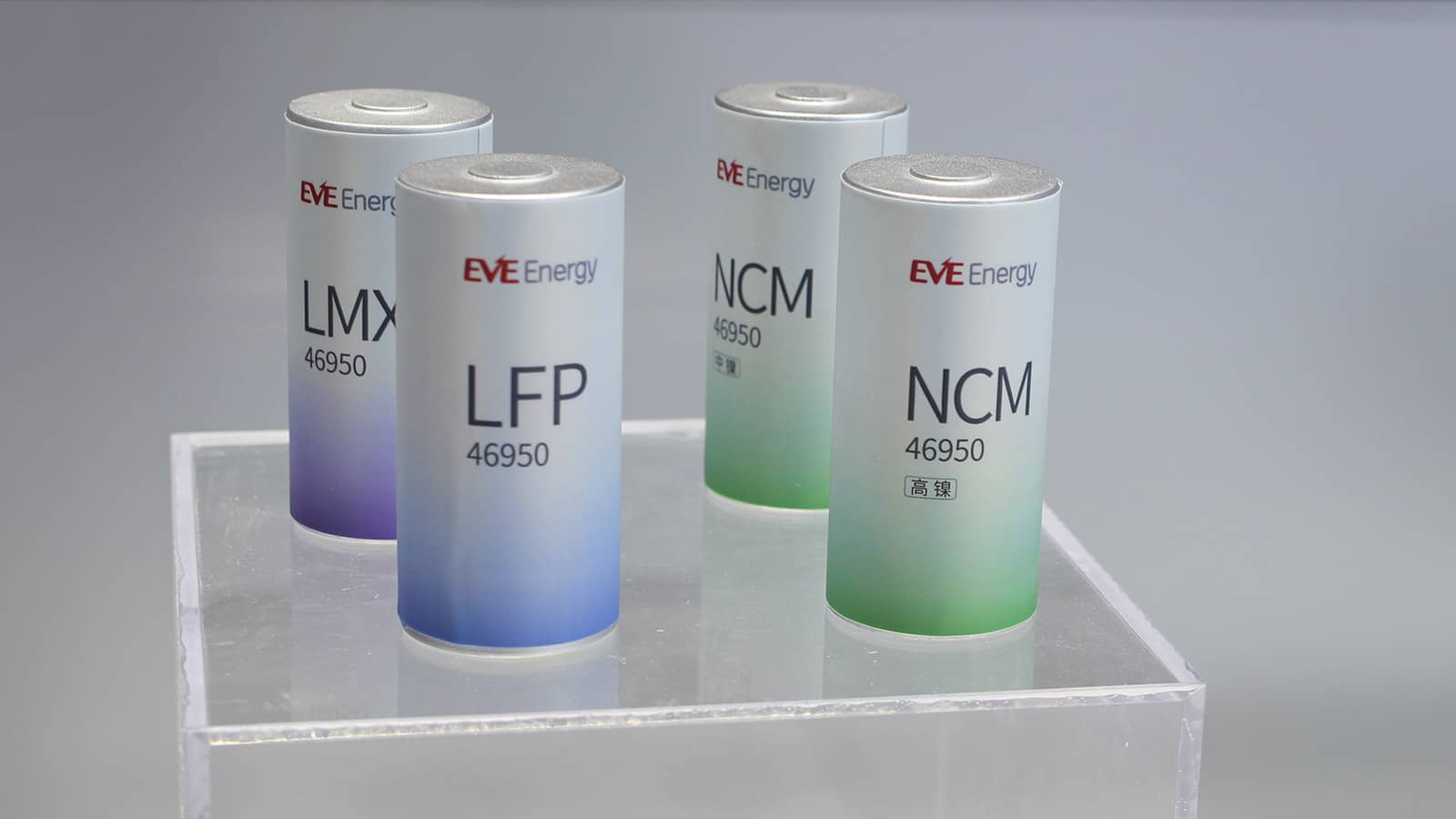
File photo shows Eve Energy’s lithium-ion battery cells. Credit: CnEVPost
- Lithium-ion batteries will be subject to a 2% consumption tax from September 1, 2026, with the rate rising to 4% from September 2027.
- Sodium-ion batteries, solid-state batteries and fuel cells will be exempt through the end of 2028, highlighting a policy tilt toward next-generation technologies.
China will levy a consumption tax on lithium-ion batteries starting September 1, 2026, ending an 11-year tax exemption for the product category.
Meanwhile, next-generation battery technologies such as sodium-ion and solid-state batteries will be exempted, showing that the policy balance is tilting toward newer technologies.
An statement released on Friday by China’s Ministry of Finance, the General Administration of Customs and the State Taxation Administration announced the policy change.
Lithium-ion batteries, lithium primary batteries, mercury-free primary batteries, nickel-metal hydride batteries and vanadium redox flow batteries will be subject to a consumption tax at a rate of 2% from September 1, 2026.
From September 1, 2027, the consumption tax rate on these battery products will rise to 4%.
By contrast, from September 1, 2026 through December 31, 2028, sodium-ion batteries, solid-state batteries and fuel cells, as well as perovskite cells, tandem cells and gallium arsenide cells among photovoltaic (PV) cells, will be exempt from the consumption tax.
Lithium-ion batteries are by far the dominant technology for electric vehicle (EV) power batteries at present.
In the first six months of this year, the cumulative volume of power batteries installed in vehicles in China reached 335.6 GWh, a 12.0% increase from the same period last year, according to data from the China Automotive Battery Innovation Alliance (CABIA).
China Monthly Power Battery Installations 2024-2026 (GWh)
Month
2024
2025
2026
January
32.3
38.8
42.0
February
18.0
34.9
26.3
March
35.0
56.6
56.5
April
35.4
54.1
62.4
May
39.9
57.1
71.9
June
42.8
58.2
76.5
July
41.6
55.9
August
47.2
62.5
September
54.5
76.0
October
59.2
84.1
November
67.2
93.5
December
75.4
98.1
China monthly power battery installations
2024
2025
2026
China began levying a 4% consumption tax on batteries in February 2015, but exempted lithium-ion batteries, nickel-metal hydride batteries, solar cells, and fuel cells at the time to promote energy conservation and environmental protection.
The latest adjustment systematically ends that exemption arrangement: all categories on the 2015 exemption list, except fuel cells, will now be taxed, and the target rate of 4% matches the standard rate that applied to lead-acid batteries and other products back then.
This means the 11-year tax break for lithium-ion batteries is coming to an end, which could push up costs for Chinese EV makers.
The targeted exemptions for sodium-ion and solid-state batteries, meanwhile, give these two closely watched technology routes a clear cost advantage.
These two product categories were not included on the 2015 tax-exemption list and have therefore been subject to a 4% consumption tax ever since. The latest adjustments have expanded their tax-exempt status.
China’s major battery makers are racing to commercialize solid-state batteries, with several manufacturers, including CATL (HKEX: 3750) and BYD (HKEX: 1211), planning small-batch vehicle installation around 2027.
The latest announcement also stipulates that PV cells, also known as solar cells, will be subject to a 2% consumption tax from April 1, 2027, with the rate rising to 4% from April 1, 2028.
Emerging PV technologies such as perovskite cells will likewise be exempt through the end of 2028.
According to the announcement, battery products eligible for the tax reduction or exemption must comply with the corresponding national standards, and taxpayers must obtain compliance test reports before filing for the tax break for the first time.
The battery tax adjustment is China’s latest move to scale back tax support for the new energy vehicle (NEV) industry.
Earlier in July, China announced that vehicle and vessel tax breaks for plug-in hybrid vehicles, battery-electric commercial vehicles and certain other vehicle types will be removed from 2027.
The policy shift comes as China’s NEV penetration rate keeps hitting new highs. According to the China Passenger Car Association (CPCA), China’s NEV sales reached 16.49 million units in 2025, exceeding 50% of domestic new car sales.
In the first half of this year, China’s NEV retail sales stood at 4.71 million units, accounting for 54% of the 8.72 million total passenger car sales, according to CPCA data.
China Passenger NEV Penetration at Retail 2024-2026
Month
2024
2025
2026
January
32.8%
41.5%
38.6%
February
35.8%
49.5%
44.9%
March
41.6%
51.1%
51.5%
April
43.7%
51.5%
61.4%
May
47%
52.9%
62.9%
June
48.4%
53.3%
62.8%
July
51.1%
54%
August
53.9%
55.2%
September
53.3%
57.8%
October
52.9%
57.2%
November
52.3%
59.3%
December
49.4%
59.1%
China passenger NEV penetration at retail
2024
2025
2026
The goal means China’s NEV fleet needs to more than double within five years.
