

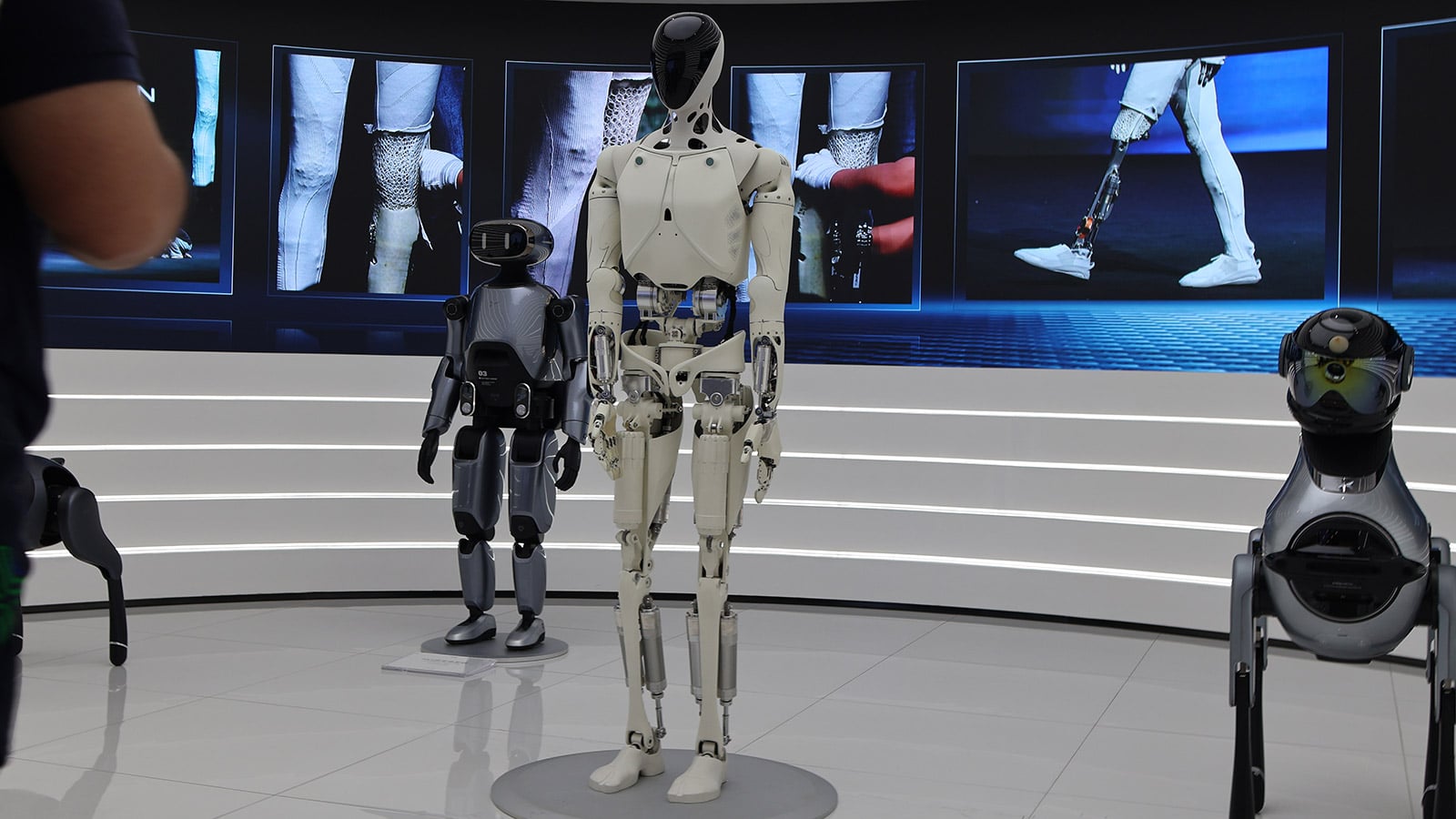
An Iron humanoid robot on display at Xpeng’s Guangzhou headquarters in April 2026. Credit: CnEVPost
- Xpeng plans to lift monthly capacity for its Iron humanoid robot to more than 1,000 units by the end of this year, paving the way for a global roll-out in 2027.
- The company plans to deploy Iron as showroom sales assistants in China in the first quarter of 2027, before expanding the service to overseas stores later that year.
Xpeng (NYSE: XPEV) is accelerating mass production of its humanoid robot as it prepares to take the product to global markets next year.
The electric vehicle (EV) maker aims to increase monthly capacity for its Iron humanoid robot to more than 1,000 units by the end of this year, paving the way for a global roll-out in 2027, The Wall Street Journal reported Wednesday, citing people familiar with the matter.
Xpeng plans to deploy Iron as sales assistants at its stores across China in the first quarter of 2027, and expand the service to overseas stores later that year, the people said.
The move underscores Xpeng’s ambition to transform from a smart-car company into a “physical AI company,” as it repurposes AI and autonomous-driving technologies developed for EVs for use in humanoid robots.
Automakers broadly see growing overlap between smart vehicles and robots in areas including AI large models, perception systems and motion control, the report noted.
Xpeng unveiled the new-generation Iron humanoid robot at its AI Day in November 2025, drawing wide industry attention after the robot appeared on stage with a natural and fluid catwalk.
The demonstration was so lifelike that it prompted public questions over whether a real person was hidden inside the robot, forcing Xpeng chairman and CEO He Xiaopeng to publicly show its internal structure.
The robot, 178 centimeters tall and weighing 70 kilograms, is powered by all-solid-state batteries.
It is equipped with 3 Xpeng-developed Turing AI chips, with total computing power of 2,250 TOPS, and is connected to the company’s second-generation VLA (Vision-Language-Action) large model.
To support the mass-production plan, Xpeng began construction in the first quarter of this year on a humanoid robot production base in Guangzhou covering about 110,000 square meters. The facility spans processes from R&D validation and small-batch trial production to scaled manufacturing.
Mr. He said on a March earnings call that Iron will enter mass production by the end of 2026, with a year-end monthly capacity target of more than 1,000 units.
He said at the time that, with Iron’s high level of intelligence and Xpeng’s advantages in scaled manufacturing and supply chains, the company has the potential to become one of the world’s largest and most valuable humanoid robot companies.
To accelerate commercialization, Mr. He announced in June that he would personally serve as “CEO” of the robotics business. Xpeng subsequently reorganized its robotics center and created 9 new second-level departments.
Under Xpeng’s previously announced roadmap, Iron will enter overseas markets in the second quarter of 2027, and eventually move into more ordinary households starting in 2028.
The company’s R&D spending in physical AI-related areas is expected to rise to RMB 7 billion ($1.03 billion) this year.
The humanoid robot industry may enter an accelerated commercialization phase this year, with companies racing to expand deployment scale, Morgan Stanley analysts wrote in a recent note.
The bank expects shipments of humanoid robots in China to reach 50,000 units in 2026 and 100,000 units next year, The Wall Street Journal noted.
“Other companies in the West are weak,” Musk said.
($1 = 6.7669 yuan)
