

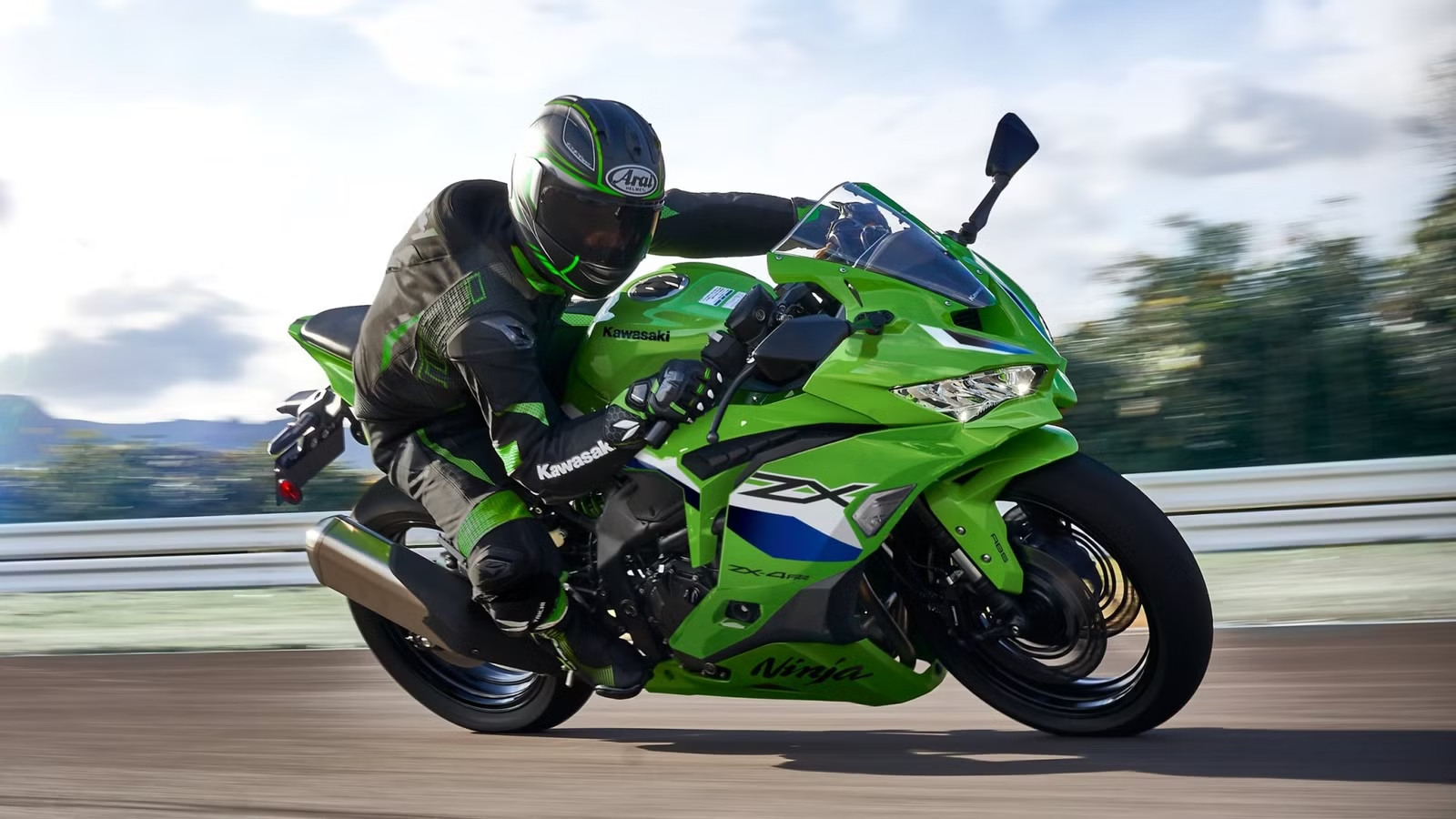
Track days almost always group riders by skill. Logic would dictate otherwise, and displacement would be the obvious differentiator. It makes sense, right? Why would one allow a 400cc and a liter-class bike together on track at the same time? Bigger sport bikes pack more power, displacement, torque, and tech. So the logic seems right on paper, but if only bikes could ride themselves. Inevitably, the rider’s skill dictates more of how a 400cc keeps up with a 1,000cc. And Kawasaki sprang a surprise when it launched a 400 to enable the skilled rider to ride beyond 15,000 RPM.
There’s No Replacement For Displacement, Except Revs
2005 – 2006 Hyundai Tiburon – RPM MeterHyundai
Even with the best of skills, a rider who spends ample time on a 400 eventually hits a wall, one where the skills exceed the bike’s capabilities. Conventional wisdom says that the smaller bike is the one holding you back. After all, there’s an adage in motoring that gets repeated often enough –– there’s no replacement for displacement. It holds up, too, since more cubic centimeters usually means more torque, and more torque means more shove. Unless turbocharging is brought into the mix, even the best of supersports don’t stand a chance.
Suzuki
But horsepower is torque multiplied by how fast the crank is spinning, and that second number is where a small engine can even the odds. Spin a 400 to 15,000 rpm, and it’s doing, at that instant, what a liter bike manages at half the revs. Run those numbers, and the gap on paper closes a lot faster than the badge on the tank would have you believe.
The Rider Completes The Package
Then, give that high-revving 400cc engine into the hands of a rider who already knows how to carry corner speed, and you have a weapon of liter-class destruction. Ok, maybe that’s a little exaggerated, but allow me to explain. A lighter supersport turns in quicker, holds its line with less input, and rewards precision instead of hesitation, basically the makings of a platform that a skilled rider can exploit.
Kawasaki
The revs claw back some of what’s lost on the straights as a high-strung inline four spinning deep into five figures spends more time in the meat of its powerband than a torquier engine lugging along at a few thousand revs lower. There’s no outrunning a liter on the straight, but the combination can shrink the deficit to being manageable on a technical circuit.
The Kawasaki Ninja ZX-4R Is The Bike That Makes Bigger Engines Feel Unnecessary
Kawasaki
Kawasaki built exactly that bike in 2023 and christened it the Ninja ZX-4R (ZX-4RR is its slightly more premium version). Its 399cc inline-four traces its lineage to the 250cc ZX-25R, stretched out with a longer stroke and wider bore until it could swing past 15,000 rpm and still hold together. Its chassis borrows key dimensions from the WorldSBK-spec ZX-10RR, shrunk down to fit a trellis frame that cumulatively weighs less than 415 pounds wet. All of that comes in at $9,299, a number that undercuts plenty of naked bikes with half the personality. If you’re not familiar with the 90s 250s and 400s, then some of this probably sounds absurd, but there’s a method to this madness.
An Inline-Four That Turns 399cc Into A Superbike Sensation
Kawasaki
Most of what makes the ZX-4R feel different from a class built on twins and singles comes down to how it makes its power. The engine produces a claimed 56 horsepower at 11,500 rpm and 26.5 lb-ft of torque at 11,000 rpm, numbers that look modest on paper and are restricted for the U.S., but there are ways around that to make it faster. Kawasaki has tuned the 4R to reward riders willing to keep the tachometer needle where a lot of engines would already be bouncing off a rev limiter. And that’s the secret sauce. It’s a willingness from the rider to toy with the rev ceiling and exploit a pure top-end loving motor.
A Heady 16,000 RPM Redline
Kawasaki
Kawasaki lets the tachometer run to a whopping 16,000 rpm, though the rev limiter steps in a bit earlier, and peak power is made at 11,500 rpm. This means that the engine keeps building power in a linear fashion through the midrange before tapering off near the top, which gives riders a wider window to time shifts instead of chasing a razor-thin powerband. And to give the ZX-4R street sense, it’s also geared short, so short-shifting out of a slow corner still has ample torque to pull cleanly. Hold a gear longer down a straight, and the engine keeps spinning hard enough to make up ground before the next braking zone.
The Magic Of Ram Air And Inline-Four Symphony
Kawasaki
Look up the Kawasaki ZXR400 and the inspiration for the ZX-4R and the ZX-4RR becomes ever so apparent. Tech from 1989 is still being used nearly five decades on; the 4R’s ram air duct placed front and center on the fairing feeds a denser charge into the engine as speed builds. And to add to the high-revving aural drama, Kawasaki pairs it with an intake and exhaust tuned to let the four-cylinder engine’s high-rpm wail come through rather than getting muffled. It’s the kind of mechanical shriek that most 400s today simply can’t produce with their twins or singles, and is among the best-sounding bikes you can get today.
A Chassis Borrowed From Kawasaki’s Own Superbike Playbook
Kawasaki
The frame is inspired by the WorldSBK-spec ZX-10RR, but made of steel, and the components hung off it are pure entry-level supersport too. A non-adjustable 37 mm inverted Showa fork and a shock with preload-only adjustment keep things simple, which suits the ZX-4R’s approachable character. Kawasaki pairs that simplicity with electronics that don’t feel tacked on either. The three-mode KTRC lets a rider dial in how the traction control behaves for the given conditions, while two power modes shape the delivery, all controlled via a 4.3-inch TFT dash. If you’re looking for more oomph, then there’s always the option of the ZX-4RR with better components.
The Kawasaki Ninja ZX-4R Against Rivals With Bigger Engines
Yamaha
Inline-four engines are being phased out as emissions rules tighten, yet Kawasaki built one anyway. That stubbornness might seem deliberate, but the 4R is as much of a statement in modern engineering. It stands without any natural rival, but in the real-world, price and practicality would be top considerations before money is put down on one, as sub-500cc competitors are aplenty.
Aprilia
Weighed against the Yamaha YZF-R7 and Aprilia RS 660, the picture gets more serious. Both are bigger twins, 689cc and 660cc respectively; both start north of the ZX-4R’s $9,299, and both trade the four-cylinder scream for low-end torque that’s easier to lean on in traffic. The RS 660 also packs 105 horsepower from its updated 2026 tune, nearly double what the restricted U.S.-spec ZX-4R makes. But neither twin focuses on the rider to work for its pace the way the ZX-4R does, and that’s precisely the point.
Source: Kawasaki
