

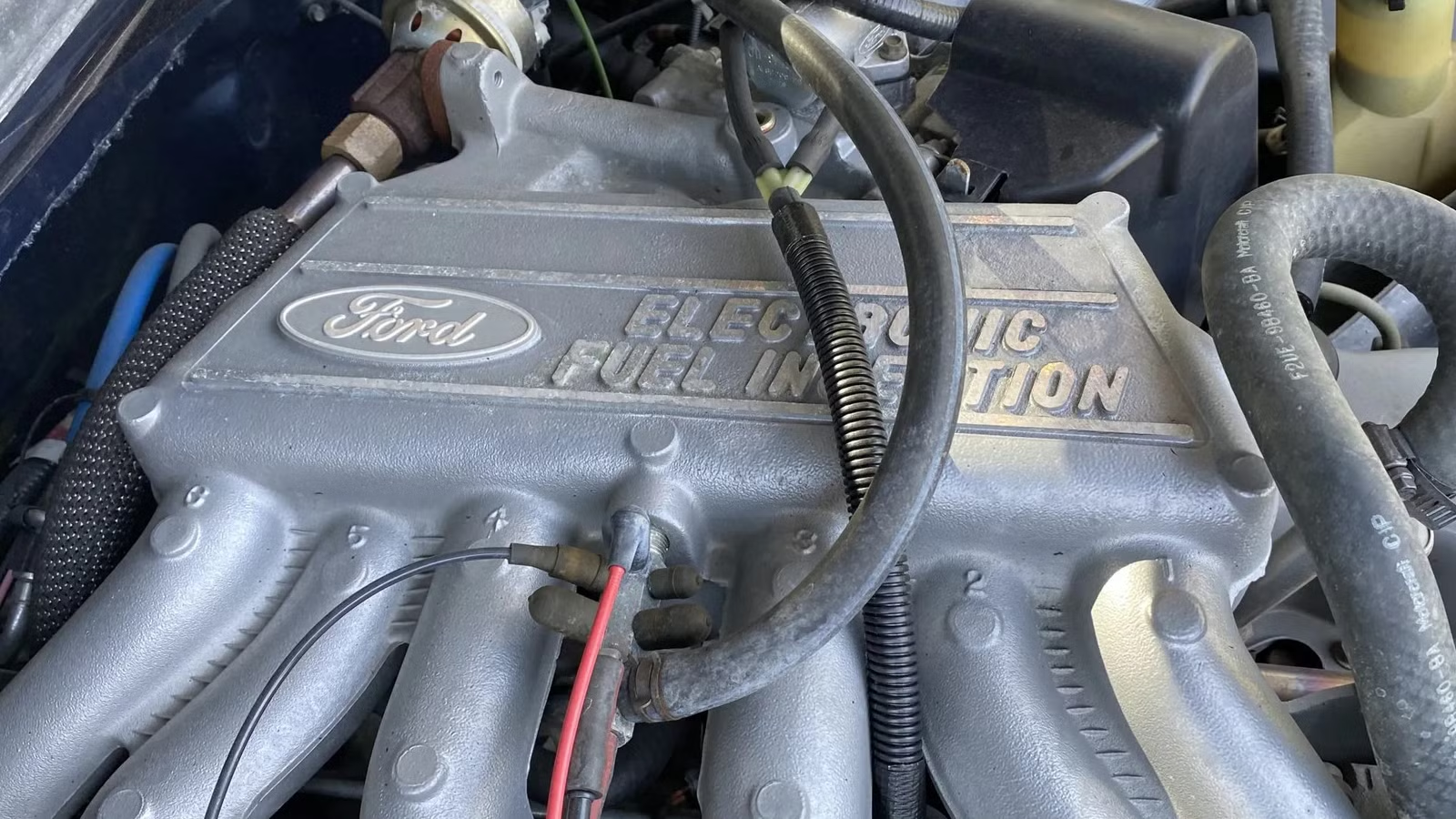
Typically, when we think of “legendary” engines, images of hopped-up, finely tuned performance motors come to mind. You don’t have to think about it very long before names like the Toyota 2JZ and the Chevrolet small-block V8 come to mind. It’s not just limited to these two, either. Over the course of automotive history, loads of legendary performance engines have been produced at one time or another.
However, as for Ford’s 300 CID inline-six engine, its legendary status did not come from an ability to light a racetrack on fire or beat out other cars in a sprint between the lights. Instead, it is best known for its near-peerless penchant for reliability. Its three-decade-long tenure is exceptionally pockmarked with tales of legendary reliability, incredible longevity, and the ability to withstand some of the harshest usage conditions you can find on civilian roads. It wasn’t all that refined, but it attempted to get the job done better than virtually any other engine ever made, and it did it without a speck of glamor.
Ford’s Underrated Workhorse
Ford 300 straight-sixBring a Trailer
The Ford 300’s story begins back in the mid 1960s, a time just before the explosion of the Vietnam War and when the Beatles were surging to the height of their popularity. While both of those things gained a ludicrous amount of fame, the Ford 300, decidedly, did not. Its first iteration hit the market in 1965 as an engine option for the Ford F-Series pickup truck. From the outset, the 300 CID mill was bred for work, leaving any and all performance-hindering refinements.
Ford 300 CID Straight-Six
Displacement
4.9L (300 CID)
Power Range
100–170 hp
Torque Range
223–260 lb-ft
Compression Ratio
7.8:1–8.8:1
Cylinder Bore
4.00 in
Piston Stroke
3.98 in
Production Timeframe
1965–1996
Notable Models
- Ford F-Series
- Ford E-Series
- Ford Bronco
*Specs courtesy of EngineLabs.com
The 300 CID straight-six’s central pillar of success is its ability to produce low-speed torque. When you’re towing something, the most important action is the initial set-off from a stop. That’s when your motor will be working its hardest, and when torque is most essential. Ford’s engineers knew this well, and set off to design the 300 to provide loads of torque at the bottom of the rev range. Because the focus was all on torque, horsepower took a noticeable back seat.
Ford 300 straight-sixBring a Trailer
Another key aspect of the 300’s design is its near-square construction. This means that the mill’s piston stroke is roughly as long as its cylinder bores are wide, which lends itself to a smooth-operating engine. Some folks reportedly – and incorrectly – refer to the 300 CID six as having a long stroke, or as being under-square, but these claims are false. What some call its “long-stroke character” comes from the engine’s timing and low-end tuning, rather than it actually having a longer stroke.
It wasn’t just the engine’s torque profile that was specifically curated for workability. Ford’s engineers tweaked, selected, and designed virtually every single aspect of the engine to excel in work. Its compression ratio was kept low, and its low-revving nature meant it never stressed too hard. You can think of the engine as a gentle giant who would never harm a fly, but could pull a cement truck with his bare hands without much of an effort if he needed to.
Related
Ford Quietly Made One Of The Most Reliable Engines In History
Unless you’re in-the-know, you may have never heard of this stupendously-reliable Ford engine.
Overengineered To Lead An Under-stressed Life
Ford 300 Straight Six EngineBring a Trailer
You can’t have a successful workhorse of an engine without a healthy dose of astute engineering. One of the hallmarks of the Ford 300’s design lies in its bottom end, with its seven-main-bearing crankshaft. Designing the crank in this manner means every segment of the crank is supported uniformly, drastically increasing its strength over engines that aren’t designed in such a way. Not to mention, the engine also sports forged connecting rods.
The outside of the engine is also designed for durability and to minimize failure risk. Both the block and cylinder head are made from cast iron, even while many other engines switched over to aluminum cylinder heads throughout the 1980s and 1990s. Not only does cast iron carry a much higher rate of thermal insulation than aluminum, you also don’t have to worry about your head gasket warping in the event of engine overheating.
1995 ford f-150 engine side viewBring A Trailer
Another key aspect of the 300’s esteemed reliability lies in its timing system. Most engines typically rely on either a timing chain or timing belt, which is usually connected to at least one overhead camshaft in modern engines. Contrarily, the 300 takes advantage of a timing gear which is slotted directly into the engine’s crankshaft. This eliminates the risk of timing belt or chain stretch, a major issue in any engine affected.
Bearing all of these longevity-boosting measures in mind, the 300 CID mill routinely manages to achieve well over 300,000 miles without any major issues affecting it. In addition, many of these high-mileage examples completed the feat without routine maintenance, as many spent their lives performing hard labor in fields and on highways. It seems that the 300 is happy enough to continue working on 15,000-mile-old oil, for example, without a fuss.
Related
The Most Reliable Toyota Engine Of All Time
Select older Toyota engines are synonymous with longevity and solid reliability. But which one is considered to be the most reliable of all time?
The Ford 300’s Recipe Is Long Dead
Ford 300 straight sixBring a Trailer
The 300 mill was conceived at a time when engine design philosophy was vastly different than it is today. Back then, engines were built to be as good as possible, with little to no regard for how efficient or how friendly to the environment they were. Instead, all of those kinds of points were ignored, and the automakers stormed ahead, creating motors that were the best they could be, polar bear-friendliness be damned.
That’s why Ford could never hope to build an engine like the 300 CID six ever again. At least, so long as emissions regulations are what they are today. Engines these days are designed with a multitude of factors in mind, many of which are directly harmful to an engine’s performance. Crankcase vapors need to be contained, catalytic converters need to clean the exhaust, and modern mill’s combustion chambers must burn its air/fuel mixture as efficiently as possible. Power output, sadly, comes after those aspects are satisfied. If they’re not, the engine is simply unable to be produced legally.
1995 ford f-150 front blueBring A Trailer
Because the 300 six is such a heavy, thirsty thing, modern-day federal regulators would laugh it out of contention. All modern brands need to conform to something called CAFE standards, which is short for “Corporate Average Fuel Economy.” The edict requires marques to manage an average combined fuel economy rating across all models it produces. Because the Ford 300 was not designed with lightness or efficiency in mind, it simply wouldn’t cut it.
In essence, this is exactly the reason it was axed. Federal emissions regulations were ever-tightening, squeezing the 300 straight-six further and further into a corner. By 1996, Ford could move the goalposts no longer, and was forced to retire its most famous, underwhelming engine it ever made following a 31-year tenure.
Related
Ford’s 7.3L Godzilla V8 Engine Proves That Size Matters
Fords Godzilla V8 is quickly proving to be one of the most compelling gas engines of the modern era – here’s why.
The 300’s Legacy Is Still Strong Today
1994 Ford F-150 rolling shotBring A Trailer
At this point in time, it’s been 30 years since Ford pulled the plug on the 300 straight-six for the USDM pickup truck market. Despite the long time in between, the 300 six is still regarded as one of the best truck engines ever made, and is even still sought-after by those seeking an older Ford pickup that can still work like a truck should.
Loads of folks actively restore 300 engines and the trucks they’re found in, too, in an effort to preserve as many as possible. There’s also loads of aftermarket support at present, so those who still own one can find virtually anything they need for a reasonable price.
1996 Ford F-150 exteriorBring a Trailer
In the end, the Ford 300 CID inline-six won’t be considered America’s toughest engine because it was advanced or otherwise mechanically complicated. Rather, it’s considered one of the toughest due to its extreme mechanical simplicity and purposeful engineering that leads to a huge amount of durability.
Overbuilt? Yes. Under-stressed? Also, yes. That’s the 300 CID and its ultra-reliable nature in a nutshell.
Sources: Ford, EngineLabs.com, OnAllCylinders.com.
