

The Honda Civic Type R is a firm favorite among car enthusiasts, and it’s not hard to see why. With its long history of providing relatively affordable high-performance motoring, it has been many gearheads’ entry point into “fun car” ownership over the years.
The Civic Type R also occupies another interesting position in the automotive world, as one of the most powerful front-wheel-drive cars currently on sale. It is not, however, the most powerful because two other front-wheel-drive cars, one of them only from earlier this month, have a higher power output.
One is another member of the Honda family, the Acura Integra Type S. The other is a special version of the Volkswagen Golf GTI, the Edition 50. Let’s take a closer look at these two models, the Civic Type R itself, and the benefits and drawbacks of front-wheel drive.
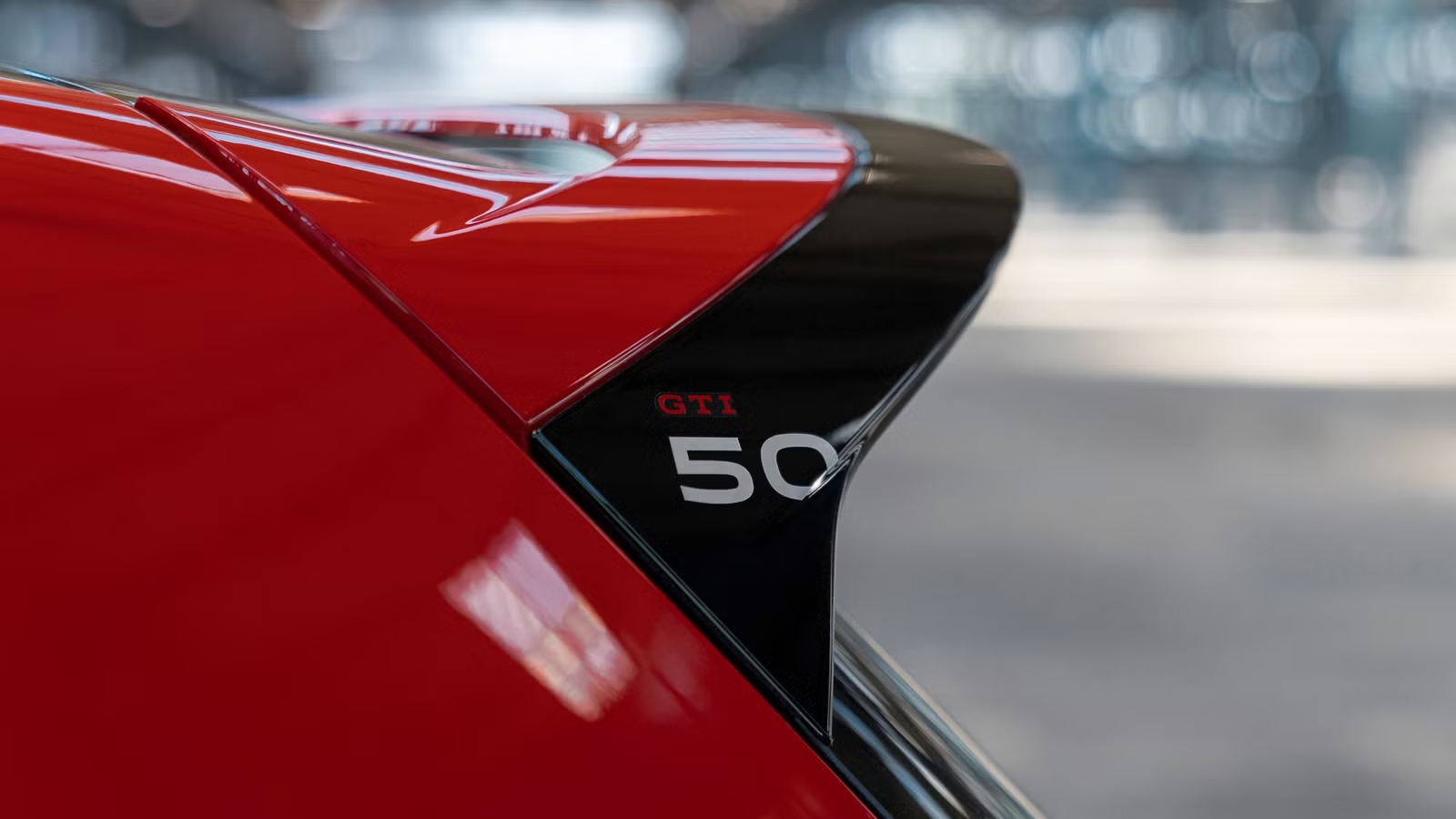
The Volkswagen Golf GTI Edition 50
Volkswagen Golf GTI Edition 50 Specs
Horsepower
320 hp
Torque
310 lb-ft
0-60
5.5 seconds
Top Speed
168 mph
The Edition 50 is the most powerful production Golf GTI to date. Its turbocharged 2.0-liter inline-four engine produces 320 hp, five more horses than in the Civic Type R. The amount of torque is exactly the same for both models, at 310 lb-ft.
The Edition 50 produces more power than the rest of the Golf GTI family and comes with several other mechanical tweaks. It has revised tuning for the limited-slip differential and adaptive shocks. There are also upgraded brakes and a 0.6-inch drop in ride height. An optional GTI Performance Package adds stiffer springs, forged wheels with Bridgestone semi-slick tires, and an Akrapovic titanium exhaust. These parts help shed around 33 pounds.
All of this resulted in the Edition 50 claiming the Type R’s title as the fastest hot hatch around the Nürburgring.
Related
Volkswagen Just Stole The Civic Type R’s Nurburgring Record
The GTI out-hustled the Honda by the absolute slimmest of margins.
The Acura Integra Type S
2025 Acura Integra Civic Type S Specs
Horsepower
320 hp
Torque
310 lb-ft
0-60
~5.2 seconds
Top Speed
~167 mph
The second car that produces more power than the Civic Type R is another model from the Honda stable. The Acura Integra Type S is one of the increasingly dwindling hot hatches in the automotive world. The Type S is the Type R’s less aggressive, more luxurious sibling. However, it also produces a little more power. The numbers are identical to those of the Golf GTI Edition 50 at 320 hp and 310 lb-ft of torque.
The Integra Type S does place more emphasis on comfort, providing a slightly plusher interior than the Civic Type R. Instead of the minimalist, sporty cabin with a bright red finish in the Honda, the Acura offers a wider variety of color options. Although the race-inspired bright crimson in the Civic is also available here, but more subtle colors such as white and black are also available.
Related
Acura Has A New Integra Type S Record In Its Sights
The specially-tuned Integra Type S will get another shot at a record that Acura set seven years ago.
The external design is also more subdued, combining the look of an ordinary daily driver with a slightly sportier edge. The grille is still rich in pointy, angular lines, but is less aggressive than the Civic’s; the rear end features a small spoiler and sharp, triangular taillights.
The Acura Integra Type S is powered by a turbocharged 2.0-liter inline-four VTEC engine, paired with a six-speed manual transmission. The suspension setup is less sporty than the Civic Type R, but the handling is still nimble. In terms of driving experience and character, the Type S essentially occupies a space between the standard Integra and the CTR.
The One To Beat: The Civic Type R
2025 Honda Civic Type R Specs
Horsepower
315 hp
Torque
310 lb-ft
0-60
4.9 seconds
Top Speed
169 mph
The vehicle both of these models narrowly beat for the “most powerful FWD car” crown is the Honda Civic Type R. The 2026 Type R produces “only” 315 hp, five less than both the Acura and the Volkswagen. It is one of the most popular high-performance hatchbacks on the market, combining daily-driver functionality with track-ready character.
Aesthetically, the current Civic Type R features a sporty body with an aggressive character. However, it doesn’t look quite as mean as the previous version’s more angular styling.
The current generation of the Civic Type R is the sixth iteration in its lineage, with the original dating back to 1997. It was somewhat of a sibling to the similarly lauded Integra Type R. In the United States, the Civic Type R nameplate didn’t arrive until 2017.
The turbocharged 2.0-liter inline-four engine exclusively attaches to a six-speed manual. Torque steer, a common problem in front-wheel-drive cars on the more powerful end of the spectrum, is mitigated through an innovative dual-axis strut suspension.
Front-Wheel Drive: Overview, Pros, And Cons
Front-wheel drive is not commonly associated with high-performance motoring today but is one of the most common drivetrain layouts in production cars overall. FWD models have several advantages, such as being cheaper to build, easier to drive, and generally more efficient powertrain packaging. They are also less likely to sacrifice interior space and cargo space because there doesn’t need to be a driveshaft running underneath the vehicle. A FWD layout can also result in better fuel economy.
Related
AWD Vs. FWD: The Pros And Cons Of Each
We closely examine both all and front-wheel drive cars in order to discover the inherent strengths and weaknesses of each drivetrain type.
In decades past, most hot hatches were equipped with a FWD drivetrain. However, as engines became more powerful, torque steer became more of a problem. The growing outputs led to AWD gradually becoming the drivetrain of choice for performance hatchbacks, such as the Golf R. By driving both axles, a model can have improved grip, whether on a track or just in slippery conditions.
Still, some performance cars out there are still holding on to FWD, such as the three models we have just looked at. In an era where AWD is becoming more and more common in the performance world, there is still a case to be made for the FWD car.
Sources: Volkswagen, Honda
